Music has a unique power over the human mind. A single melody can trigger deep emotions, memories, and even physical reactions. One of the most fascinating responses is the sensation of chills or “goosebumps” when listening to certain songs. This phenomenon is not just emotional—it is deeply rooted in brain activity. Understanding it reveals how music directly interacts with our nervous system and emotions.
What Are Musical Chills?
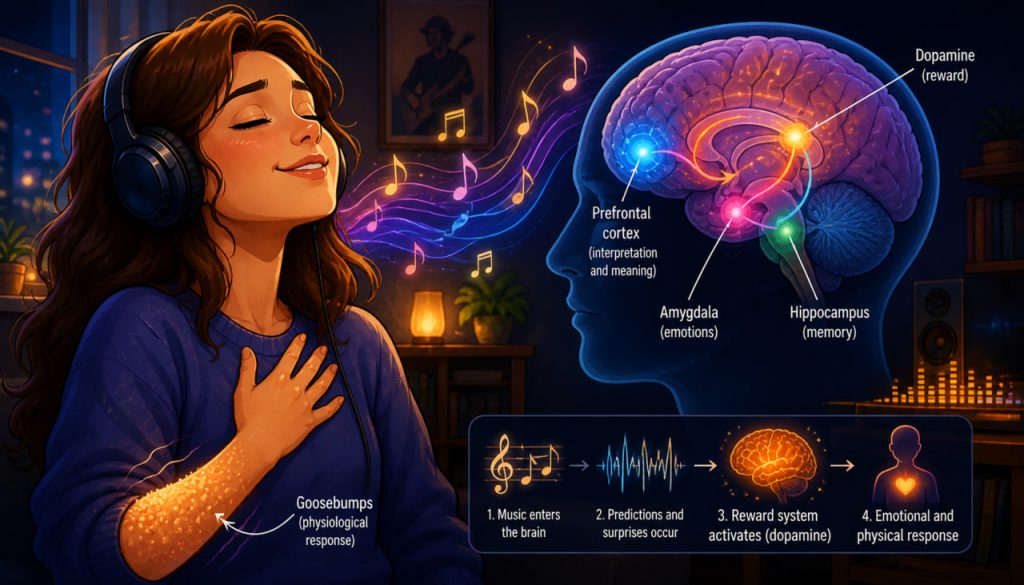
Musical chills, sometimes called “frisson,” are physical sensations that occur while listening to emotionally powerful music.
They may include:
- Goosebumps on the skin
- A tingling feeling along the spine
- Sudden emotional intensity
- A sense of awe or excitement
These reactions are real physiological responses, not just imagination.
The Brain’s Reward System
One of the main reasons music affects us so strongly is the brain’s reward system.
When we hear music we love:
- The brain releases dopamine
- This is the same chemical linked to pleasure and motivation
- It creates feelings of enjoyment and anticipation
Music can activate the brain similarly to food, social interaction, or other rewarding experiences.
The Role of Prediction and Surprise
Music is powerful because it plays with expectation.
The brain:
- Predicts what comes next in a melody
- Responds strongly when expectations are met or violated
When a song includes:
- A sudden change
- A powerful chorus
- An unexpected harmony
The brain reacts with excitement, which can trigger chills.
Emotional Processing in the Brain
Music activates several brain regions involved in emotion.
These include:
- The amygdala (emotional processing)
- The hippocampus (memory)
- The prefrontal cortex (interpretation and meaning)
Because of this, music can connect emotions and memories in a powerful way.
Why Some Songs Affect Us More
Not all music causes chills. The effect depends on several factors.
Personal Experience
Songs linked to memories or life events are more likely to trigger strong reactions.
Musical Structure
Certain features increase emotional impact:
- Rising intensity
- Strong vocals
- Sudden silence followed by sound
Individual Sensitivity
Some people are more responsive to music than others.
Expert Insight
Neuroscientist Robert Zatorre, who has studied music and the brain, explains:
“Music can engage the brain’s reward system in a very direct way, especially when it creates a sense of anticipation and emotional release.”
This highlights how music interacts with both emotion and expectation.
The Role of the Nervous System
Musical chills are also linked to the autonomic nervous system.
This system controls:
- Heart rate
- Breathing
- Skin responses
When emotionally stimulated:
- The body reacts automatically
- Tiny muscles in the skin contract
- Goosebumps appear
This is the same system involved in strong emotional reactions like fear or excitement.
Music and Memory
Music is closely connected to memory.
Hearing a song can:
- Trigger vivid memories
- Recreate past emotions
- Strengthen emotional responses
This connection makes music deeply personal.
Evolutionary Perspective
Scientists have proposed theories about why music affects us so strongly.
Possible explanations:
- Music enhances social bonding
- It helps communicate emotions
- It stimulates pattern recognition in the brain
Although music is not essential for survival, it may have evolved as a powerful social and emotional tool.
Why This Phenomenon Matters
Musical chills show how deeply connected the brain, body, and emotions are.
They demonstrate that:
- Sound can influence physical reactions
- Emotions are tied to neural activity
- The brain interprets patterns in complex ways
Music is not just entertainment—it is a direct pathway into the human mind.
Interesting Facts
- Not everyone experiences musical chills.
- Dopamine release can occur before the emotional peak of a song.
- Music activates multiple brain regions simultaneously.
- Goosebumps are controlled by tiny muscles in the skin.
- Emotional songs often follow patterns of tension and release.
Glossary
- Frisson — A sudden feeling of excitement or chills.
- Dopamine — A chemical linked to pleasure and reward.
- Amygdala — A brain region involved in emotions.
- Autonomic Nervous System — Controls automatic body functions.
- Hippocampus — A brain area associated with memory.