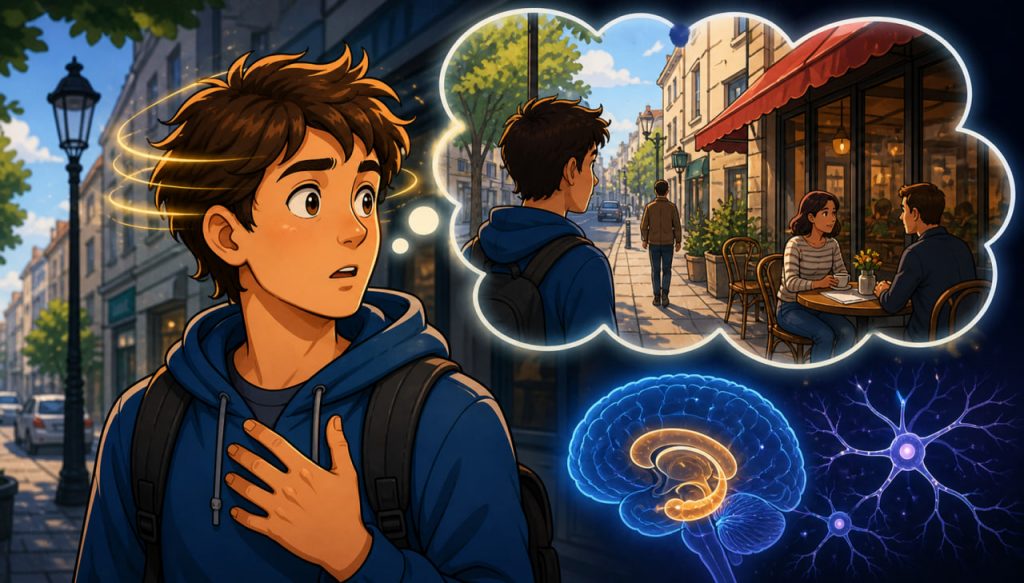
Déjà vu is one of the most mysterious and intriguing experiences of the human mind. Many people have felt it at least once—a sudden, powerful sensation that a current situation has already happened before. Despite its familiarity, the experience is difficult to explain. Modern science suggests that déjà vu is not a supernatural phenomenon, but a complex interaction of memory, perception, and brain processing.
Understanding déjà vu helps reveal how the brain constructs reality and processes information.
What Is Déjà Vu?
Déjà vu is a French term meaning “already seen.” It describes the feeling that a present moment has been experienced in the past, even when it clearly has not.
Typical features include:
- A brief but intense sense of familiarity
- Awareness that the feeling is unusual
- A short duration, usually a few seconds
It is a cognitive illusion rather than a real memory.
How Common Is It?
Déjà vu is very common.
Research shows:
- Around 60–80% of people experience it at least once
- It is more frequent in younger individuals
- It tends to decrease with age
This suggests that it is a normal brain function rather than a disorder.
The Role of Memory
One of the leading explanations involves memory processing.
The brain constantly:
- Stores new experiences
- Compares them with past memories
- Identifies patterns and similarities
Déjà vu may occur when:
- A current situation resembles a past experience
- The similarity is not consciously recognized
- The brain mistakenly labels it as familiar
This creates the illusion of a repeated experience.
Dual Processing Theory
Another explanation is based on how the brain processes information.
According to this theory:
- Information is processed through multiple pathways
- A slight delay or mismatch between these processes can occur
- One pathway signals familiarity before full processing is complete
This timing error leads to the feeling of déjà vu.
Brain Regions Involved
Several areas of the brain are linked to déjà vu.
These include:
- The temporal lobe (memory processing)
- The hippocampus (memory formation)
- The frontal cortex (decision-making and awareness)
Studies show that déjà vu is associated with activity in memory-related brain regions.
Expert Insight
Neuroscientist Anne Cleary, who has studied déjà vu extensively, explains:
“Déjà vu appears to be a memory phenomenon, where familiarity is triggered without conscious recollection of a specific past event.”
This supports the idea that the brain recognizes something without identifying its source.
Déjà Vu and the Temporal Lobe
There is a strong connection between déjà vu and the temporal lobe.
In some cases:
- People with temporal lobe epilepsy experience intense déjà vu
- Electrical stimulation of this area can trigger similar sensations
This suggests that déjà vu may result from brief, harmless disruptions in brain activity.
Psychological Factors
Certain factors can increase the likelihood of experiencing déjà vu:
- Fatigue
- Stress
- High levels of attention
- New or unfamiliar environments
These conditions may affect how the brain processes information.
Why Déjà Vu Feels So Real
The feeling of familiarity in déjà vu is powerful because it comes from the brain’s recognition system.
Even when incorrect:
- The brain generates a strong sense of certainty
- This creates a convincing experience
- Logical reasoning recognizes the mismatch
This conflict makes déjà vu both fascinating and unsettling.
Is Déjà Vu Dangerous?
For most people, déjà vu is completely harmless.
However:
- Frequent or intense episodes may require medical attention
- It can sometimes be linked to neurological conditions
In general, occasional déjà vu is a normal part of brain function.
What Déjà Vu Teaches Us
Déjà vu provides insight into how the brain works.
It shows that:
- Memory is not perfect
- Perception can be misleading
- The brain constantly interprets reality
Our sense of familiarity is constructed, not always accurate.
Why This Phenomenon Matters
Studying déjà vu helps scientists understand:
- Memory systems
- Brain processing speed
- Cognitive illusions
It highlights the complexity of the human mind and how easily perception can be altered.
Interesting Facts
- Déjà vu is most common between ages 15 and 25.
- It usually lasts only a few seconds.
- The experience often occurs in new environments.
- It is less common in older adults.
- Scientists can sometimes trigger it through brain stimulation.
Glossary
- Déjà Vu — A feeling of having already experienced a current situation.
- Hippocampus — A brain region involved in memory.
- Temporal Lobe — A part of the brain related to memory and perception.
- Cognitive Illusion — A misinterpretation of information by the brain.
- Familiarity — A sense of recognition without specific memory.