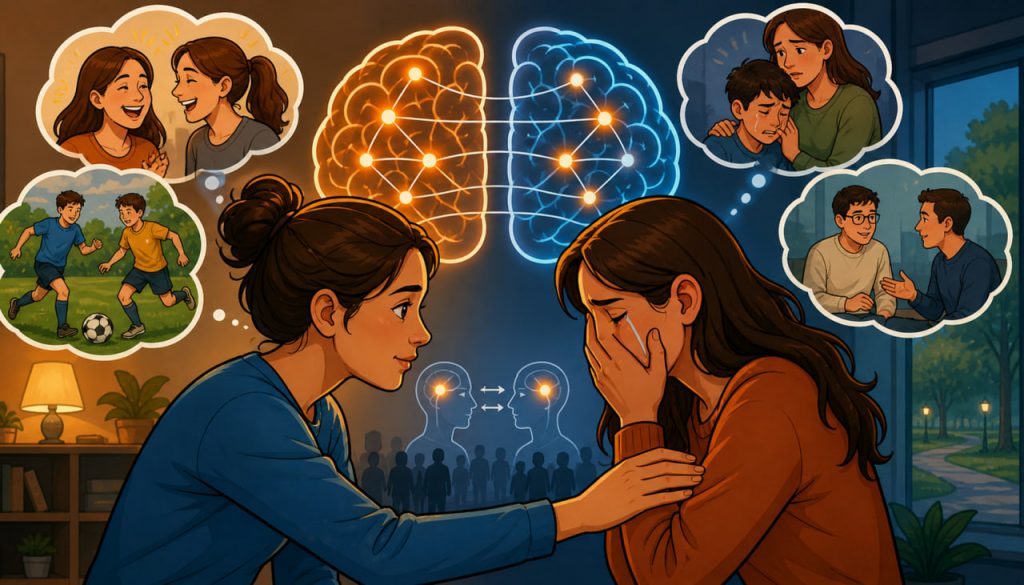
Mirror neurons are one of the most intriguing discoveries in modern neuroscience. They provide a biological explanation for empathy, imitation, and social understanding. When you watch someone laugh and feel joy, or see someone in pain and instinctively react, your brain is activating a powerful system that connects perception with emotion. Scientists believe that mirror neurons allow us to internally simulate the experiences of others, forming the foundation of human empathy.
What Are Mirror Neurons?
Mirror neurons are specialized brain cells that activate both when you perform an action and when you observe someone else performing the same action.
In simple terms:
- You act → neurons fire
- You observe → the same neurons fire
This creates a shared neural representation between you and others.
Discovery of Mirror Neurons
Mirror neurons were first discovered in the 1990s by a team of Italian researchers led by Giacomo Rizzolatti.
They found that:
- Certain neurons in monkeys activated when they grabbed objects
- The same neurons fired when the monkeys watched someone else perform the action
This discovery suggested that the brain links observation and action in a direct way.
Where Are Mirror Neurons Located?
In humans, mirror neuron systems are believed to exist in several brain regions:
- Premotor cortex (movement planning)
- Inferior parietal lobule (integration of sensory information)
- Areas related to emotion and social processing
These regions work together to connect what we see with what we feel.
How Mirror Neurons Create Empathy
Empathy is the ability to understand and share the feelings of others.
Mirror neurons contribute by:
- Simulating observed actions and emotions
- Creating an internal representation of another person’s state
- Allowing us to “feel” what others experience
This mechanism helps transform observation into emotional understanding.
Emotional Contagion
Mirror neurons are closely linked to emotional contagion—the phenomenon where emotions spread between people.
Examples include:
- Laughing when others laugh
- Feeling tension in a stressful situation
- Experiencing sadness when seeing someone cry
Our brains naturally synchronize with others.
Role in Learning and Imitation
Mirror neurons are essential for learning through observation.
They help:
- Children imitate adults
- People acquire new skills
- Social behaviors develop
This system allows humans to learn without direct experience.
Expert Insight
Neuroscientist Giacomo Rizzolatti, who led the discovery, explained:
“Mirror neurons show that understanding others is not only a cognitive process—it is also rooted in the motor system of the brain.”
This highlights how deeply empathy is embedded in our biology.
Mirror Neurons and Social Behavior
These neurons play a major role in human interaction.
They contribute to:
- Communication
- Understanding intentions
- Building relationships
They help us navigate complex social environments.
Are Mirror Neurons the Whole Story?
While mirror neurons are important, they are not the only factor in empathy.
Other systems also play roles:
- Emotional processing regions
- Cognitive interpretation
- Personal experience
Empathy is a combination of multiple brain processes.
Controversies and Ongoing Research
Some scientists debate the extent of mirror neurons’ role.
Questions include:
- Are they responsible for all empathy?
- Do they function the same in humans as in animals?
Research continues to explore their exact role.
Why Mirror Neurons Matter
Understanding mirror neurons helps explain:
- Why humans are social beings
- How emotions spread
- How learning through observation works
They reveal the biological basis of connection between people.
Interesting Facts
- Mirror neurons activate even when imagining actions.
- They were first discovered in monkeys.
- They may play a role in language development.
- Emotional reactions can occur automatically.
- They help explain why humans are highly social.
Glossary
- Mirror Neurons — Brain cells that respond to both action and observation.
- Empathy — The ability to share and understand others’ emotions.
- Premotor Cortex — Brain area involved in planning movement.
- Emotional Contagion — Spread of emotions between individuals.
- Social Cognition — Understanding others’ thoughts and intentions.