Mirror therapy is one of the most fascinating and innovative approaches in modern neuroscience and rehabilitation. It is a simple yet powerful technique that uses visual illusion to reduce pain and improve motor function. Originally developed to treat phantom limb pain, it has since been applied to a variety of neurological conditions. Understanding mirror therapy reveals how the brain’s perception of the body can be reshaped using visual feedback.
What Is Mirror Therapy?
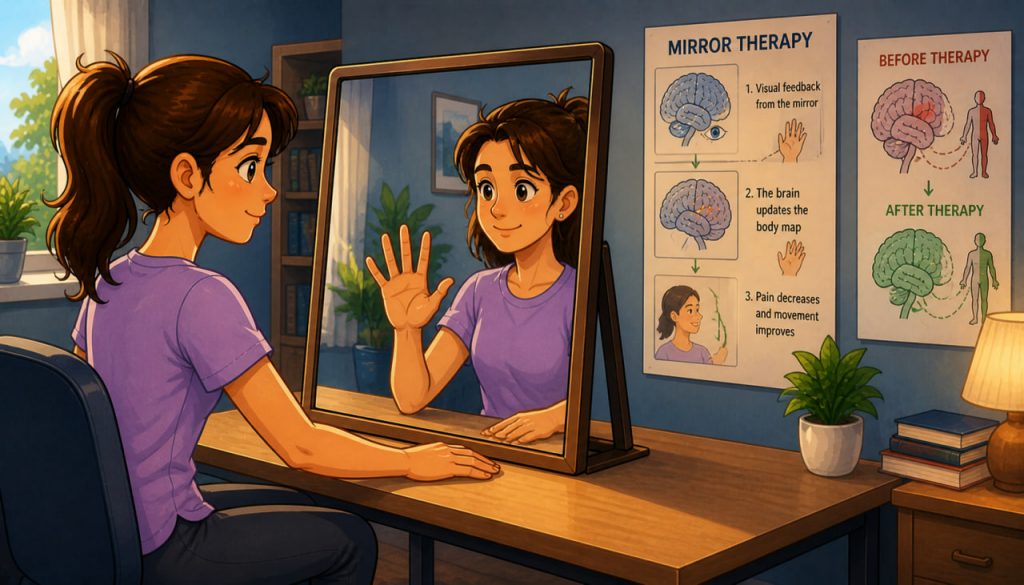
Mirror therapy is a rehabilitation technique in which a mirror is used to create the illusion of a missing or affected limb.
The basic idea:
- A mirror is placed between two limbs
- The reflection of the healthy limb appears as the affected one
- The brain interprets the reflection as real
This visual illusion can influence how the brain processes pain and movement.
How Mirror Therapy Works
The effectiveness of mirror therapy lies in the brain’s reliance on visual input.
When a person sees the reflection:
- The brain receives visual confirmation of movement
- The body map in the brain is updated
- Pain signals may be reduced
This process helps resolve the mismatch between what the brain expects and what it perceives.
The Brain and Body Representation
The brain maintains a detailed internal model of the body, known as the body schema.
After injury or amputation:
- This map can become distorted
- Signals may no longer match reality
- Pain or dysfunction can occur
Mirror therapy helps recalibrate this internal map using visual cues.
Origins of Mirror Therapy
Mirror therapy was popularized by neuroscientist V. S. Ramachandran in the 1990s.
He used it to treat phantom limb pain in amputees, demonstrating that:
- Visual illusions can change perception
- The brain can adapt quickly
- Pain can be reduced without medication
This discovery opened new directions in neuroscience and rehabilitation.
Applications of Mirror Therapy
Although initially developed for phantom pain, mirror therapy is now used in many areas.
Phantom Limb Pain
- Reduces painful sensations in missing limbs
Stroke Rehabilitation
- Helps restore movement in paralyzed limbs
Chronic Pain Conditions
- Improves pain perception and function
Motor Recovery
- Enhances coordination and control
It is a versatile and accessible therapy.
Why It Is Effective
Mirror therapy works because the brain integrates multiple types of information.
It combines:
- Visual input
- Motor signals
- Sensory feedback
When these signals align, the brain can correct errors in perception.
The brain trusts what it sees, even if it is an illusion.
Expert Insight
Neuroscientist V. S. Ramachandran has explained:
“Mirror therapy demonstrates that pain is not just in the body—it is constructed by the brain, and can be modified by changing perception.”
This insight highlights the central role of the brain in shaping experience.
Benefits of Mirror Therapy
Mirror therapy offers several advantages:
- Non-invasive and drug-free
- Simple and inexpensive
- Can be done at home
- Effective for multiple conditions
These features make it widely accessible.
Limitations and Challenges
Despite its benefits, mirror therapy is not a universal solution.
Limitations include:
- Not all patients respond equally
- Requires consistent practice
- May be less effective in severe cases
Understanding individual differences is important.
Scientific Evidence
Research supports the effectiveness of mirror therapy in many cases.
Studies show:
- Reduced phantom limb pain
- Improved motor function after stroke
- Changes in brain activity patterns
However, results can vary depending on the condition and individual.
The Role of Neuroplasticity
Mirror therapy relies heavily on neuroplasticity, the brain’s ability to change.
Through repeated sessions:
- Neural pathways are reorganized
- The brain adapts to new information
- Symptoms can improve over time
This shows how flexible the brain can be.
Why Mirror Therapy Matters
Mirror therapy is a powerful example of how perception shapes reality.
It demonstrates that:
- The brain can be retrained
- Pain is not always tied to physical damage
- Simple tools can produce significant effects
It represents a shift toward brain-based approaches in medicine.
P.S. My advice is to stop fooling around in the mirror and go to the doctor. Pain is a sign that something is wrong and you need to take action.
Interesting Facts
- Mirror therapy was first used for phantom limb pain.
- It can improve motor function after strokes.
- The brain often trusts visual input over other senses.
- The therapy can be practiced at home with minimal equipment.
- It highlights the importance of perception in pain.
Glossary
- Mirror Therapy — A technique using reflection to influence brain perception.
- Body Schema — The brain’s internal representation of the body.
- Phantom Pain — Pain felt in a missing limb.
- Neuroplasticity — The brain’s ability to adapt and change.
- Rehabilitation — Therapy to restore function after injury.