Sleep is one of the most fundamental biological processes, yet it remains one of the most misunderstood. Every human spends about one-third of their life sleeping, but many underestimate its importance. Modern science shows that sleep is essential for brain function, physical health, and emotional stability. Without it, the body and mind cannot operate properly.
Understanding sleep helps explain why it is not a passive state, but an active and vital process.
What Is Sleep?
Sleep is a natural, reversible state of reduced awareness and activity. During sleep, the body enters a series of stages that support restoration and regulation.
It is characterized by:
- Reduced responsiveness to external stimuli
- Specific patterns of brain activity
- Cycles of different sleep stages
Sleep is not simply “turning off” the brain—it is a highly active process.
The Stages of Sleep
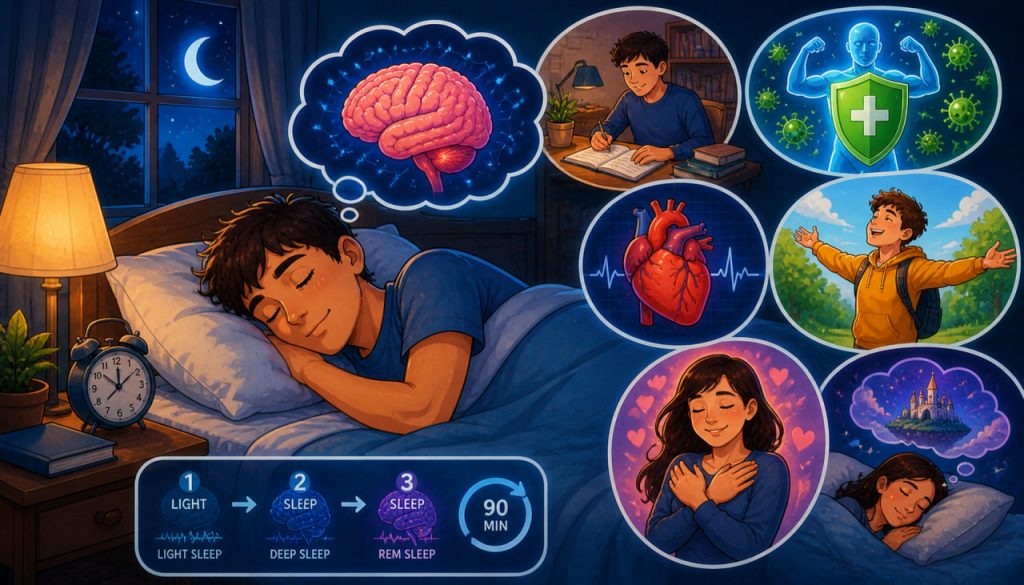
Sleep occurs in repeating cycles, each lasting about 90 minutes.
Light Sleep
This is the transition phase between wakefulness and deeper sleep. The body begins to relax, and brain activity slows.
Deep Sleep
This is the most restorative stage. During this phase:
- The body repairs tissues
- The immune system strengthens
- Energy is restored
REM Sleep (Rapid Eye Movement)
This stage is associated with dreaming. The brain becomes highly active, similar to wakefulness.
REM sleep is important for:
- Memory processing
- Learning
- Emotional regulation
All stages are necessary for healthy functioning.
Why Sleep Is Important for the Brain
Sleep plays a critical role in brain health.
During sleep:
- The brain processes information from the day
- Memories are consolidated
- Unnecessary information is filtered out
This helps improve:
- Learning ability
- Decision-making
- Focus and attention
Without sleep, cognitive performance declines rapidly.
Physical Health Benefits
Sleep affects nearly every system in the body.
It helps:
- Regulate hormones
- Support heart health
- Maintain metabolism
- Strengthen the immune system
Chronic lack of sleep is linked to:
- Heart disease
- Diabetes
- Obesity
Sleep is essential for long-term physical health.
Emotional and Mental Health
Sleep is closely connected to emotional well-being.
Good sleep:
- Improves mood
- Reduces stress
- Enhances resilience
Lack of sleep can lead to:
- Irritability
- Anxiety
- Depression
The brain needs sleep to regulate emotions effectively.
Expert Insight
Sleep researcher Matthew Walker, a leading authority in sleep science, explains:
“Sleep is the single most effective thing we can do to reset our brain and body health each day.”
His research highlights how deeply sleep impacts overall health.
The Role of Circadian Rhythm
The body follows an internal clock called the circadian rhythm.
This rhythm:
- Regulates sleep and wake cycles
- Responds to light and darkness
- Controls hormone release
Disruptions to this rhythm, such as irregular schedules, can negatively affect sleep quality.
What Happens When You Don’t Sleep Enough
Sleep deprivation has serious consequences.
Short-term effects:
- Poor concentration
- Slower reaction times
- Memory problems
Long-term effects:
- Increased disease risk
- Weakened immune system
- Mental health issues
Sleep deprivation affects both the brain and body.
Why Do We Dream?
Dreaming occurs mainly during REM sleep.
Although not fully understood, dreams may:
- Help process emotions
- Organize memories
- Simulate experiences
Dreaming is an important part of brain activity during sleep.
How Much Sleep Do You Need?
Sleep needs vary by age.
General guidelines:
- Adults: 7–9 hours
- Teenagers: 8–10 hours
- Children: more depending on age
Quality of sleep is just as important as quantity.
Why Sleep Is Not Optional
Sleep is not a luxury—it is a biological necessity.
It supports:
- Brain function
- Physical health
- Emotional balance
Skipping sleep is not sustainable for long-term well-being.
Interesting Facts
- Humans spend about one-third of life sleeping.
- The brain remains active during sleep.
- Dreams occur mostly during REM sleep.
- Lack of sleep affects decision-making.
- Sleep helps remove waste from the brain.
Glossary
- Sleep Cycle — A repeating pattern of sleep stages.
- REM Sleep — A stage associated with dreaming and brain activity.
- Circadian Rhythm — The body’s internal biological clock.
- Sleep Deprivation — Lack of sufficient sleep.
- Hormones — Chemical messengers in the body.