Phantom pain is one of the most fascinating and puzzling phenomena in neuroscience. It occurs when a person feels pain in a body part that has been lost, such as after an amputation. Despite the absence of the physical limb, the sensation is often vivid and real. This condition reveals how deeply the brain is involved in creating our perception of the body and pain.
Understanding phantom pain helps scientists explore how the brain constructs reality—and why pain is not always linked to physical damage.
What Is Phantom Pain?
Phantom pain refers to painful sensations perceived in a body part that is no longer present.
People may experience:
- Burning or stabbing pain
- Tingling or pressure
- Movement sensations
These experiences feel real because pain is generated by the brain, not the limb itself.
How Common Is It?
Phantom pain is surprisingly common.
- Up to 80% of amputees report phantom sensations
- Not all sensations are painful, but many are
- It can occur shortly after amputation or years later
This shows that the brain continues to “map” the missing limb.
The Brain’s Body Map
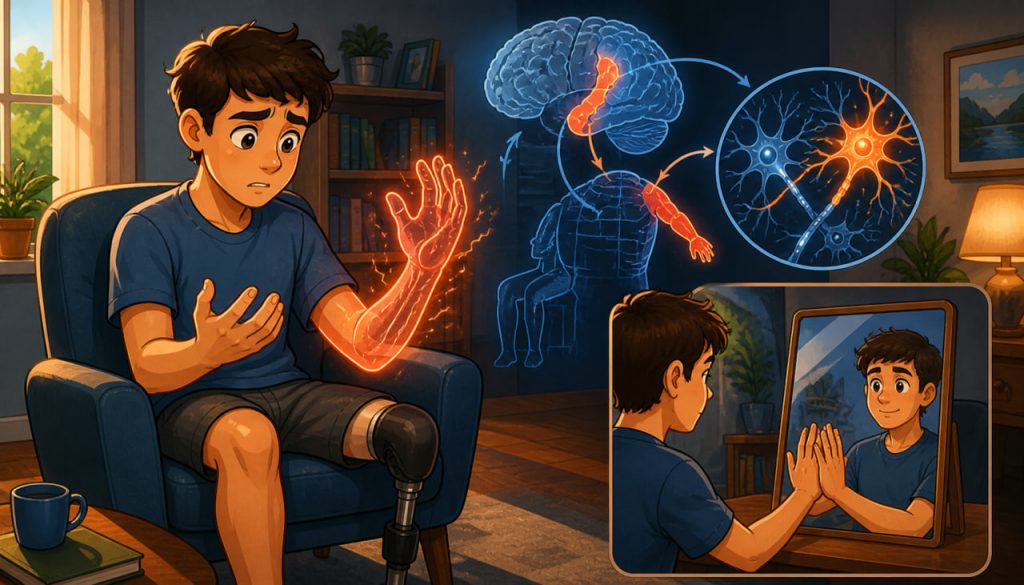
The brain maintains a representation of the body called the body schema.
This map:
- Exists in the sensory cortex
- Tracks the position and state of body parts
- Remains even after limb loss
When a limb is removed, the brain’s map does not immediately update, leading to phantom sensations.
Why Phantom Pain Occurs
There is no single cause, but several mechanisms are involved.
Neural Reorganization
After amputation:
- The brain reorganizes itself
- Nearby regions take over the missing limb’s area
- Signals become misinterpreted
Nerve Signals
Damaged nerves may:
- Send abnormal signals
- Trigger pain responses in the brain
Memory of Pain
If the limb had pain before removal:
- The brain may “remember” that pain
- It continues to reproduce the sensation
Pain can persist even without a physical source.
The Role of the Nervous System
Phantom pain involves both the central and peripheral nervous systems.
- Peripheral nerves may send faulty signals
- The spinal cord processes these signals
- The brain interprets them as real pain
This complex interaction explains why the experience feels genuine.
Expert Insight
Neuroscientist V. S. Ramachandran, a leading researcher in this field, has stated:
“Phantom limbs show that our body image is constructed by the brain and can exist independently of the physical body.”
His work has been crucial in understanding how perception and reality are linked.
Mirror Therapy: A Breakthrough Approach
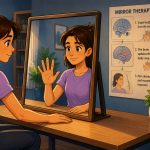
One of the most innovative treatments is mirror therapy.
It involves:
- Using a mirror to reflect the existing limb
- Creating the illusion of the missing limb
- Allowing the brain to “see” movement
This can:
- Reduce pain
- Help the brain update its body map
Visual feedback can influence how the brain processes pain.
Other Treatment Options
Phantom pain is treated using various methods:
- Medications (pain relievers, nerve stabilizers)
- Physical therapy
- Psychological support
- Neuromodulation techniques
No single treatment works for everyone, but combining approaches often helps.
Psychological Factors
Emotions and mental state can influence phantom pain.
Stress, anxiety, and trauma may:
- Increase pain intensity
- Affect perception
This shows that pain is both a physical and psychological experience.
What Phantom Pain Teaches Us
Phantom pain challenges traditional ideas about the body and pain.
It demonstrates that:
- Pain is created in the brain
- The body is represented internally
- Perception can exist without physical input
The brain plays a central role in shaping reality.
Why This Matters
Understanding phantom pain has broader implications.
It helps in:
- Treating chronic pain
- Developing brain-based therapies
- Understanding consciousness and perception
This research is changing how medicine approaches pain.
Interesting Facts
- Phantom sensations can include movement and temperature.
- Mirror therapy can significantly reduce pain in some patients.
- The brain’s body map can persist for years after amputation.
- Not all phantom sensations are painful.
- The phenomenon has been studied for over a century.
Glossary
- Phantom Pain — Pain felt in a missing body part.
- Body Schema — The brain’s representation of the body.
- Neural Reorganization — Changes in brain structure after injury.
- Mirror Therapy — A treatment using visual illusions to reduce pain.
- Nervous System — The network that transmits signals in the body.