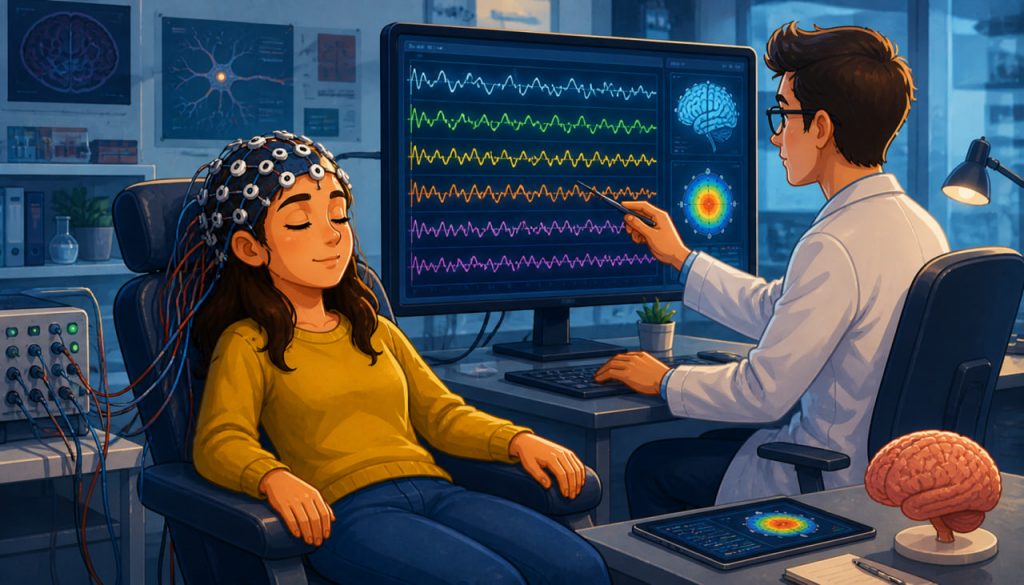
Electroencephalography, commonly known as EEG, is one of the most important tools in neuroscience and medicine. It allows scientists and doctors to observe the brain’s electrical activity in real time. This technology has transformed our understanding of how the brain works and plays a critical role in diagnosing neurological conditions. Understanding EEG reveals how tiny electrical signals inside the brain can be measured and interpreted to uncover complex mental processes.
What Is Electroencephalography?
Electroencephalography (EEG) is a non-invasive method used to record electrical activity in the brain.
It works by:
- Placing small sensors (electrodes) on the scalp
- Detecting electrical signals produced by neurons
- Recording these signals as wave patterns
These signals reflect the communication between brain cells.
How the Brain Produces Electrical Signals
The brain is made up of billions of neurons that communicate through electrical and chemical signals.
When neurons are active:
- They generate tiny electrical impulses
- Groups of neurons create detectable patterns
- These patterns can be measured by EEG
Although individual signals are very small, the combined activity of many neurons produces measurable waves.
How EEG Works
EEG uses electrodes placed on the scalp to capture brain activity.
The process includes:
- Placing electrodes in specific positions
- Recording electrical signals over time
- Displaying results as waveforms
These waveforms show:
- Frequency (how fast the waves are)
- Amplitude (how strong they are)
- Patterns linked to different brain states
Types of Brain Waves
EEG identifies several types of brain waves, each associated with different mental states.
Delta Waves
- Slowest waves
- Associated with deep sleep
Theta Waves
- Linked to drowsiness and early sleep stages
Alpha Waves
- Present during relaxed wakefulness
Beta Waves
- Associated with active thinking and focus
Gamma Waves
- Linked to high-level processing and cognition
These patterns help researchers understand brain activity in different conditions.
Medical Applications of EEG
EEG is widely used in medicine.
It helps diagnose and monitor:
- Epilepsy and seizures
- Sleep disorders
- Brain injuries
- Neurological conditions
Doctors analyze EEG patterns to detect abnormalities in brain function.
EEG in Research and Science
EEG is also essential in scientific research.
It is used to study:
- Memory and learning
- Attention and perception
- Decision-making
- Consciousness
Because EEG provides real-time data, it is especially useful for studying how the brain responds to stimuli.
Advantages of EEG
EEG has several important advantages:
- Non-invasive and painless
- Provides real-time brain activity
- Relatively affordable compared to other brain imaging methods
- Safe for repeated use
These features make it a widely used tool in both clinics and research.
Limitations of EEG
Despite its usefulness, EEG has some limitations:
- Limited ability to pinpoint exact locations in the brain
- Sensitive to external noise and movement
- Signals can be complex to interpret
Other imaging techniques like MRI or fMRI are often used alongside EEG for more detailed analysis.
Expert Insight
Neuroscientist Ernst Niedermeyer, a pioneer in EEG research, once noted:
“Electroencephalography remains one of the most direct and informative methods for studying brain function.”
This emphasizes the continued importance of EEG in neuroscience.
EEG and Modern Technology
Advances in technology are expanding EEG applications.
Today, EEG is used in:
- Brain-computer interfaces
- Neurofeedback therapy
- Gaming and virtual reality research
These innovations show how EEG is moving beyond medicine into everyday technology.
Why EEG Matters
EEG provides a window into the brain’s activity. It helps scientists understand how thoughts, emotions, and actions are connected to neural signals.
It bridges the gap between physical brain activity and human experience, making it one of the most valuable tools in neuroscience.
Interesting Facts
- EEG can detect brain activity in milliseconds.
- It was first developed in the early 20th century.
- EEG is commonly used to study sleep patterns.
- Brain waves change depending on mental state.
- It is one of the safest brain-monitoring techniques.
Glossary
- EEG (Electroencephalography) — A method for recording brain electrical activity.
- Neuron — A nerve cell that transmits signals.
- Electrode — A sensor used to detect electrical signals.
- Brain Waves — Patterns of electrical activity in the brain.
- Neurofeedback — Training the brain using real-time EEG data.