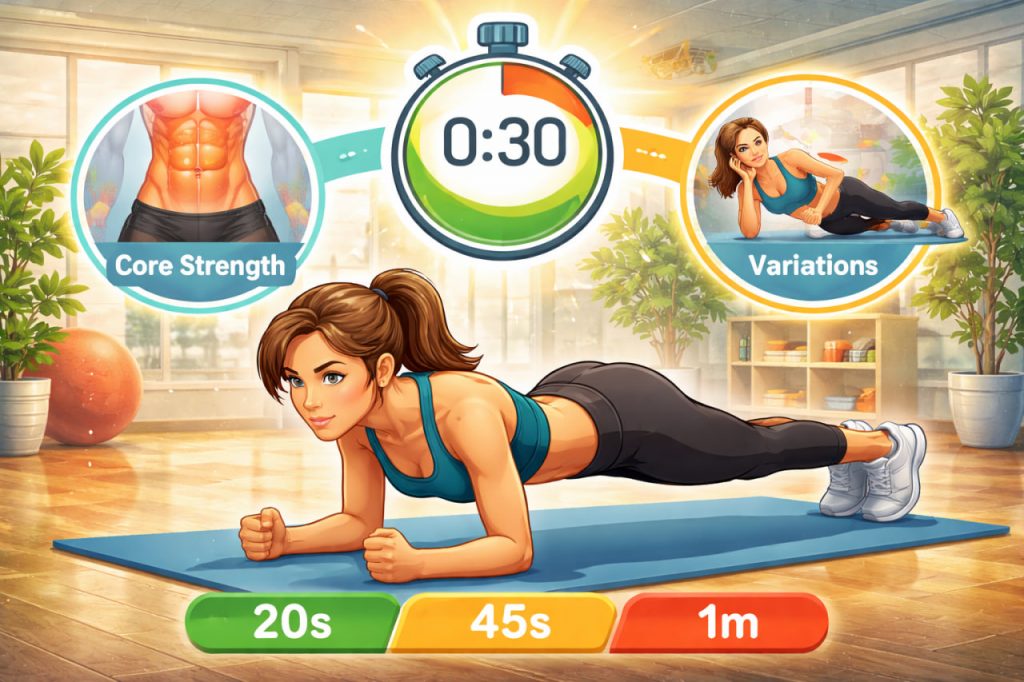
The plank is one of the most effective and widely used exercises for strengthening the core muscles, improving posture, and enhancing overall stability. Despite its simplicity, many people wonder how long they should hold a plank to achieve real results. Unlike dynamic exercises, the plank relies on sustained tension, making duration a key factor in its effectiveness. However, longer is not always better, and proper technique plays a more important role than sheer time. The ideal plank duration depends on individual fitness level, goals, and consistency of training. Understanding how to approach plank timing helps maximize benefits while avoiding strain or injury.
The Ideal Duration for Beginners and Advanced Levels
The appropriate plank duration varies depending on experience and physical condition. For beginners, holding a plank for 20–30 seconds with correct form is already beneficial and helps build foundational strength. As endurance improves, individuals can gradually increase the duration to 45–60 seconds, which is considered an effective standard for general fitness. Advanced individuals may hold a plank for 1–2 minutes, but beyond this point, the benefits tend to plateau. Fitness coach Dr. Ryan Keller explains:
“A perfectly executed 30-second plank is far more effective
than a two-minute plank performed with poor form.”
This highlights the importance of quality over quantity when performing static exercises.
Why Technique Matters More Than Time
Maintaining proper body alignment is essential during a plank. The body should form a straight line from head to heels, with the core engaged and the lower back neither sagging nor excessively arched. Poor form reduces the effectiveness of the exercise and increases the risk of strain, particularly in the lower back and shoulders. When fatigue sets in, form often deteriorates, making extended durations counterproductive. Focusing on controlled breathing and muscle engagement ensures that even shorter planks deliver significant results.
Benefits of Regular Planking
Regular plank practice strengthens not only the abdominal muscles but also the shoulders, back, and stabilizing muscles throughout the body. It improves posture by reinforcing proper spinal alignment and can reduce the risk of back pain when performed correctly. Planking also enhances balance and coordination, as multiple muscle groups must work together to maintain stability. Over time, consistent practice leads to increased muscular endurance and overall functional strength.
Short vs Long Planks: What Works Better?
Research and fitness experts suggest that performing multiple shorter planks can be more effective than holding one long plank. For example, completing three sets of 30–45 seconds allows muscles to recover slightly between efforts while maintaining high-quality engagement. This approach reduces fatigue-related form breakdown and supports better long-term progress. Shorter, controlled sets also make it easier to track improvements and gradually increase intensity.
Progression and Variation
To continue improving, it is important to gradually increase difficulty rather than just extending time. Variations such as side planks, plank with leg lifts, or dynamic planks challenge different muscle groups and prevent adaptation. Increasing intensity through variation often provides greater benefits than simply holding a standard plank longer. Progression should always be gradual to avoid injury and ensure sustainable improvement.
Interesting Facts
- Holding a plank for just 30 seconds daily can significantly improve core strength over time.
- The world record for the longest plank exceeds 9 hours, though such extremes are not necessary for fitness.
- Planking activates more than 20 muscle groups simultaneously.
- Short plank sets with rest periods often produce better results than one long hold.
- Proper planking can help improve posture and reduce lower back discomfort.
Glossary
- Plank — a static exercise that involves holding the body in a straight, supported position to engage core muscles.
- Core Muscles — muscles in the abdomen, lower back, and pelvis responsible for stability.
- Endurance — the ability of muscles to sustain activity over time.
- Body Alignment — maintaining correct posture during exercise to prevent strain and maximize effectiveness.
- Variation — modified versions of an exercise that target different muscles or increase difficulty.