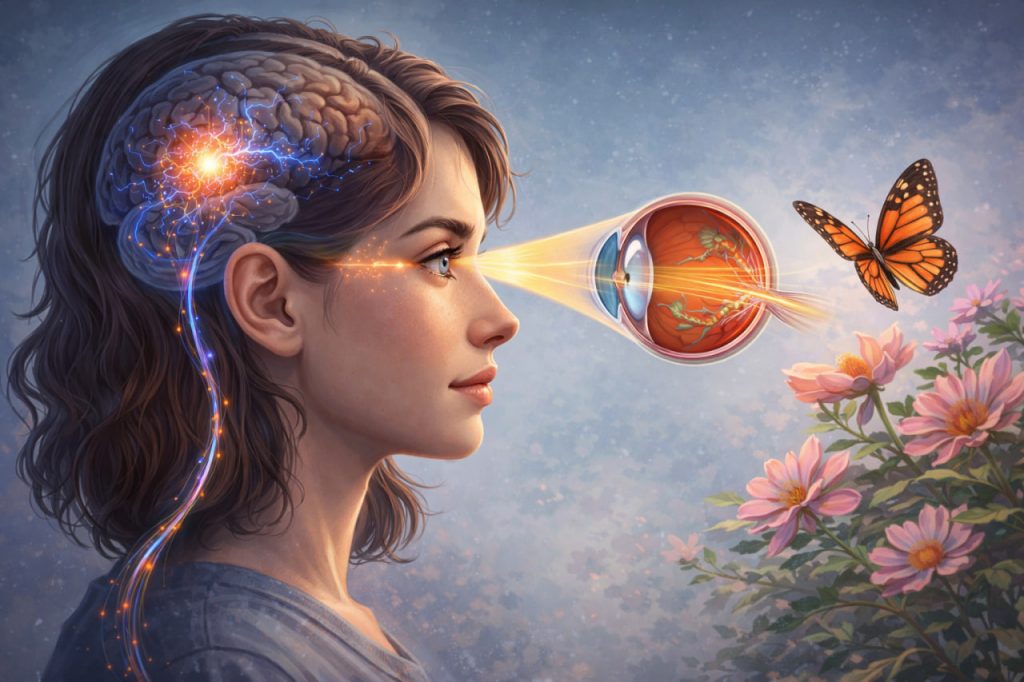
Vision is one of the most complex and fascinating processes in the human body. Every moment, our eyes capture light from the environment and transform it into meaningful images that the brain can understand. This process may feel effortless, but it involves a highly coordinated system of optics, biology, and neural processing. Understanding how we see reveals just how remarkable the human body truly is.
What Is Vision
Vision is the ability to detect light and interpret it as images. It begins when light enters the eye and ends when the brain processes that information into something we recognize. As experts explain:
“Seeing is not just about the eyes—it is a collaboration between the eyes and the brain.”
Without the brain, the eyes alone would not be able to create a visual experience.
How Light Enters the Eye
The process starts when light reflects off objects and enters the eye through the cornea, the transparent outer layer. The light then passes through the pupil, whose size is controlled by the iris. The pupil adjusts depending on how much light is present, allowing more light in darkness and less in bright conditions.
After passing through the pupil, light reaches the lens, which focuses it onto the retina at the back of the eye.
The Role of the Retina
The retina is a thin layer of tissue filled with specialized cells called photoreceptors. These include rods and cones. Rods are sensitive to low light and help us see in dim conditions, while cones are responsible for color vision and fine detail.
When light hits these cells, it is converted into electrical signals. This transformation is a crucial step in turning physical light into information the brain can understand.
From Eye to Brain
The electrical signals generated in the retina travel through the optic nerve to the brain. Specifically, they are sent to the visual cortex, where the brain begins to interpret them. The brain processes these signals into recognizable shapes, colors, and movement.
Interestingly, the image formed on the retina is actually upside down, but the brain automatically corrects this without us noticing.
How the Brain Interprets Images
The brain does much more than simply receive signals—it actively interprets them. It combines visual input with memory and context to create a meaningful picture of the world. This is why perception can sometimes differ from reality, leading to visual illusions.
Depth, Motion, and Color
Our ability to perceive depth comes from having two eyes, each capturing a slightly different image. The brain combines these images to create a sense of three-dimensional space. Motion detection and color perception are also processed in specialized areas of the brain.
Common Vision Challenges
Vision can be affected by various factors, such as focusing issues or sensitivity to light. While the basic process remains the same, small differences in how light is focused or processed can influence clarity and perception.
A Complex System Working Instantly
The entire process of vision—from light entering the eye to image interpretation—happens almost instantly. It is a seamless combination of physical and neurological processes that allows us to navigate and understand the world around us.
Interesting Facts
- The image on the retina is upside down before the brain processes it.
- Rods help us see in low light conditions.
- Cones are responsible for color vision.
- The brain plays a major role in interpreting visual information.
- Vision combines both eye function and neural processing.
Glossary
- Cornea — the transparent front part of the eye.
- Pupil — the opening that controls how much light enters.
- Retina — the light-sensitive layer at the back of the eye.
- Photoreceptors — cells that detect light.
- Optic Nerve — the pathway that sends signals to the brain.