Microwave ovens are among the most common household appliances in the world. Millions of people use them daily to:
- Heat food
- Defrost frozen products
- Prepare simple meals
- Save time in the kitchen
Despite their popularity, microwave ovens have long been surrounded by myths and concerns. Some people worry that microwaves:
- Destroy nutrients
- Cause cancer
- Emit dangerous radiation
- Make food unhealthy
Others view them as one of the safest and most convenient cooking technologies ever developed.
So what does modern science actually say?
The good news is that decades of research have provided clear answers regarding:
- Safety
- Nutrition
- Radiation exposure
- Practical alternatives
Understanding how microwave ovens work helps separate scientific facts from misconceptions.
How Does a Microwave Oven Work?
A microwave oven uses:
- Electromagnetic waves
called:
- Microwaves
These waves typically operate at a frequency of about:
- 2.45 GHz
Microwaves cause water molecules inside food to:
- Vibrate rapidly
This vibration generates:
- Heat
which warms the food from within.
Unlike conventional ovens, microwave ovens do not directly heat:
- Air
- Metal heating elements
Instead, they primarily heat the water-containing parts of food.
Is Microwave Radiation Dangerous?
One of the most common misconceptions is that microwave ovens expose food to:
- Harmful radiation
The word “radiation” often causes confusion.
There are two major categories:
- Ionizing radiation
- Non-ionizing radiation
Ionizing radiation includes:
- X-rays
- Gamma rays
These can damage DNA and increase cancer risk.
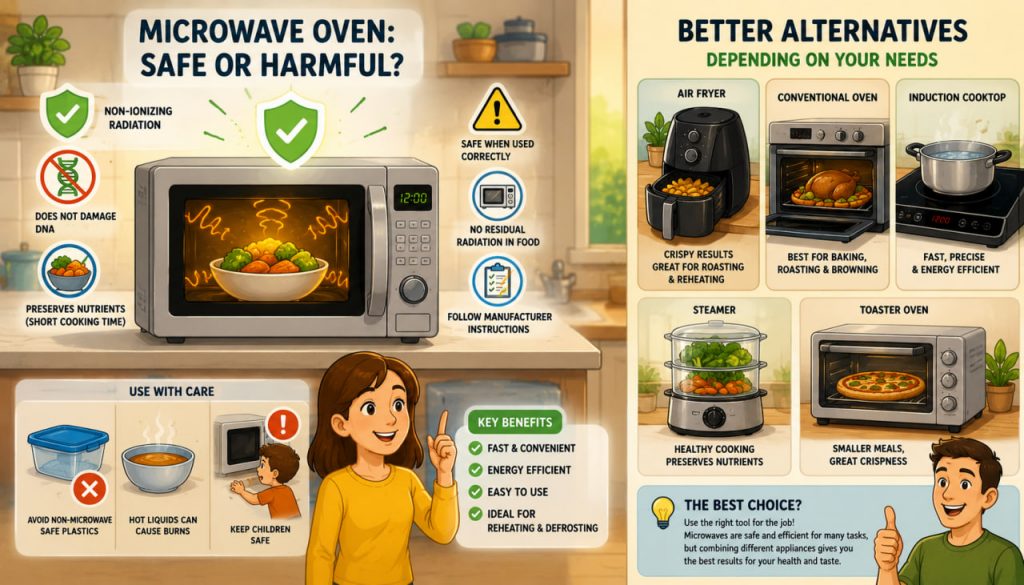
Microwave ovens use:
- Non-ionizing radiation
which does not possess enough energy to:
- Break chemical bonds
- Damage DNA
As a result, properly functioning microwave ovens are considered safe by major health organizations.
Can Microwaves Cause Cancer?
Scientific evidence does not support the claim that microwave ovens cause cancer.
Microwave energy:
- Does not remain in food
- Does not make food radioactive
Once the microwave is turned off:
- The radiation disappears
The food itself contains no residual microwave energy.
Major health authorities worldwide have repeatedly concluded that properly used microwave ovens do not increase cancer risk.
Do Microwaves Destroy Nutrients?
All cooking methods affect nutrients to some degree.
The key factors are:
- Temperature
- Cooking time
- Water exposure
Interestingly, microwave cooking often preserves nutrients relatively well because:
- Cooking times are shorter
- Less water is often required
For some vegetables, microwave cooking may preserve more vitamins than:
- Boiling
because fewer nutrients dissolve into cooking water.
Why Some Foods Heat Unevenly
Microwave ovens sometimes produce:
- Hot spots
- Cold spots
This occurs because microwaves interact differently with various parts of the food.
Uneven heating can become a safety concern when cooking:
- Meat
- Poultry
- Prepared meals
Proper stirring and sufficient heating help reduce this issue.
What About Microwave Leakage?
Modern microwave ovens are designed with:
- Metal shielding
- Protective screens
- Safety interlocks
These features prevent significant microwave leakage.
When appliances are:
- Undamaged
- Properly maintained
radiation exposure remains well below established safety limits.
Advantages of Microwave Ovens
Microwave ovens offer several practical benefits:
- Fast heating
- Energy efficiency
- Convenience
- Reduced cooking times
- Minimal kitchen heat generation
These advantages make them especially useful for:
- Busy households
- Small apartments
- Office kitchens
Limitations of Microwave Cooking
Despite their convenience, microwaves have limitations.
They are generally poor at producing:
- Crispy textures
- Browning
- Roasting effects
Foods such as:
- Bread
- Pizza crust
- Roasted vegetables
often achieve better texture using other cooking methods.
Can Plastic Containers Be a Problem?
The microwave itself is not usually the issue.
Certain containers may create concerns.
Only containers labeled:
- Microwave-safe
should be used.
Some plastics may:
- Warp
- Melt
- Release unwanted chemicals
if exposed to excessive heat.
Glass and ceramic containers are often safer choices.
Are Microwave Ovens Safe for Children?
When used correctly, microwave ovens are generally safe.
However, caution is necessary because:
- Heated liquids can become extremely hot
- Containers may cause burns
- Steam can cause injuries
Adult supervision is recommended for younger children.
What Are the Best Alternatives?
Several alternatives can replace microwave ovens depending on cooking goals.
Common options include:
- Conventional ovens
- Toaster ovens
- Air fryers
- Induction cookers
- Steamers
Each method offers unique advantages.
Air Fryers: A Popular Modern Alternative
Air fryers have become increasingly popular because they can:
- Crisp food
- Roast vegetables
- Reheat leftovers
more effectively than many microwaves.
They use:
- Hot circulating air
rather than electromagnetic waves.
For texture and browning, air fryers often outperform microwave ovens.
Induction Cooking
Induction cooktops provide:
- Fast heating
- High efficiency
- Precise temperature control
They are excellent for:
- Soups
- Sauces
- Reheating meals
while often using less energy than traditional stovetops.
Conventional Ovens
Traditional ovens remain superior for:
- Baking
- Roasting
- Browning
They produce more even heating and better texture.
The tradeoff is:
- Longer cooking times
- Higher energy consumption
Steam Cooking
Steamers offer an excellent alternative for:
- Vegetables
- Fish
- Healthy meal preparation
Steam cooking can preserve:
- Flavor
- Moisture
- Nutrients
while avoiding excessive oils.
Expert Opinion on Microwave Safety
According to many food scientists and public health experts, microwave ovens are among the most thoroughly studied kitchen appliances.
Organizations such as the:
- World Health Organization
have consistently indicated that properly functioning microwave ovens are safe when used according to manufacturer instructions.
Should You Replace Your Microwave?
For most households:
There is no health-related reason to replace a functioning microwave oven.
Microwave ovens remain:
- Safe
- Convenient
- Efficient
However, alternatives may be preferable when:
- Better texture is desired
- Larger meals are prepared
- Specialized cooking techniques are needed
Many modern kitchens successfully combine:
- Microwave ovens
- Air fryers
- Conventional ovens
- Induction cookers
to achieve the advantages of each technology.
Why Microwave Ovens Remain Popular
The microwave oven represents one of the most successful applications of electromagnetic science in everyday life.
Despite persistent myths, decades of research indicate that microwave ovens:
- Do not make food radioactive
- Do not cause cancer
- Do not uniquely destroy nutrients
when used correctly.
While alternatives such as air fryers and induction cookers offer benefits for certain cooking styles, microwave ovens remain one of the safest and most efficient tools for quickly heating food.
For most people, the best choice is not necessarily replacing the microwave, but understanding its strengths and using it appropriately alongside other cooking methods.
Interesting Facts
- Microwave ovens were invented after radar research in the 1940s.
- The first commercial microwave oven weighed hundreds of kilograms.
- Microwaves heat water molecules directly.
- Microwave cooking often uses less energy than conventional ovens.
- Modern microwave ovens contain multiple safety systems to prevent radiation leakage.
Glossary
- Microwave — Electromagnetic wave used to heat food in microwave ovens.
- Non-Ionizing Radiation — Radiation that lacks sufficient energy to damage DNA directly.
- Ionizing Radiation — High-energy radiation capable of removing electrons from atoms.
- Induction Cooktop — Cooking surface that uses magnetic fields to heat cookware.
- Air Fryer — Appliance that cooks food using rapidly circulating hot air.