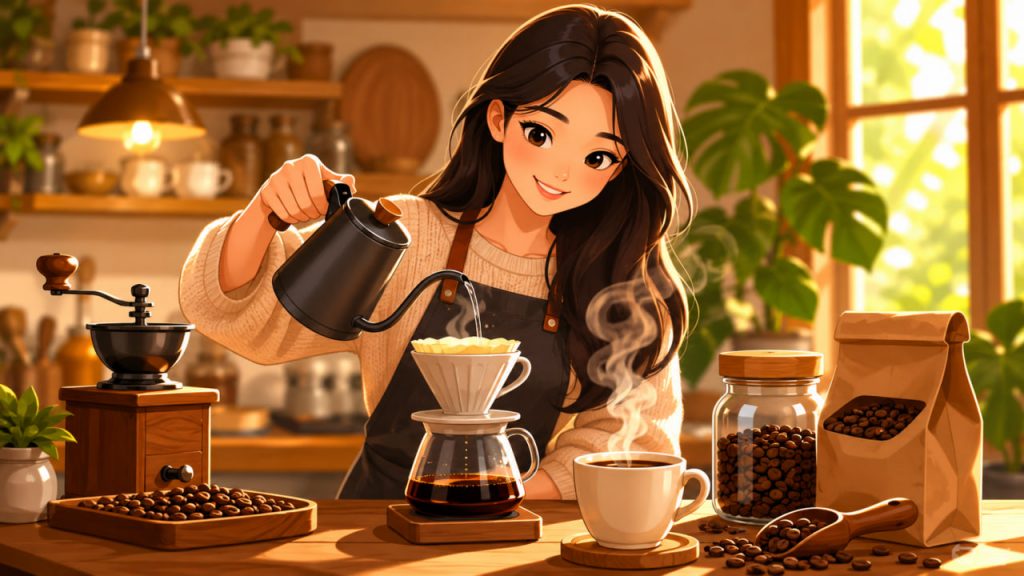
Good coffee is not only about expensive beans or professional equipment. The real secret is understanding a few simple principles: freshness, roast level, grind size, water quality, brewing method, and correct ratios. When these elements work together, even a simple home setup can produce a cup that tastes rich, balanced, aromatic, and satisfying.
Many people blame the coffee machine when their coffee tastes bitter, sour, weak, or flat. But the problem is often easier to fix. Old beans, the wrong grind, water that is too hot or too cold, poor storage, or inaccurate measurements can ruin even high-quality coffee.
Great coffee starts before brewing. It begins with buying the right beans and treating them carefully.
Choose Whole Beans Instead of Ground Coffee
If you want better coffee at home, buy whole beans whenever possible.
Ground coffee loses aroma much faster because more surface area is exposed to oxygen. Whole beans preserve volatile aromatic compounds longer, especially when stored properly.
Look for coffee with:
- A clear roast date
- Origin information
- Roast level
- Processing method if available
- Fresh aroma
- Reliable packaging
Avoid coffee that has no roast date and only shows an expiration date. Expiration dates can be far in the future and do not tell you when the coffee was actually roasted.
Freshly ground coffee almost always tastes better than pre-ground coffee.
Understand Roast Levels
Coffee roast level strongly affects flavor.
Light roast usually tastes brighter, more acidic, floral, fruity, or tea-like. It often preserves more of the bean’s origin character.
Medium roast is balanced, with sweetness, aroma, mild acidity, and flavors like caramel, nuts, chocolate, or fruit.
Dark roast has stronger bitterness, lower acidity, heavier body, and flavors like dark chocolate, smoke, roasted nuts, or spice.
There is no universally “best” roast. The right choice depends on taste and brewing method.
For beginners, medium roast is often the safest option because it gives balance without extreme acidity or bitterness.
Arabica vs. Robusta
The two most common commercial coffee species are Arabica and Robusta.
Arabica is usually more aromatic, sweeter, and more complex. It often has notes of fruit, flowers, chocolate, nuts, or caramel.
Robusta usually has more caffeine, stronger bitterness, heavier body, and earthy or woody notes. It is often used in espresso blends for crema and intensity.
High-quality Robusta can be interesting, but cheap Robusta is often harsh.
For smoother everyday coffee, start with 100% Arabica or a quality espresso blend with a small Robusta percentage.
Look at Origin and Processing
Coffee flavor depends on where and how it is grown.
Origin can influence taste:
- Ethiopia often produces floral, citrus, or berry-like coffees.
- Colombia is often balanced, sweet, and clean.
- Brazil often has nutty, chocolatey, lower-acid profiles.
- Kenya is often bright, juicy, and complex.
- Guatemala may offer chocolate, spice, and fruit notes.
Processing also matters.
Washed coffee often tastes clean and bright.
Natural coffee can taste fruitier, heavier, and sometimes wine-like.
Honey process usually sits between washed and natural, with sweetness and body.
The Specialty Coffee Association’s Coffee Taster’s Flavor Wheel is widely used in the industry to describe coffee flavors more precisely, from fruity and floral notes to chocolate, spice, and nutty tones.
Check Freshness and Storage
Fresh coffee is important, but coffee does not need to be brewed immediately after roasting.
Many beans taste best after a short resting period because freshly roasted coffee releases carbon dioxide.
For home use, a practical rule is:
- Use beans within a few weeks after roasting.
- Grind just before brewing.
- Store beans in an airtight, opaque container.
- Keep coffee away from heat, light, moisture, and strong odors.
Coffee storage guidance commonly emphasizes minimizing exposure to oxygen, light, moisture, and heat, and whole beans generally stay fresher longer than ground coffee.
Do not store daily coffee in the refrigerator. Moisture and odors can damage flavor.
Grind Size: The Most Common Mistake
Grind size controls extraction.
If coffee is ground too fine, water extracts too much too quickly. The result may taste bitter, dry, harsh, or muddy.
If coffee is ground too coarse, water extracts too little. The result may taste sour, thin, weak, or grassy.
General grind guide:
- French press: coarse
- Pour-over: medium
- Drip coffee maker: medium
- AeroPress: medium-fine depending on recipe
- Moka pot: fine-medium
- Espresso: very fine
Changing grind size is one of the fastest ways to improve coffee flavor.
Use the Right Coffee-to-Water Ratio
Measuring coffee by eye often leads to inconsistent results.
A kitchen scale makes brewing much easier.
A common starting ratio is:
1 gram of coffee to 15–17 grams of water
For example:
- 15 g coffee + 250 g water
- 30 g coffee + 500 g water
Use more coffee for a stronger cup and more water for a lighter cup.
Once you find a ratio you like, repeat it.
Consistency is what turns random brewing into good brewing.
Water Temperature Matters
Water that is too cool under-extracts coffee, making it taste flat or sour.
Water that is too hot can over-extract, making coffee taste bitter and harsh.
Many coffee professionals use a brewing range around 195–205°F, or about 90.5–96°C, for balanced extraction; this range is widely associated with Specialty Coffee Association brewing guidance and is also referenced by coffee education sources.
If you do not have a thermometer, boil water and let it rest for about 30–60 seconds before brewing.
Choose the Right Brewing Method
Different brewing methods create different flavor profiles.
French press gives a full-bodied cup with more oils and texture.
Pour-over produces a cleaner, brighter, more delicate cup.
Drip coffee maker is convenient for daily brewing.
AeroPress is flexible, fast, and travel-friendly.
Moka pot creates strong, concentrated coffee, close to espresso style but not true espresso.
Espresso machine produces intense coffee under pressure and is the base for cappuccino, latte, and flat white.
There is no perfect method for everyone.
The best brewing method is the one that matches your taste, budget, and daily routine.
How to Fix Bad Coffee Taste
Coffee too bitter?
Try:
- Coarser grind
- Lower water temperature
- Shorter brew time
- Lighter roast
- Less coffee contact time
Coffee too sour?
Try:
- Finer grind
- Hotter water
- Longer brew time
- Slightly darker roast
- Better water quality
Coffee too weak?
Try:
- More coffee
- Finer grind
- Fresh beans
- Better extraction
- Correct ratio
Coffee too muddy?
Try:
- Coarser grind
- Better filter
- Cleaner equipment
- Avoid over-agitating
Most coffee problems can be solved by adjusting grind, ratio, temperature, or brew time.
Keep Equipment Clean
Coffee oils build up quickly.
Old oils become rancid and create bitter, stale flavors.
Clean regularly:
- Grinder burrs
- French press mesh
- Dripper
- Coffee maker basket
- Water tank
- Moka pot parts
- Espresso machine group head
Even great beans can taste bad in dirty equipment.
Clean gear is part of good flavor.
Expert Perspective
Coffee professionals often focus on extraction balance. The Specialty Coffee Association has helped standardize sensory language and brewing education through tools such as the Coffee Taster’s Flavor Wheel, which has been an industry standard resource for describing coffee flavor since its original publication in 1995.
The expert message is simple: good coffee is not luck. It is controlled extraction, fresh ingredients, and careful tasting.
Once you learn to adjust one variable at a time, coffee becomes much easier to improve.
Build a Simple Home Coffee Setup
You do not need a luxury setup.
A strong beginner kit includes:
- Whole beans
- Burr grinder
- Digital scale
- Kettle
- Brewing device
- Airtight container
- Clean water
The grinder is often the most important upgrade.
A burr grinder produces more even particles than a cheap blade grinder, which improves extraction and flavor.
If you buy one serious coffee tool, buy a good grinder.
Interesting Facts
- Coffee flavor can include hundreds of aromatic compounds.
- Whole beans usually stay fresher longer than pre-ground coffee.
- The Specialty Coffee Association’s Coffee Taster’s Flavor Wheel is one of the most recognized tools for describing coffee flavor.
- Grind size affects extraction more than many beginners expect.
- Water that is too hot or too cold can make the same coffee taste completely different.
- Espresso is not a bean type; it is a brewing method.
- Dark roast coffee often tastes stronger, but it does not always contain more caffeine by volume.
Glossary
- Arabica — A coffee species known for aromatic complexity, sweetness, and acidity.
- Robusta — A coffee species often higher in caffeine, with stronger bitterness and heavier body.
- Roast Date — The date when coffee beans were roasted.
- Extraction — The process of dissolving flavor compounds from ground coffee into water.
- Grind Size — How coarse or fine coffee particles are after grinding.
- Bloom — The release of carbon dioxide when hot water first contacts fresh ground coffee.
- Burr Grinder — A grinder that crushes beans between two burrs for more consistent particle size.
- Body — The texture or weight of coffee in the mouth.