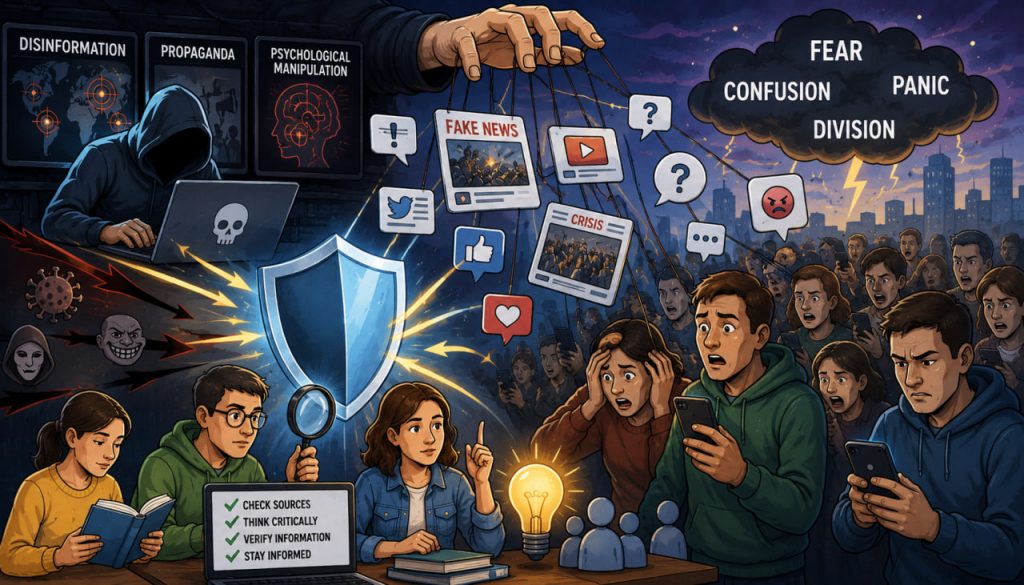
In the digital age, information travels faster than ever before. News, videos, social media posts, and online discussions can reach millions of people within minutes. While this rapid exchange of information has many benefits, it has also created new opportunities for manipulation.
One of the most concerning phenomena of the modern era is often described as:
- Information terrorism
The term generally refers to the deliberate use of information, misinformation, propaganda, or psychological influence to:
- Create fear
- Cause panic
- Destabilize societies
- Manipulate public opinion
- Influence political or social behavior
Unlike traditional terrorism, information terrorism often relies not on physical violence but on:
- Psychological impact
- Mass communication
- Emotional manipulation
Its primary goal is frequently to influence how people:
- Think
- Feel
- React
Understanding information terrorism is increasingly important in a world where information itself has become a powerful strategic resource.
What Is Information Terrorism?
Information terrorism can be described as the intentional use of information tools to produce:
- Fear
- Confusion
- Social disruption
The concept overlaps with:
- Propaganda
- Disinformation
- Psychological warfare
- Influence operations
However, information terrorism specifically emphasizes creating widespread psychological effects that may resemble the societal impact traditionally associated with terrorism.
Rather than targeting physical infrastructure, information terrorism often targets:
- Trust
- Perception
- Public confidence
- Social stability
Why Information Is Powerful
Human decisions depend heavily on:
- Information
- Beliefs
- Perceptions
People often act based on what they believe to be true.
As a result, influencing information can influence:
- Elections
- Financial markets
- Public behavior
- Social relationships
Modern communication technologies have dramatically increased the speed and reach of influence campaigns.
The Role of Fear
Fear is one of the most powerful human emotions.
When people feel threatened, they may:
- Make impulsive decisions
- Spread rumors
- Become more susceptible to manipulation
Information terrorism frequently attempts to exploit:
- Anxiety
- Uncertainty
- Emotional reactions
because fear can spread rapidly through populations.
Social Media Amplification
Social media platforms allow information to spread with unprecedented speed.
Content that triggers strong emotions often receives:
- More attention
- More shares
- More engagement
This creates an environment where alarming or sensational information may spread faster than:
- Careful analysis
- Fact-checking
As a result, false information can sometimes reach large audiences before corrections appear.
Disinformation and Misinformation
Two important concepts related to information terrorism are:
- Misinformation
- Disinformation
Misinformation refers to:
- False information shared unintentionally
Disinformation refers to:
- False information spread deliberately
Disinformation campaigns are often designed to:
- Mislead audiences
- Create confusion
- Undermine trust
These tactics can become powerful tools in influence operations.
Psychological Impact
Information attacks often focus on:
- Human psychology
Rather than changing physical reality, they attempt to change:
- Perception of reality
This can lead to:
- Panic
- Distrust
- Polarization
- Social conflict
Psychological effects sometimes persist long after the original information campaign has ended.
Information Warfare and National Security
Governments increasingly recognize information as a domain of competition alongside:
- Land
- Sea
- Air
- Space
- Cyberspace
Modern conflicts may involve efforts to influence:
- Public opinion
- Political stability
- International perceptions
Information operations have therefore become a significant topic in:
- National security
- Intelligence studies
- Military strategy
The Importance of Trust
Healthy societies depend on trust in:
- Institutions
- Media
- Science
- Public information
Information terrorism often seeks to weaken that trust.
When people become uncertain about:
- Facts
- Sources
- Expertise
social cooperation can become more difficult.
Trust is therefore one of the most valuable resources in modern information environments.
Deepfakes and Artificial Intelligence
Emerging technologies create new challenges.
Artificial intelligence can generate:
- Realistic images
- Audio recordings
- Videos
known as:
- Deepfakes
These synthetic media technologies can make it increasingly difficult to distinguish:
- Authentic content
- Fabricated content
Experts consider this one of the major information challenges of the coming decades.
Why People Believe False Information
Human cognition is not perfectly objective.
People are influenced by:
- Emotions
- Existing beliefs
- Social groups
- Cognitive biases
Information campaigns often exploit these tendencies.
Researchers have found that individuals may accept information more readily when it:
- Confirms prior beliefs
- Comes from trusted sources
- Triggers strong emotions
Education as a Defense
One of the most effective defenses against information manipulation is:
- Media literacy
Media literacy involves learning how to:
- Evaluate sources
- Verify claims
- Recognize bias
- Identify manipulation techniques
Critical thinking skills help individuals navigate increasingly complex information environments.
The Role of Journalism
Professional journalism plays an important role in:
- Verification
- Investigation
- Accountability
High-quality reporting can help counter false information by providing:
- Evidence
- Context
- Fact-checking
Strong journalistic standards contribute to healthier public discourse.
Information Overload
Modern society faces another challenge:
- Information overload
People are exposed to enormous amounts of content every day.
This can make it difficult to:
- Verify information
- Assess credibility
- Maintain attention
Information terrorism may exploit this environment by flooding audiences with:
- Conflicting narratives
- Misleading content
- Emotional messages
Expert Opinion on Information and Society
Communication scholar Marshall McLuhan famously observed:
“The medium is the message.”
Although written before the internet era, this insight highlights how communication technologies themselves shape human behavior and social structures.
His work continues to influence discussions about media, information, and public perception.
Why Information Terrorism Matters
Information has become one of the most influential forces in modern civilization.
The ability to shape beliefs and perceptions can affect:
- Politics
- Economics
- Public health
- Social stability
Information terrorism demonstrates that power is no longer exercised solely through:
- Physical force
- Military action
but also through:
- Communication
- Psychology
- Influence
As digital technologies continue evolving, societies will increasingly need:
- Critical thinking
- Media literacy
- Reliable information systems
to protect themselves from manipulation and maintain informed public decision-making.
Interesting Facts
- False information often spreads faster than corrections on social media.
- Deepfake technology can generate highly realistic synthetic videos.
- Modern influence campaigns may target emotions more than facts.
- Media literacy programs are becoming increasingly important worldwide.
- Information warfare is now studied alongside traditional military domains.
Glossary
- Information Terrorism — The deliberate use of information to create fear, confusion, or social disruption.
- Disinformation — False information spread intentionally to mislead.
- Misinformation — False information shared without intent to deceive.
- Deepfake — AI-generated synthetic media that imitates real people.
- Media Literacy — The ability to critically evaluate and understand information sources.