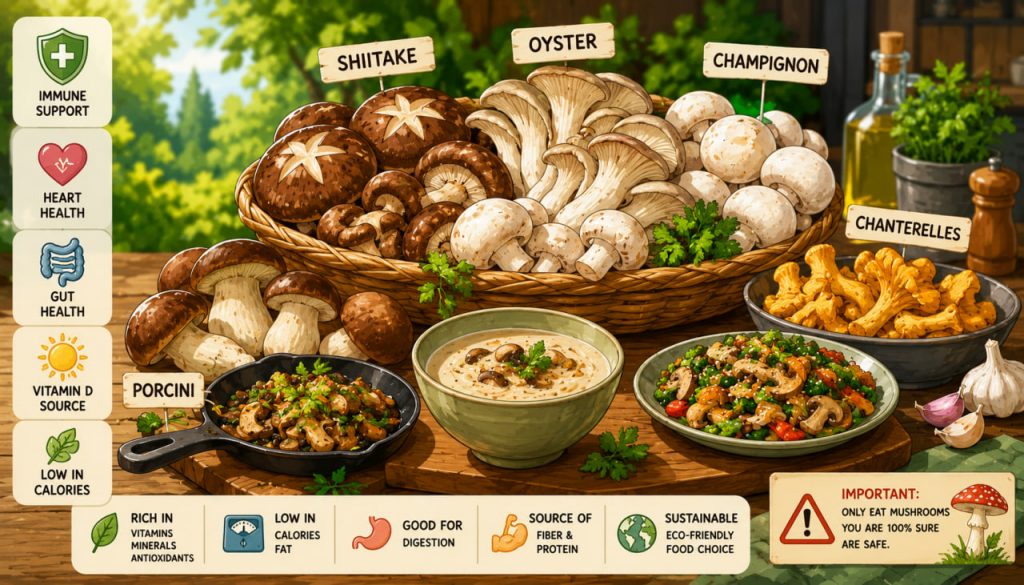
Mushrooms have been part of the human diet for thousands of years. In many cultures they are valued not only for:
- Flavor
- Texture
- Culinary variety
but also for their possible:
- Nutritional benefits
- Medicinal properties
- Low calorie content
Today mushrooms remain popular in:
- Healthy diets
- Vegetarian nutrition
- Traditional medicine
- Modern nutritional science
Some mushrooms provide important nutrients while remaining:
- Affordable
- Filling
- Versatile in cooking
At the same time, not all mushrooms are equal.
Certain species are:
- Highly nutritious
while others may be: - Difficult to digest
or even: - Deadly poisonous
Understanding which mushrooms are beneficial and how to consume them safely is extremely important.
Modern scientific research increasingly studies mushrooms because they contain:
- Fiber
- Antioxidants
- Vitamins
- Minerals
- Bioactive compounds
that may support overall health.
However, experts also warn that mushrooms should not be viewed as:
- Miracle foods
but rather as one useful part of:
- A balanced diet.
What Are Mushrooms?
Mushrooms are not:
- Plants
nor: - Animals
They belong to their own biological kingdom called:
- Fungi
Unlike plants, mushrooms do not perform:
- Photosynthesis
Instead they absorb nutrients from:
- Organic material
Many edible mushrooms grow naturally in:
- Forests
- Grasslands
- Decaying wood environments
while others are cultivated commercially.
Why Mushrooms Are Popular in Healthy Diets
Mushrooms are often considered healthy because they are generally:
- Low in calories
- Low in fat
- Rich in water
- Containing fiber and micronutrients
Many varieties also contain:
- B vitamins
- Selenium
- Potassium
- Copper
- Antioxidants
Some mushrooms provide:
- Umami flavor
which creates satisfying savory taste without excessive:
- Salt
- Fat
- Artificial additives
Mushrooms and Protein
Although mushrooms are sometimes called:
- “Meat substitutes”
their protein content is usually:
- Lower than meat or legumes
However, mushrooms can still complement diets by adding:
- Texture
- Satiety
- Nutritional diversity
Vegetarian and vegan diets often include mushrooms because of their:
- Rich flavor
- Culinary flexibility.
Mushrooms May Support Gut Health
Mushrooms contain:
- Dietary fiber
- Beta-glucans
which may help support:
- Digestion
- Gut microbiome balance
Beta-glucans are bioactive compounds also studied for possible effects on:
- Immunity
- Cholesterol regulation
Researchers continue exploring how mushroom compounds influence:
- Human health.
The Most Popular Edible Mushrooms
Several mushroom types are commonly considered:
- Safe
- Nutritious
- Widely available
Popular examples include:
- Champignons
- Oyster mushrooms
- Shiitake
- Porcini
- Chanterelles
Each variety has different:
- Flavor
- Texture
- Nutritional composition.
Champignons Are Affordable and Versatile
White button mushrooms, often called:
- Champignons
are among the world’s most common edible mushrooms.
They are:
- Inexpensive
- Mild in flavor
- Easy to cook
Champignons work well in:
- Soups
- Salads
- Pasta
- Omelets
- Stir-fries
They are also relatively low in:
- Calories.
Shiitake Mushrooms and Traditional Medicine
Shiitake mushrooms are widely used in:
- Asian cuisine
- Traditional medicine
They contain compounds studied for possible effects on:
- Immunity
- Inflammation
- Cholesterol metabolism
Shiitake mushrooms also provide:
- Rich savory flavor
making them popular in:
- Soups
- Rice dishes
- Noodle meals.
Oyster Mushrooms Are Nutritious and Affordable
Oyster mushrooms are valued because they are:
- Easy to cultivate
- Budget-friendly
- Soft in texture
They contain:
- Fiber
- Antioxidants
- Micronutrients
and are commonly used in:
- Stir-fries
- Vegetarian dishes
- Soups.
Wild Mushrooms Require Extreme Caution
Wild mushroom collection can be:
- Dangerous
Many poisonous mushrooms strongly resemble:
- Edible species
Some toxic mushrooms may cause:
- Organ failure
- Severe poisoning
- Death
Experts strongly recommend:
- Eating only mushrooms confidently identified as safe
especially when foraging in forests.
Cooking Mushrooms Properly Matters
Most mushrooms should be:
- Properly cooked
Cooking improves:
- Digestibility
- Flavor
- Food safety
Raw mushrooms sometimes contain compounds that may irritate:
- Digestion
Cooking also helps destroy certain:
- Natural toxins
- Harmful microorganisms.
Mushrooms and Vitamin D
Some mushrooms naturally produce:
- Vitamin D
when exposed to:
- Sunlight or ultraviolet light
This makes certain mushrooms unique among non-animal foods.
Vitamin D supports:
- Bone health
- Immune function
- Calcium regulation.
Can Mushrooms Replace Meat?
Mushrooms cannot fully replace meat nutritionally because they contain:
- Less protein
- Less iron
- Less vitamin B12
However, mushrooms can help reduce excessive meat consumption while adding:
- Flavor
- Texture
- Fiber
Balanced diets may combine mushrooms with:
- Legumes
- Whole grains
- Protein-rich foods.
Medicinal Mushrooms Are Being Studied
Scientists continue researching mushrooms such as:
- Reishi
- Lion’s Mane
- Turkey Tail
for possible effects involving:
- Immunity
- Brain health
- Inflammation
However, many health claims still require:
- More scientific evidence
Experts advise caution regarding exaggerated:
- Supplement marketing.
Mushrooms Are Environmentally Efficient
Compared to many animal products, mushrooms often require:
- Less land
- Less water
- Fewer environmental resources
This makes mushroom cultivation potentially attractive for:
- Sustainable food systems.
Expert Opinion on Mushrooms and Health
Nutrition researcher Jo Ann Hattner explained:
“Mushrooms provide nutrients and flavor while remaining low in calories, making them useful in balanced diets.”
Many dietitians recommend mushrooms as part of:
- Diverse healthy eating patterns.
Who Should Be Careful With Mushrooms?
Some individuals may experience:
- Digestive sensitivity
- Allergic reactions
after consuming certain mushrooms.
People with:
- Gastrointestinal disorders
sometimes tolerate mushrooms less easily because fungi contain:
- Complex fibers
that may be difficult to digest in large amounts.
Moderation remains important.
Why Mushrooms Can Be a Good Dietary Choice
Mushrooms offer several advantages:
- Low calorie content
- Nutritional value
- Rich flavor
- Culinary versatility
- Affordable options
When chosen safely and prepared properly, mushrooms may become a healthy addition to:
- Balanced diets
- Summer meals
- Vegetarian cooking
- Budget-friendly nutrition plans
They are not magical superfoods, but they are fascinating organisms that combine:
- Biology
- Nutrition
- Culinary tradition
- Modern science
in one of nature’s most unusual food groups.
Interesting Facts
- Mushrooms belong to the fungi kingdom, not the plant kingdom.
- Some mushrooms can naturally produce vitamin D.
- Poisonous mushrooms may closely resemble edible ones.
- Shiitake mushrooms have been used in Asian cuisine for centuries.
- Mushrooms contain compounds called beta-glucans studied for immune effects.
Glossary
- Fungi — Biological kingdom including mushrooms, molds, and yeasts.
- Beta-Glucans — Natural fiber compounds found in fungi and some grains.
- Microbiome — Community of microorganisms living in the body.
- Umami — Savory taste often associated with mushrooms and fermented foods.
- Antioxidants — Molecules helping protect cells from damage.