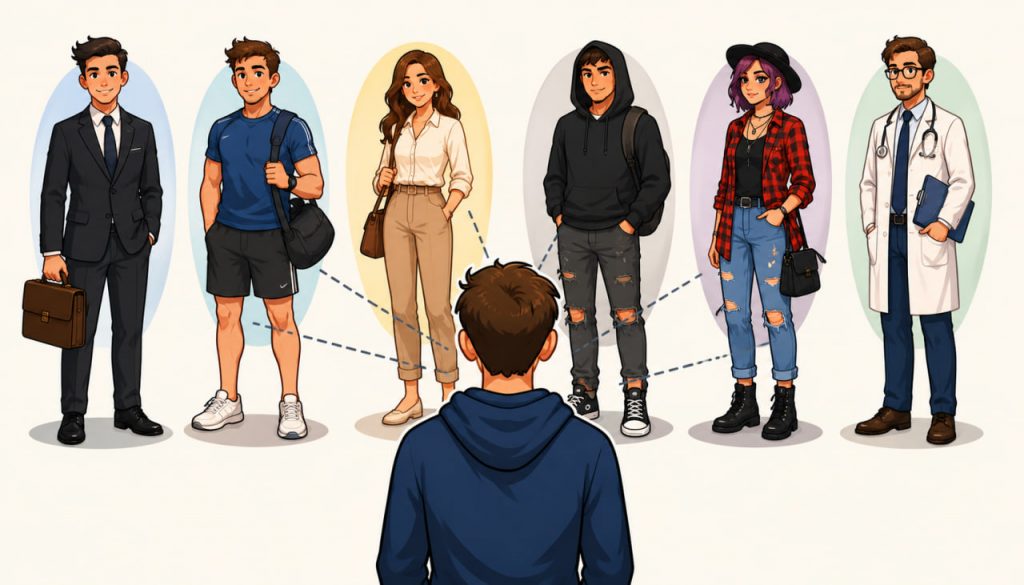
Clothing is far more than:
- Fabric
- Fashion
- Protection from weather
What people wear strongly influences how others perceive:
- Personality
- Intelligence
- Social status
- Confidence
- Trustworthiness
- Professionalism
Long before humans speak, clothing already communicates powerful social information.
Psychologists, sociologists, and neuroscientists have studied how appearance affects:
- First impressions
- Human behavior
- Social interaction
- Self-esteem
- Decision-making
Research shows the human brain evaluates visual appearance extremely quickly — often within:
- Seconds
Clothing therefore functions almost like:
- A nonverbal language
capable of shaping both:
- External perception
and: - Internal psychology.
Modern fashion is not only about beauty or trends. It also involves:
- Identity
- Culture
- Social signaling
- Emotional expression
- Group belonging
Understanding how clothing affects perception helps explain why appearance plays such a powerful role in:
- Human society
- Business
- Relationships
- Politics
- Everyday communication.
Humans Judge Appearance Very Quickly
The human brain evolved to make rapid social judgments.
Within seconds of seeing someone, people often unconsciously evaluate:
- Safety
- Status
- Confidence
- Competence
- Attractiveness
Clothing strongly influences these instant impressions.
Psychologists call this:
- Thin-slice judgment
where the brain forms conclusions from limited visual information.
Clothing Functions as Social Communication
What people wear sends signals involving:
- Profession
- Personality
- Wealth
- Culture
- Values
- Lifestyle
For example:
- Formal clothing may suggest authority
- Sportswear may suggest activity or relaxation
- Luxury brands may signal social status
Humans constantly interpret these visual cues, often subconsciously.
First Impressions Matter
Research consistently shows first impressions influence:
- Hiring decisions
- Dating outcomes
- Social trust
- Leadership perception
Although personality matters greatly long-term, appearance often shapes:
- Initial assumptions
before conversation even begins.
Psychologist Albert Mehrabian became famous for studying nonverbal communication and noted how visual presentation affects social interaction strongly.
Clothing Can Influence Confidence
Interestingly, clothing affects not only:
- How others see us
but also:
- How people see themselves
Scientists sometimes call this phenomenon:
- Enclothed cognition
Research suggests certain clothing may influence:
- Confidence
- Attention
- Behavior
- Emotional state
For example:
- Professional clothing may increase feelings of competence
- Athletic clothing may encourage active behavior
The brain partially associates clothing with:
- Identity and role perception.
Uniforms Create Authority
Throughout history, uniforms helped establish:
- Social order
- Group identity
- Authority structures
Police uniforms, military clothing, and medical coats create immediate psychological associations involving:
- Expertise
- Discipline
- Responsibility
People often respond differently depending on:
- Symbolic clothing signals.
Fashion and Social Status
Clothing historically played a major role in displaying:
- Wealth
- Power
- Social class
In many societies, expensive fabrics and rare materials symbolized:
- Prestige
- Influence
- Economic status
Even today, luxury fashion often functions partly as:
- Social signaling
rather than simple practicality.
Color Psychology in Clothing
Colors influence perception significantly.
Examples include:
- Black — authority, elegance, seriousness
- Blue — trust, calmness, professionalism
- Red — energy, passion, dominance
- White — cleanliness, simplicity
- Green — balance, nature
Marketers, politicians, and designers frequently use color psychology intentionally.
However, color meaning may vary between:
- Cultures
- Historical periods
- Social contexts
Cultural Differences Matter
Clothing meanings differ greatly across:
- Countries
- Religions
- Traditions
What appears:
- Formal
- Respectful
or: - Attractive
in one culture may communicate something completely different elsewhere.
Fashion therefore reflects not only personal choice but also:
- Cultural identity.
Why Humans Care About Appearance
Humans evolved as:
- Highly social creatures
Appearance helped ancient humans quickly evaluate:
- Allies
- Enemies
- Group membership
- Health status
- Reproductive fitness
The brain still carries many of these ancient social instincts today.
This partly explains why appearance strongly affects:
- Social perception.
Clothing and Professional Success
Studies suggest appearance may influence:
- Workplace evaluation
- Career opportunities
- Leadership perception
Professional attire often increases perceived:
- Competence
- Reliability
- Authority
This does not mean clothing determines actual intelligence or skill, but visual presentation affects:
- Human psychology
very strongly.
Fashion as Self-Expression
Clothing also allows people to express:
- Personality
- Creativity
- Mood
- Identity
- Beliefs
Fashion became a form of:
- Personal storytelling
Some people use clothing to:
- Blend into groups
while others use it to: - Stand out individually.
Social Media Intensified Appearance Culture
Modern social media dramatically increased focus on:
- Appearance
- Fashion
- Visual identity
Platforms filled with curated images may affect:
- Self-esteem
- Body image
- Consumer behavior
Fashion trends now spread globally faster than at almost any time in history.
The Psychology of Luxury Brands
Luxury brands often rely heavily on:
- Symbolic perception
People sometimes purchase expensive clothing not only for quality but also for:
- Status signaling
- Group identity
- Emotional satisfaction
Behavioral economists study how clothing interacts with:
- Human psychology
- Social competition
- Identity formation
Clothing and Stereotypes
One important issue is that clothing may trigger:
- Bias
- Stereotypes
- Unfair assumptions
People may incorrectly judge others based on:
- Style
- Brand
- Uniform
- Cultural clothing
This demonstrates how visual perception may sometimes distort:
- Objective understanding.
Why Fashion Changes Constantly
Fashion trends change because humans balance:
- Group belonging
and: - Individual uniqueness
People often want to:
- Fit socially
while also: - Express individuality
This creates constantly evolving fashion cycles involving:
- Innovation
- Rebellion
- Cultural influence.
Expert Opinion on Appearance and Psychology
Psychologist Karen Pine explained:
“What we wear can influence our mood, confidence, and even the way we think.”
Modern psychological studies increasingly support the idea that clothing affects:
- Mental states
- Social interaction
- Behavior patterns
more than many people realize.
Why Clothing Matters So Much
Clothing influences:
- First impressions
- Confidence
- Social identity
- Communication
- Emotional perception
The human brain naturally interprets visual appearance as:
- Social information
Even though personality and character ultimately matter more than fashion alone, clothing remains one of the most powerful nonverbal tools humans use every day.
Fashion is therefore not merely decoration — it is part of:
- Human psychology
- Social evolution
- Cultural communication
- Personal identity
woven directly into the way humans understand one another.
Interesting Facts
- Humans often form first impressions within seconds.
- Uniforms strongly affect perceived authority.
- Colors influence emotional and social perception.
- Clothing may affect the wearer’s confidence psychologically.
- Fashion trends spread globally faster because of social media.
Glossary
- Enclothed Cognition — Psychological influence of clothing on thoughts and behavior.
- Nonverbal Communication — Communication without spoken language.
- Social Signaling — Sending social information through behavior or appearance.
- Thin-Slice Judgment — Rapid conclusions formed from limited observations.
- Stereotype — Oversimplified assumption about people or groups.