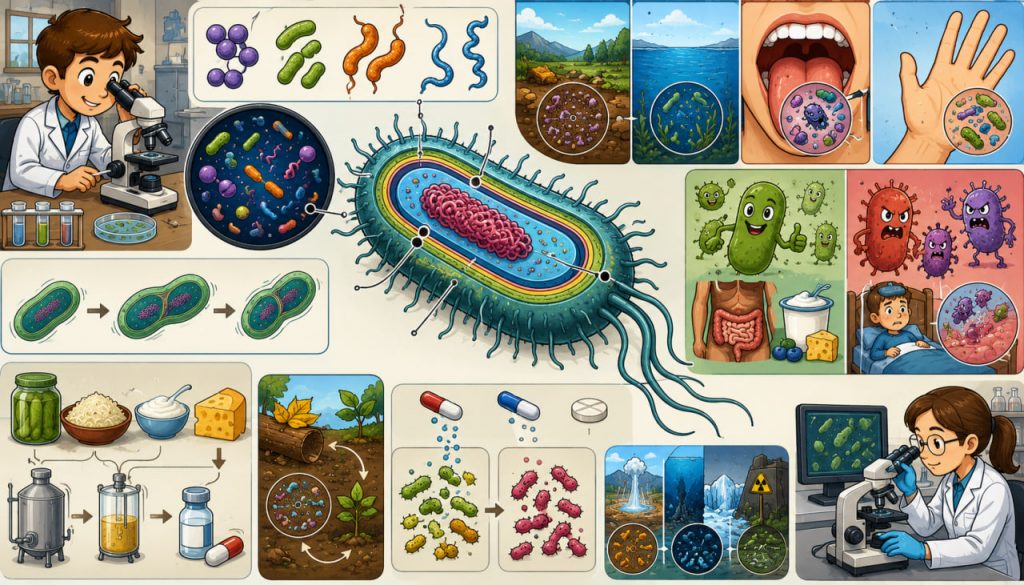
Bacteria are among the oldest and most successful life forms on Earth. Although invisible to the naked eye, these microscopic organisms exist:
- In the air
- In water
- In soil
- On human skin
- Inside the human body
In fact, humans live surrounded by trillions of bacteria every day.
Many people associate bacteria only with:
- Disease
- Dirt
- Infection
But the truth is far more complicated.
Some bacteria are dangerous, yet many are:
- Essential for life
- Helpful for digestion
- Important for ecosystems
- Used in food production
- Necessary for medicine and biotechnology
Without bacteria:
- Human civilization and even complex life itself might not exist.
Scientists study bacteria because they influence:
- Health
- Evolution
- Climate
- Agriculture
- Food production
- Medicine
Understanding bacteria reveals an invisible world that constantly shapes life on Earth.
What Are Bacteria?
Bacteria are:
- Single-celled microorganisms
They belong to some of the simplest known forms of life.
Unlike human cells, bacterial cells do not contain:
- A nucleus
Their genetic material floats freely inside the cell.
Bacteria are incredibly small:
- Thousands may fit on the tip of a needle.
Yet despite their size, bacteria possess remarkable survival abilities.
Bacteria Are Ancient Organisms
Scientists believe bacteria appeared roughly:
- 3.5 to 4 billion years ago
making them among Earth’s earliest life forms.
For most of Earth’s history:
- Bacteria dominated the planet.
Long before:
- Dinosaurs
- Plants
- Humans
bacteria already existed in oceans and ancient ecosystems.
Some scientists believe bacteria helped transform Earth’s atmosphere by producing:
- Oxygen
through early photosynthesis.
Not All Bacteria Are Dangerous
One of the biggest misconceptions is that:
- All bacteria are harmful.
In reality:
- Most bacteria are harmless or beneficial.
Only a relatively small number cause:
- Human disease
Beneficial bacteria help with:
- Digestion
- Vitamin production
- Immune system regulation
- Food fermentation
Humans actually depend heavily on:
- Symbiotic bacteria
living inside the body.
The Human Microbiome
The human body contains enormous bacterial communities called:
- The microbiome
These microorganisms live mainly inside:
- The intestines
- Mouth
- Skin
Scientists discovered gut bacteria strongly influence:
- Digestion
- Immunity
- Metabolism
- Possibly even mood and brain function
Modern microbiome research became one of the fastest-growing fields in biology.
How Bacteria Reproduce
Bacteria reproduce mainly through:
- Binary fission
meaning one bacterium splits into:
- Two identical cells
Some bacteria can reproduce extremely quickly under favorable conditions.
This rapid reproduction helps bacteria:
- Adapt rapidly
- Evolve quickly
- Spread efficiently
It also explains why bacterial populations may grow explosively.
Why Bacteria Evolve So Fast
Because bacteria reproduce rapidly:
- Mutations appear frequently.
Some mutations help bacteria survive:
- Antibiotics
- Environmental stress
- Heat
- Chemicals
This rapid evolution explains phenomena such as:
- Antibiotic resistance
where bacteria become harder to kill with medicine.
Dangerous Bacteria and Disease
Some bacteria can cause serious illnesses including:
- Tuberculosis
- Cholera
- Pneumonia
- Food poisoning
- Sepsis
Disease-causing bacteria are called:
- Pathogenic bacteria
These organisms may produce:
- Toxins
- Tissue damage
- Dangerous immune responses
Modern medicine uses:
- Antibiotics
to fight bacterial infections.
Bacteria Help Make Food
Humans intentionally use bacteria in many foods including:
- Yogurt
- Cheese
- Sauerkraut
- Kimchi
- Pickles
Fermentation bacteria help:
- Preserve food
- Produce flavor
- Create acids
Without bacteria, many traditional foods would not exist.
Bacteria and the Environment
Bacteria play enormous ecological roles involving:
- Nutrient recycling
- Decomposition
- Soil fertility
- Carbon cycles
Dead plants and animals are often broken down partly by:
- Bacterial activity
Without decomposing bacteria:
- Organic waste would accumulate massively on Earth.
Some Bacteria Survive Extreme Conditions
Scientists discovered bacteria living in:
- Hot springs
- Deep oceans
- Acidic lakes
- Arctic ice
- Radioactive environments
These extreme organisms are called:
- Extremophiles
Their survival abilities amaze scientists and may even help researchers study:
- Possible extraterrestrial life.
Bacteria and Medicine
Modern medicine relies heavily on bacteria research.
Scientists use bacteria for:
- Biotechnology
- Vaccine production
- Genetic engineering
- Insulin manufacturing
Some bacteria even help produce:
- Medicines
- Industrial chemicals
- Biofuels
Tiny microorganisms became essential tools for:
- Modern science and industry.
Antibiotic Resistance Became a Global Threat
One major modern concern is:
- Antibiotic resistance
Overuse of antibiotics allows some bacteria to evolve survival mechanisms.
This creates:
- Superbugs
that resist multiple medicines.
Microbiologist Alexander Fleming warned:
“The thoughtless person playing with penicillin treatment is morally responsible for the death of the man who succumbs to the resistant organism.”
Today scientists continue fighting resistant bacterial strains globally.
Bacteria and Human Evolution
Humans evolved alongside bacteria for millions of years.
The relationship between:
- Humans and microbes
is extremely complex.
Some scientists believe bacterial interactions influenced:
- Immune system evolution
- Digestion
- Brain chemistry
Life on Earth evolved not in isolation, but through constant interaction between:
- Organisms
- Microorganisms
- Ecosystems
Why Cleanliness Matters
Although many bacteria are harmless, proper hygiene remains important because dangerous bacteria may spread through:
- Food
- Water
- Surfaces
- Human contact
Practices such as:
- Hand washing
- Safe cooking
- Clean water systems
dramatically reduced deadly infections throughout history.
Scientists Continue Discovering New Bacteria
Researchers continue finding:
- Previously unknown bacterial species
in environments around the world.
Scientists estimate humanity has identified only a fraction of all bacterial diversity existing on Earth.
The microscopic world remains largely:
- Unexplored.
Why Bacteria Matter So Much
Despite their tiny size, bacteria influence nearly every part of:
- Life
- Ecology
- Human health
- Evolution
- Industry
They can:
- Cause disease
- Save lives
- Produce food
- Recycle nutrients
- Shape ecosystems
Bacteria remind humanity that some of the most powerful forces on Earth are completely invisible to the naked eye.
Understanding bacteria helps humans better understand:
- Nature
- Medicine
- Evolution
- The hidden complexity of life itself.
Interesting Facts
- Bacteria existed billions of years before humans appeared.
- The human body contains trillions of bacteria.
- Some bacteria survive extreme heat and radiation.
- Fermented foods depend on bacterial activity.
- Most bacteria are harmless or beneficial.
Glossary
- Microorganism — Tiny living organism visible only under magnification.
- Microbiome — Community of microorganisms living in a specific environment.
- Pathogenic — Capable of causing disease.
- Binary Fission — Simple bacterial cell division process.
- Antibiotic Resistance — Ability of bacteria to survive antibiotic treatment.