Antibiotics are among the greatest medical discoveries in human history. Since the discovery of:
- Penicillin
millions of lives have been saved from:
- Pneumonia
- Wound infections
- Tuberculosis
- Sepsis
- Dangerous bacterial diseases
Before antibiotics, even small infections could become:
- Deadly
However, modern medicine now faces a growing global crisis known as:
- Antibiotic resistance
This happens when bacteria evolve the ability to:
- Survive antibiotic treatment
As resistant bacteria spread, some infections become increasingly:
- Difficult
or even: - Impossible to treat
Scientists warn that antibiotic resistance may eventually threaten:
- Modern surgery
- Cancer treatment
- Organ transplantation
- Intensive care medicine
because all of these rely heavily on effective infection control.
The rise of so-called:
- Superbugs
became one of the most serious public health concerns of the 21st century.
Understanding antibiotic resistance reveals how:
- Evolution
- Medicine
- Human behavior
- Microbiology
interact in ways that directly affect global survival.
What Are Antibiotics?
Antibiotics are:
- Medicines designed to kill bacteria or stop their growth.
They work against:
- Bacterial infections
but do not treat:
- Viruses
such as:
- Influenza
- Common colds
- Most sore throats
Different antibiotics target bacteria using various mechanisms involving:
- Cell walls
- Protein production
- DNA replication
- Metabolism
How Antibiotic Resistance Happens
Bacteria reproduce extremely quickly.
During reproduction:
- Random genetic mutations may appear.
Sometimes these mutations help bacteria survive:
- Antibiotic exposure
When antibiotics kill weaker bacteria, resistant bacteria remain alive and continue multiplying.
This process is an example of:
- Natural selection
the same evolutionary principle described by Charles Darwin.
Over time:
- Resistant strains become more common.
Why Overuse of Antibiotics Is Dangerous
One of the largest causes of antibiotic resistance is:
- Antibiotic overuse
Antibiotics are often:
- Prescribed unnecessarily
- Used incorrectly
- Stopped too early
Some people take antibiotics for:
- Viral illnesses
where antibiotics provide no benefit.
Each unnecessary exposure gives bacteria more opportunities to:
- Adapt
- Evolve resistance
The World Health Organization considers misuse of antibiotics a major global threat.
Agriculture Also Contributes
Antibiotics are widely used in:
- Livestock farming
sometimes not only for treating disease but also for:
- Growth promotion
- Infection prevention in crowded conditions
This widespread exposure may encourage resistant bacteria to develop inside:
- Farm animals
- Food systems
- Environmental ecosystems
Resistant bacteria may later spread to humans.
What Are Superbugs?
The term:
- Superbug
refers to bacteria resistant to multiple antibiotics.
Examples include:
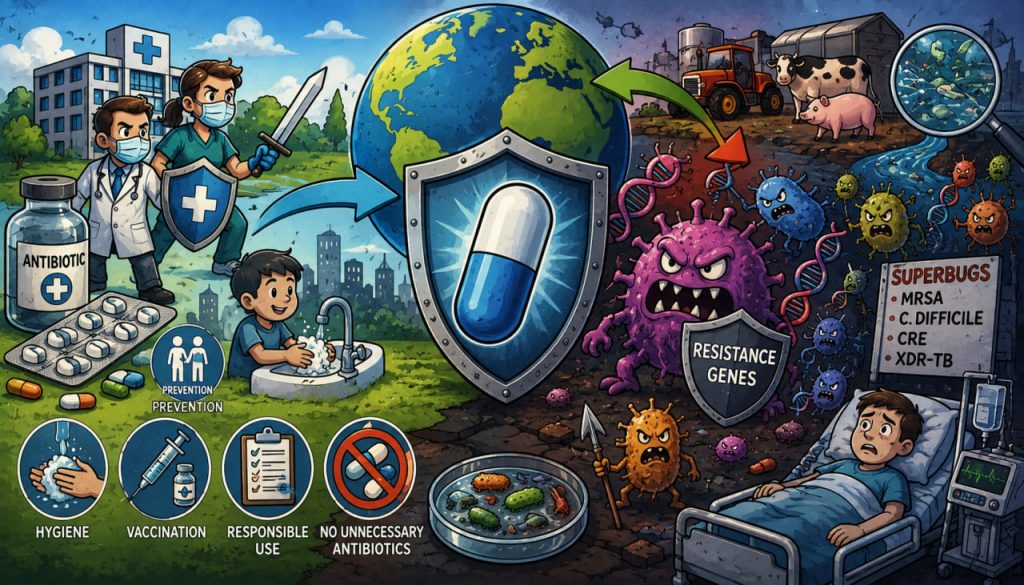
- MRSA
- Drug-resistant tuberculosis
- Carbapenem-resistant bacteria
Some infections now resist:
- Nearly all available antibiotics
This creates extremely dangerous medical situations.
Why Antibiotic Resistance Is So Serious
Modern medicine depends heavily on:
- Effective antibiotics
Without them, many medical procedures become far riskier.
These include:
- Surgery
- Childbirth
- Chemotherapy
- Organ transplantation
- Intensive care treatment
Even routine infections could once again become:
- Potentially fatal
if resistance continues increasing globally.
Hospitals Are High-Risk Environments
Hospitals often contain:
- Vulnerable patients
- Frequent antibiotic use
- High bacterial exposure
This creates ideal conditions for resistant bacteria to:
- Spread rapidly
Healthcare-associated infections remain a major concern worldwide.
Strict hygiene and infection-control systems are critically important.
Bacteria Exchange Resistance Genes
One frightening feature of bacteria is their ability to:
- Share genetic material
Some bacteria transfer resistance genes directly to:
- Other bacteria
This means resistance may spread rapidly between different bacterial species.
Microbiologists consider this one of the biggest challenges in controlling:
- Superbugs.
Why New Antibiotics Are Hard to Develop
Creating new antibiotics is:
- Difficult
- Expensive
- Time-consuming
Bacteria may evolve resistance faster than scientists develop:
- Replacement drugs
Pharmaceutical companies also face economic challenges because antibiotics are typically used:
- Short-term
rather than continuously.
As a result:
- Fewer new antibiotics are entering development.
Evolution Happens Extremely Fast in Bacteria
Bacteria evolve rapidly because they:
- Reproduce quickly
- Exist in enormous numbers
A single bacterial population may contain:
- Billions of organisms
This creates countless opportunities for:
- Mutation
- Adaptation
- Evolutionary selection
Antibiotic resistance demonstrates evolution occurring in:
- Real time.
Climate Change and Resistance
Scientists increasingly study connections between:
- Climate change
- Antibiotic resistance
Warmer temperatures may influence:
- Bacterial growth
- Disease spread
- Environmental contamination
Global travel and urbanization also help resistant bacteria spread internationally.
Expert Warning About the Future
Microbiologist Alexander Fleming, who discovered penicillin, warned early about resistance risks.
He stated:
“The thoughtless person playing with penicillin treatment is morally responsible for the death of the man who succumbs to infection with the penicillin-resistant organism.”
His warning became increasingly relevant over time.
How Doctors Try to Prevent Resistance
Modern healthcare systems attempt to reduce resistance through:
- Responsible prescribing
- Infection prevention
- Vaccination
- Hygiene protocols
- Antibiotic stewardship programs
Doctors increasingly avoid prescribing antibiotics unless:
- Clearly necessary
This helps reduce unnecessary evolutionary pressure on bacteria.
Why Vaccines Also Help
Vaccines indirectly reduce antibiotic resistance because they:
- Prevent infections before they occur
Fewer infections mean:
- Less antibiotic use
which reduces opportunities for bacteria to evolve resistance.
Public health measures therefore play important roles in:
- Fighting superbugs.
Personal Actions Matter
Individuals can help reduce resistance by:
- Taking antibiotics exactly as prescribed
- Avoiding self-medication
- Not demanding antibiotics unnecessarily
- Completing treatment properly
- Practicing hygiene
Small individual behaviors collectively influence:
- Global bacterial evolution.
Could Humanity Enter a Post-Antibiotic Era?
Some scientists warn about a possible:
- Post-antibiotic era
where common infections become difficult to treat again.
This would dramatically affect:
- Life expectancy
- Surgery safety
- Emergency medicine
- Childbirth survival
The future depends heavily on:
- Scientific innovation
- Responsible antibiotic use
- Global cooperation.
Why Antibiotic Resistance Matters to Everyone
Antibiotic resistance is not only a hospital problem.
It affects:
- Global health
- Food systems
- Travel
- Economics
- Modern medicine itself
The crisis demonstrates how human actions influence:
- Evolutionary biology
- Ecosystems
- Public health
Understanding antibiotic resistance reminds humanity that even tiny microorganisms can challenge some of civilization’s greatest medical achievements.
Interesting Facts
- Antibiotic resistance is driven by natural selection.
- Some bacteria can exchange resistance genes directly.
- Penicillin was discovered accidentally by Alexander Fleming.
- Antibiotics do not work against viruses.
- Resistant bacteria are sometimes called “superbugs.”
Glossary
- Antibiotic — Medicine used to treat bacterial infections.
- Antibiotic Resistance — Ability of bacteria to survive antibiotic treatment.
- Superbug — Bacteria resistant to multiple antibiotics.
- Mutation — Random genetic change in organisms.
- Natural Selection — Evolutionary process favoring traits improving survival.