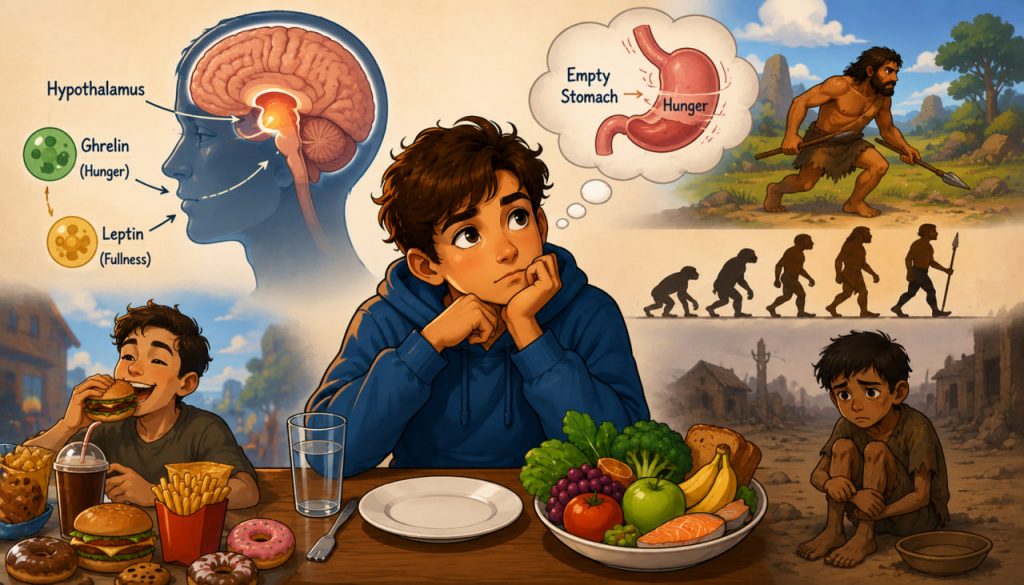
Hunger is one of the most fundamental biological sensations experienced by humans and animals. It is far more than simply:
- “Wanting to eat”
Hunger is a complex survival mechanism controlled by:
- The brain
- Hormones
- Metabolism
- Energy balance
- Evolutionary biology
Without hunger, living organisms would not consistently search for:
- Food
- Nutrients
- Energy
and survival would become impossible.
At the same time, hunger also exists as one of humanity’s greatest global challenges. Millions of people worldwide experience:
- Malnutrition
- Food insecurity
- Starvation
despite modern technological progress.
Scientists study hunger not only to understand:
- Human biology
but also: - Obesity
- Eating disorders
- Metabolism
- Brain chemistry
- Public health
Understanding hunger reveals how deeply food is connected to:
- Survival
- Emotions
- Evolution
- Society
- Human civilization itself.
What Is Hunger?
Hunger is the body’s biological signal indicating:
- Need for energy and nutrients
The sensation involves communication between:
- The stomach
- Hormones
- Blood sugar systems
- The brain
When energy levels decrease, the body activates mechanisms encouraging:
- Food-seeking behavior
Hunger evolved because organisms that successfully searched for food were more likely to:
- Survive
- Reproduce
- Pass on genes
This made hunger one of evolution’s most important survival systems.
The Brain Controls Hunger
The primary control center for hunger is located in:
- The hypothalamus
inside the brain.
The hypothalamus receives signals about:
- Energy reserves
- Blood glucose
- Fat storage
- Hormonal activity
and helps regulate:
- Appetite
- Satiety
- Metabolism
The brain constantly monitors whether the body needs:
- More energy
or: - Less food intake
Hormones Behind Hunger
Several important hormones influence hunger.
One major hormone is:
- Ghrelin
often called:
- “The hunger hormone”
Ghrelin levels increase before meals and stimulate appetite.
Another important hormone is:
- Leptin
which helps signal:
- Fullness
- Energy storage levels
These hormonal systems work together to maintain:
- Energy balance
inside the body.
Why Humans Feel Hungry
The body requires constant energy to support:
- Brain activity
- Organ function
- Movement
- Temperature regulation
- Cell repair
Even during sleep:
- The body continues consuming energy.
Without food:
- Blood sugar decreases
- Energy reserves become depleted
- Metabolism changes
The sensation of hunger encourages food consumption before severe damage occurs.
What Happens During Starvation?
When food becomes unavailable for extended periods:
- The body enters survival mode.
Initially the body uses:
- Stored glucose
- Glycogen reserves
Later it begins breaking down:
- Fat tissue
- Muscle tissue
to maintain energy supply.
Prolonged starvation may damage:
- Organs
- Immune systems
- Hormonal systems
- Brain function
Severe starvation eventually becomes life-threatening.
Hunger and Evolution
Humans evolved in environments where food was often:
- Unpredictable
- Scarce
- Seasonal
As a result, the human brain evolved strong motivations involving:
- High-calorie foods
- Sugar
- Fat
- Energy conservation
These ancient survival instincts still influence modern eating behavior today.
Evolution prepared humans for:
- Food scarcity
not for constant food abundance.
Why Hunger Feels Emotional
Hunger affects not only the body but also:
- Mood
- Concentration
- Emotional stability
Low blood sugar and energy availability may increase:
- Irritability
- Fatigue
- Anxiety
- Difficulty focusing
The brain strongly prioritizes food access because survival depends on it.
This is why extreme hunger may dominate:
- Attention
- Decision-making
- Emotional behavior
Psychological Hunger vs Physical Hunger
Scientists distinguish between:
- Physical hunger
and: - Psychological appetite
Physical hunger develops from:
- Biological energy needs
Psychological eating may involve:
- Stress
- Emotions
- Habits
- Social situations
- Reward systems
Modern food industries often exploit these reward pathways using highly processed foods designed to stimulate:
- Cravings
- Dopamine responses
- Repeated consumption
Hunger and Modern Society
Ironically, modern societies experience both:
- Obesity
and: - Malnutrition
simultaneously.
Some populations face:
- Excess calories but poor nutrition
while others suffer:
- Severe food shortages
Global hunger remains connected to:
- Poverty
- War
- Climate change
- Economic inequality
- Agricultural instability
According to the United Nations:
- Hundreds of millions of people still experience chronic hunger worldwide.
The Science of Satiety
After eating, the body activates:
- Satiety mechanisms
Signals from:
- The stomach
- Intestines
- Hormones
- Blood chemistry
inform the brain that energy needs are being met.
However, modern highly processed foods may disrupt natural satiety systems because they are engineered for:
- Hyper-palatability
- Rapid consumption
- Reward stimulation
This may contribute to overeating.
Hunger and the Gut Microbiome
Scientists increasingly study how:
- Gut bacteria
may influence hunger and metabolism.
The human digestive system contains trillions of microorganisms that may affect:
- Appetite
- Digestion
- Cravings
- Nutrient absorption
Research in this area remains active and complex.
Fasting and Human Biology
Humans can survive limited periods without food because the body evolved:
- Energy storage systems
Controlled fasting may trigger metabolic changes involving:
- Fat burning
- Ketone production
- Hormonal adaptation
However, extreme fasting or starvation can become dangerous quickly without proper medical supervision.
The body requires:
- Vitamins
- Minerals
- Protein
- Essential nutrients
for long-term health.
Hunger in History
Throughout history, famine shaped:
- Civilizations
- Migration
- Wars
- Political systems
Crop failures and food shortages historically caused:
- Massive mortality
- Social collapse
- Economic crises
Modern agriculture dramatically improved food production, but hunger still remains a major global challenge.
Why Food Is Deeply Emotional
Food became strongly connected to:
- Culture
- Family
- Identity
- Celebration
- Survival
This is why hunger affects humans psychologically as well as physically.
Sharing meals helped strengthen:
- Social bonds
- Cooperation
- Community survival
throughout human evolution.
Why Scientists Study Hunger
Understanding hunger helps researchers study:
- Obesity
- Diabetes
- Eating disorders
- Metabolism
- Public health
Scientists continue exploring how:
- Brain systems
- Hormones
- Genetics
- Environment
shape human eating behavior.
Modern research increasingly shows hunger is far more complicated than:
- Simple willpower.
Why Hunger Matters
Hunger is one of the oldest and most powerful biological forces on Earth.
It shaped:
- Human evolution
- Civilization
- Agriculture
- Social systems
- Modern medicine
Without hunger:
- Humans would not survive.
Yet uncontrolled hunger, malnutrition, and food inequality continue affecting millions worldwide.
Understanding hunger scientifically helps humanity better understand:
- The body
- The brain
- Evolution
- Society
- Survival itself.
Interesting Facts
- The brain uses large amounts of the body’s energy even at rest.
- Ghrelin is often called the “hunger hormone.”
- Humans evolved strong cravings for calorie-dense foods.
- Severe starvation may shrink muscle and organ tissue.
- Hunger affects emotions and decision-making.
Glossary
- Hypothalamus — Brain region regulating hunger and energy balance.
- Ghrelin — Hormone stimulating appetite.
- Leptin — Hormone associated with fullness and fat storage signals.
- Metabolism — Chemical processes converting food into energy.
- Malnutrition — Lack of proper nutrients needed for health.