The human brain is often described as:
- The most complex known object in the universe
Inside a structure weighing roughly:
- 1.3–1.4 kilograms
exists the system responsible for:
- Thought
- Memory
- Emotions
- Consciousness
- Language
- Creativity
- Decision-making
- Human civilization itself
The brain allows humans to:
- Build cities
- Explore space
- Create mathematics
- Compose music
- Develop artificial intelligence
Yet scientists still do not fully understand how the brain produces:
- Conscious experience
- Self-awareness
- Imagination
Modern neuroscience continues discovering astonishing details about the incredible complexity hidden inside the human nervous system.
Understanding how the brain works reveals one of the greatest scientific challenges humanity has ever faced.
The Brain Contains Billions of Neurons
The brain is built from specialized cells called:
- Neurons
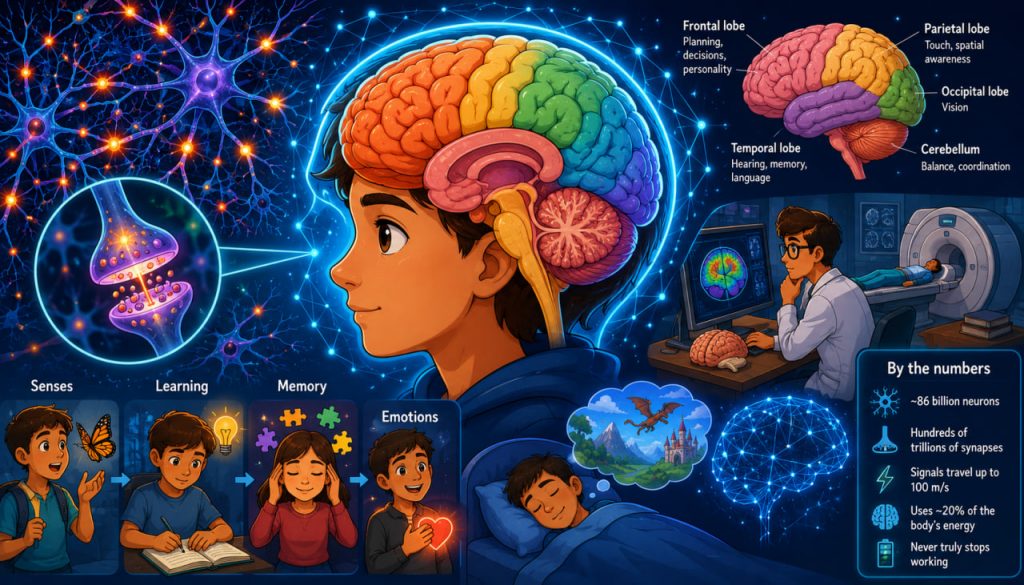
Scientists estimate the human brain contains roughly:
- 86 billion neurons
Each neuron may form thousands of connections with other neurons.
These connections are called:
- Synapses
Altogether, the brain may contain:
- Hundreds of trillions of synaptic connections
forming one of the densest information-processing systems known.
How Neurons Communicate
Neurons communicate using:
- Electrical signals
- Chemical neurotransmitters
Information travels through neural networks at remarkable speeds.
Some signals move over:
- 100 meters per second
This constant electrical activity allows the brain to:
- Process sensory information
- Control movement
- Form memories
- Generate thoughts
every second of life.
The Brain Never Truly Rests
Even during sleep:
- The brain remains highly active.
It continues regulating:
- Breathing
- Heart rate
- Memory consolidation
- Hormonal systems
- Dream activity
Neuroscientists discovered the brain constantly consumes energy even when humans appear inactive.
The human brain represents only about:
- 2% of body weight
yet consumes roughly:
- 20% of the body’s energy.
Different Brain Regions Perform Different Tasks
The brain contains specialized regions involved in different functions.
Examples include:
- Frontal lobe — planning and decision-making
- Occipital lobe — visual processing
- Temporal lobe — hearing and memory
- Cerebellum — coordination and balance
However, modern neuroscience shows the brain works mainly through:
- Interconnected networks
rather than isolated compartments.
Most complex behaviors require many regions cooperating simultaneously.
Memory Is Incredibly Complex
Human memory is not like a simple computer hard drive.
Memories involve:
- Dynamic neural patterns
- Reinforcement
- Reconstruction
- Emotional associations
The brain continuously:
- Modifies
- Strengthens
- Weakens
- Reorganizes
memory connections over time.
Neuroscientist Eric Kandel explained:
“Memory is the glue that binds our mental life together.”
Without memory:
- Identity itself becomes unstable.
The Brain Changes Throughout Life
One remarkable feature of the brain is:
- Neuroplasticity
This means the brain can:
- Adapt
- Reorganize
- Learn new patterns
throughout life.
Neural connections strengthen with:
- Practice
- Learning
- Experience
The brain physically changes in response to:
- Habits
- Education
- Environment
- Trauma
This flexibility helps humans adapt to changing conditions.
Consciousness Remains a Mystery
Despite enormous scientific progress, one major question remains unresolved:
- How does consciousness emerge?
Scientists still debate how electrical activity inside neurons creates:
- Subjective awareness
- Emotions
- Thoughts
- Inner experiences
This problem is sometimes called:
- The hard problem of consciousness
The brain not only processes information — it somehow produces:
- Human experience itself.
The Brain Processes Massive Amounts of Information
Every second, the brain receives enormous sensory input involving:
- Vision
- Hearing
- Touch
- Smell
- Body position
- Internal organs
Most of this information is processed:
- Automatically
without conscious awareness.
The brain constantly filters and prioritizes data to prevent:
- Sensory overload
Emotions and Logic Are Connected
Older theories sometimes separated:
- Emotion
from: - Rational thinking
Modern neuroscience shows these systems are deeply interconnected.
Emotions influence:
- Decisions
- Attention
- Memory
- Motivation
Patients with emotional-processing damage often struggle with:
- Decision-making itself
demonstrating emotion is essential for intelligent behavior.
The Brain and Artificial Intelligence
Modern AI systems were partly inspired by:
- Neural networks
However, artificial neural networks remain vastly simpler than the human brain.
Even advanced AI lacks many human abilities involving:
- General reasoning
- Emotional understanding
- Consciousness
- Flexible learning
Computer scientist Geoffrey Hinton noted:
“The brain is still the best model we have for intelligence.”
Scientists continue studying biological brains to improve:
- Artificial intelligence research.
Why the Brain Uses So Much Energy
The brain requires enormous energy because neurons constantly maintain:
- Electrical gradients
- Communication signals
- Synaptic activity
Even small disruptions in oxygen or glucose supply may quickly affect:
- Consciousness
- Thinking
- Coordination
This demonstrates how metabolically demanding neural activity truly is.
Dreams and the Sleeping Brain
During sleep, the brain generates:
- Dreams
- Memory processing
- Emotional regulation
Scientists still debate exactly why dreams exist.
Some theories suggest dreams help:
- Process emotions
- Simulate threats
- Consolidate memories
The sleeping brain often remains highly active despite physical rest.
The Human Brain and Evolution
The human brain evolved gradually over millions of years.
Compared to many animals, humans developed:
- Larger cerebral cortex regions
- Advanced language systems
- Abstract reasoning abilities
These changes helped humans develop:
- Culture
- Technology
- Science
- Complex societies
The brain became humanity’s most powerful evolutionary adaptation.
Can Humans Fully Understand the Brain?
One fascinating philosophical question asks:
- Can the brain completely understand itself?
The human brain studies:
- Its own structure
- Its own consciousness
- Its own thinking processes
This creates one of science’s deepest intellectual challenges.
Even today, many neuroscientists believe humanity still understands only part of:
- How the brain truly works.
Brain Disorders Reveal Its Complexity
Conditions such as:
- Alzheimer’s disease
- Epilepsy
- Depression
- Schizophrenia
- Parkinson’s disease
demonstrate how delicate brain systems are.
Small neural disruptions may dramatically affect:
- Personality
- Memory
- Movement
- Perception
Studying these disorders helps scientists better understand normal brain function.
Why the Brain Is So Extraordinary
The human brain created:
- Language
- Mathematics
- Music
- Art
- Philosophy
- Civilization
It allows humans to:
- Imagine the future
- Reflect on the past
- Explore the universe
- Study existence itself
No known technology matches the brain’s flexibility, creativity, and adaptability fully.
Why Brain Research Matters
Understanding the brain may help humanity improve:
- Medicine
- Mental health treatment
- Artificial intelligence
- Education
- Human well-being
Neuroscience continues advancing rapidly through:
- Brain imaging
- Genetics
- Computational models
- Cognitive science
Yet the brain remains one of the greatest scientific mysteries ever studied.
The organ humans use to understand reality may itself be the most complicated structure humans have ever encountered.
Interesting Facts
- The brain contains roughly 86 billion neurons.
- Human brains consume about 20% of the body’s energy.
- Neural signals may travel over 100 meters per second.
- The brain continues working actively during sleep.
- Scientists still do not fully understand consciousness.
Glossary
- Neuron — Specialized brain cell transmitting information.
- Synapse — Connection point between neurons.
- Neuroplasticity — The brain’s ability to reorganize and adapt.
- Consciousness — Subjective awareness and experience.
- Cerebral Cortex — Outer brain layer involved in higher thinking functions.