Color surrounds human life everywhere. People encounter colors constantly in:
- Advertising
- Packaging
- Clothing
- Websites
- Supermarkets
- Restaurants
- Brand logos
Most people believe they choose products rationally based mainly on:
- Price
- Quality
- Functionality
However, psychology and marketing research show that visual perception strongly influences human behavior — often subconsciously.
One of the most powerful visual influences is:
- Color psychology
Different colors may affect:
- Emotions
- Attention
- Trust
- Appetite
- Urgency
- Luxury perception
- Decision-making
Businesses worldwide invest enormous resources into color design because shades and tones can significantly influence:
- Consumer emotions
- Brand identity
- Purchasing behavior
The psychology of color combines:
- Neuroscience
- Marketing
- Human evolution
- Cultural associations
- Visual perception
Understanding how color affects the brain reveals why modern advertising and product design are carefully engineered far beyond simple aesthetics.
What Is Color Psychology?
Color psychology studies how colors influence:
- Human emotions
- Behavior
- Perception
- Decision-making
Human brains process visual information extremely quickly.
Before people consciously analyze a product, the brain already reacts emotionally to:
- Shape
- Brightness
- Contrast
- Color
Colors may create subconscious impressions involving:
- Excitement
- Calmness
- Trust
- Hunger
- Energy
- Luxury
- Safety
This is why companies carefully select color palettes for branding and advertising.
Why the Human Brain Reacts to Colors
Human color perception evolved partly through survival mechanisms.
Certain colors historically signaled:
- Danger
- Food
- Water
- Poison
- Fire
- Safety
For example:
- Red may attract attention because it resembles blood, warning signals, or ripe fruit.
- Green often connects psychologically to nature and safety.
- Blue frequently feels calm because it resembles sky and water.
These ancient associations continue influencing modern human psychology.
Red: Urgency, Energy, and Attention
Red is one of the most emotionally intense colors.
It often creates associations involving:
- Excitement
- Passion
- Energy
- Urgency
In marketing, red may stimulate:
- Faster decisions
- Appetite
- Attention
This is one reason many fast-food brands heavily use red tones.
Red may also increase physiological arousal slightly by raising:
- Heart rate
- Attention levels
However, excessive red may also feel:
- Aggressive
- Stressful
- Overstimulating
Blue: Trust and Stability
Blue is one of the most widely used corporate colors worldwide.
It is commonly associated with:
- Trust
- Calmness
- Stability
- Professionalism
- Security
Banks, technology companies, and healthcare brands frequently use blue branding because it creates feelings of:
- Reliability
- Safety
- Logic
Psychologist Angela Wright explained:
“Color affects people emotionally before they become consciously aware of it.”
Blue often produces calming psychological responses in many individuals.
Green: Nature and Health
Green strongly connects to:
- Nature
- Freshness
- Growth
- Health
Brands promoting:
- Organic food
- Environmental sustainability
- Wellness
frequently use green tones.
Green may create perceptions of:
- Balance
- Natural quality
- Relaxation
This color became especially important in modern eco-friendly marketing.
Yellow and Orange: Optimism and Energy
Yellow and orange are often associated with:
- Warmth
- Optimism
- Energy
- Happiness
These colors may attract attention quickly because they are visually bright.
Retailers often use yellow or orange for:
- Discounts
- Promotions
- Sales signs
because these shades may stimulate impulsive purchasing behavior.
However, excessive bright yellow may sometimes increase visual fatigue.
Black and Luxury Branding
Black frequently symbolizes:
- Luxury
- Elegance
- Power
- Sophistication
Luxury fashion and premium product brands often use black packaging and minimalist design.
Black may psychologically increase perceptions of:
- Exclusivity
- Prestige
- Higher value
Simple dark packaging often appears more expensive to consumers.
White and Minimalism
White commonly represents:
- Simplicity
- Cleanliness
- Modernity
- Purity
Technology companies often use white spaces in product design because it creates feelings of:
- Precision
- Simplicity
- Clarity
Minimalist aesthetics became strongly connected to modern premium branding.
Color and Food Marketing
Food companies carefully select colors based on appetite psychology.
For example:
- Red and yellow may stimulate hunger.
- Blue is rarely used in natural foods because blue food is uncommon in nature.
Packaging colors may influence perceived:
- Taste
- Freshness
- Sweetness
- Healthiness
Interestingly, people sometimes rate identical products differently when packaging colors change.
Online Shopping and Digital Interfaces
Color psychology became extremely important in:
- Website design
- App interfaces
- Online advertising
Button colors may affect:
- Click rates
- User engagement
- Purchase behavior
E-commerce companies often test different color combinations scientifically to optimize sales.
This process is called:
- A/B testing
Small visual changes may significantly influence customer behavior.
Cultural Differences in Color Meaning
Color meanings are not universal everywhere.
Different cultures may associate colors with:
- Celebration
- Mourning
- Luck
- Danger
- Spirituality
For example:
- White symbolizes purity in some cultures but mourning in others.
- Red may symbolize luck or warning depending on cultural context.
Global companies therefore adapt branding strategies across regions.
Emotional Shopping and Impulse Purchases
Many purchasing decisions are:
- Emotional first
- Rational second
Colors help create emotional environments encouraging:
- Comfort
- Excitement
- Trust
- Urgency
Modern retail spaces carefully combine:
- Lighting
- Music
- Scent
- Color design
to shape consumer behavior subtly.
Neuroscience and Visual Processing
The human brain processes visual information extremely rapidly.
Color signals reach emotional brain regions before full conscious analysis occurs.
This means colors may influence impressions within:
- Milliseconds
Marketing experts increasingly combine:
- Neuroscience
- Behavioral psychology
- Design theory
to understand consumer reactions more deeply.
Why Color Psychology Matters
Color psychology demonstrates that human decisions are influenced by far more than logic alone.
Visual perception affects:
- Emotion
- Trust
- Attention
- Desire
- Consumer behavior
Understanding color influence helps explain why modern advertising and branding are carefully engineered psychological experiences rather than random artistic choices.
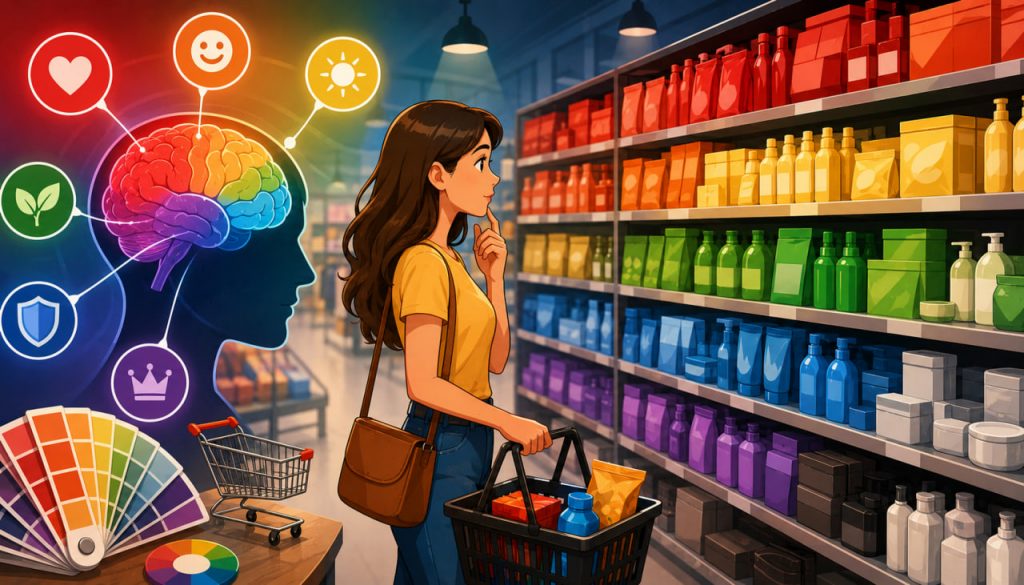
The next time someone chooses a product from a shelf, color may already have shaped the decision long before conscious reasoning begins.
Interesting Facts
- Human brains process visual information extremely quickly.
- Red and yellow are commonly used in fast-food branding.
- Luxury brands frequently use black minimalist packaging.
- Packaging color may influence perceived taste and quality.
- Different cultures may interpret colors differently.
Glossary
- Color Psychology — The study of how colors influence human emotions and behavior.
- Branding — Visual and emotional identity used by companies or products.
- Visual Perception — The brain’s interpretation of visual information.
- Minimalism — A design style emphasizing simplicity and clean aesthetics.
- A/B Testing — Comparing different design versions to measure consumer response.