Why do some paintings feel emotionally powerful while others leave people indifferent? Why can music create chills, architecture inspire awe, or colors instantly affect mood?
For centuries, philosophers and artists debated the nature of beauty and artistic experience. Today, modern neuroscience introduced a fascinating scientific field called:
- Neuroaesthetics
Neuroaesthetics studies how the brain perceives:
- Beauty
- Creativity
- Visual harmony
- Music
- Artistic emotion
- Aesthetic pleasure
Scientists discovered that art is not only a cultural phenomenon — it is also deeply connected to:
- Brain activity
- Emotional systems
- Pattern recognition
- Memory
- Reward mechanisms
Human brains constantly analyze artistic experiences through complex networks involving:
- Emotion
- Attention
- Imagination
- Sensory perception
Understanding how the brain responds to art reveals why creativity became such an important part of human civilization.
What Is Neuroaesthetics?
Neuroaesthetics is an interdisciplinary scientific field combining:
- Neuroscience
- Psychology
- Art theory
- Cognitive science
Researchers study how the brain reacts to:
- Paintings
- Music
- Sculpture
- Architecture
- Dance
- Literature
The goal is to understand:
- Why humans create art
- Why certain works feel beautiful
- How artistic experiences influence emotions and cognition
This field attempts to scientifically explore one of humanity’s most subjective experiences:
- Beauty itself
The Brain as a Pattern Detector
The human brain constantly searches for:
- Patterns
- Symmetry
- Contrast
- Meaning
Art often stimulates these natural cognitive tendencies.
Visual systems rapidly process:
- Shapes
- Color relationships
- Movement
- Composition
The brain tends to enjoy discovering order and structure within complexity.
This is one reason humans may find certain artistic compositions visually satisfying.
Why Humans Experience Beauty
Scientists still debate exactly what beauty is biologically.
However, research suggests aesthetic pleasure may involve:
- Reward systems
- Emotional processing
- Evolutionary preferences
Beautiful experiences often activate brain regions associated with:
- Pleasure
- Motivation
- Emotional value
Neuroscientist Semir Zeki, one of the founders of neuroaesthetics, explained:
“Artists are, in a sense, neurologists studying the brain through visual experience.”
This idea suggests art and neuroscience may explore similar aspects of human perception from different directions.
Art and Dopamine
Art may activate dopamine systems in the brain.
Dopamine is associated with:
- Reward
- Curiosity
- Motivation
- Emotional engagement
This explains why people sometimes feel:
- Excitement
- Wonder
- Emotional intensity
while experiencing music, paintings, or films.
The brain often rewards experiences perceived as meaningful or emotionally stimulating.
Color and Emotional Response
Colors strongly influence emotional perception.
Different colors may evoke feelings involving:
- Calmness
- Energy
- Warmth
- Tension
- Sadness
Artists intentionally use color psychology to shape emotional reactions.
For example:
- Blue tones often feel calm or reflective.
- Red may feel energetic or emotionally intense.
- Dark contrasts may create drama or mystery.
The brain processes color rapidly before conscious interpretation fully develops.
Symmetry, Balance, and Visual Harmony
The brain often prefers:
- Symmetry
- Balance
- Proportional structure
because these patterns are easier to process visually.
This may explain why many classical artworks use:
- Geometric balance
- Harmonious composition
- Repeating structures
However, complete perfection may sometimes feel emotionally cold or artificial.
Artists frequently combine:
- Order
- Imperfection
- Contrast
to create emotional complexity.
Music and the Emotional Brain
Music is one of the most powerful artistic experiences neurologically.
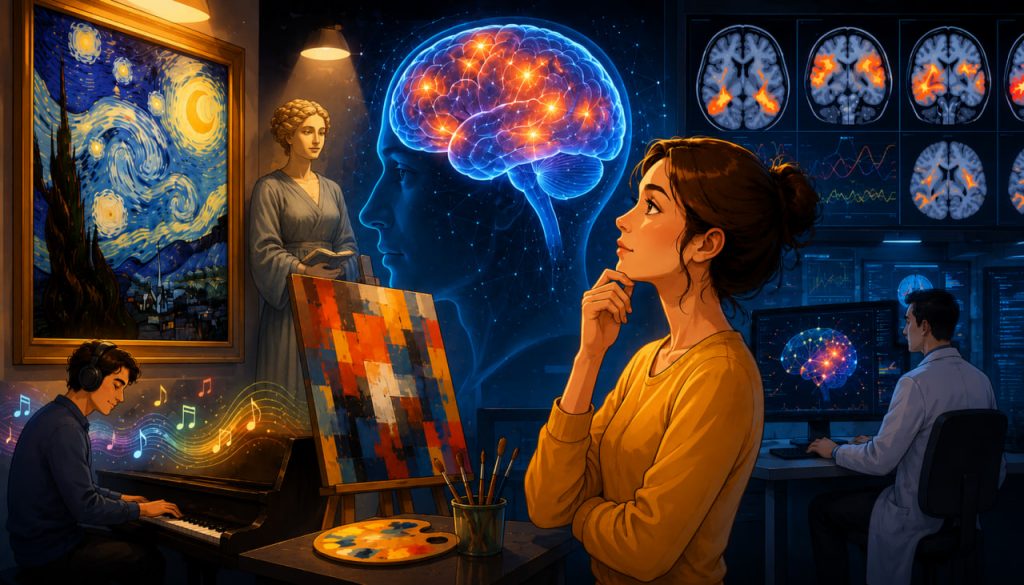
Brain imaging studies show music activates:
- Emotional centers
- Memory systems
- Motor regions
- Reward circuits
Music may trigger:
- Chills
- Tears
- Nostalgia
- Euphoria
Interestingly, the brain reacts emotionally to music even though music itself has no direct survival function.
Scientists continue studying why humans evolved such strong responses to sound patterns.
Art, Memory, and Personal Experience
Aesthetic reactions are not entirely universal.
Personal experiences strongly influence how individuals perceive art.
The brain connects artistic experiences with:
- Memories
- Emotions
- Cultural background
- Personality
This means two people may react very differently to the same artwork.
Art becomes emotionally meaningful partly because it interacts with individual life experiences.
The Role of Imagination
Art stimulates:
- Imagination
- Interpretation
- Symbolic thinking
Unlike simple factual information, art often allows multiple meanings.
The brain enjoys actively interpreting:
- Ambiguity
- Symbolism
- Hidden patterns
This cognitive participation helps make artistic experiences emotionally engaging.
Why Abstract Art Can Feel Powerful
Some people wonder why abstract art affects emotions despite lacking realistic representation.
Abstract art often emphasizes:
- Color
- Shape
- Texture
- Movement
- Emotional atmosphere
The brain may respond emotionally to visual energy and composition even without recognizable objects.
Art does not always require literal meaning to influence human perception.
Evolution and Creativity
Scientists believe creativity may have evolved because it supported:
- Social bonding
- Communication
- Cultural identity
- Innovation
Artistic expression became important for:
- Rituals
- Storytelling
- Group cooperation
Human creativity may therefore reflect both biological and social evolution.
Neuroaesthetics and Modern Technology
Modern neuroscience uses advanced tools such as:
- Brain imaging
- EEG monitoring
- AI analysis
to study aesthetic responses.
Researchers investigate how the brain reacts to:
- Digital art
- Virtual reality
- AI-generated images
- Interactive experiences
Technology increasingly changes how humans create and experience art.
Artificial Intelligence and Artistic Perception
AI can now generate:
- Paintings
- Music
- Visual design
This raises important questions:
- Can machines create true art?
- Does art require consciousness or emotion?
- How does the human brain distinguish human creativity from algorithmic production?
Neuroaesthetics may become increasingly important as artificial intelligence transforms creative industries.
Why Art Feels Human
Despite scientific analysis, art remains deeply emotional and personal.
The brain does not experience art merely as information.
Art influences:
- Emotion
- Identity
- Imagination
- Meaning
- Social connection
This is why humans continue creating paintings, music, stories, and architecture across every civilization in history.
Why Neuroaesthetics Matters
Neuroaesthetics reveals that beauty is not random.
The brain actively shapes artistic experience through:
- Perception
- Emotion
- Reward systems
- Memory
- Cognitive interpretation
Understanding how the brain evaluates art helps explain why creativity became such a powerful force in human evolution and culture.
Art is not separate from science — it is deeply connected to the biology of the human mind itself.
P.S. It’s interesting that when you look at icons painted by monks who truly aspired to God, you get a special feeling of the Divine presence that can’t be compared to even the best paintings. If you don’t believe me, take a closer look at the miraculous icons from Mount Athos, such as “Pantanassa”, and its photographs, and you’ll understand for yourself.
Interesting Facts
- Beautiful artworks may activate brain reward systems.
- Music can stimulate emotional and memory-related brain regions simultaneously.
- Humans often prefer balanced and symmetrical visual patterns.
- Personal memories strongly influence artistic interpretation.
- Neuroaesthetics combines neuroscience with art theory and psychology.
Glossary
- Neuroaesthetics — The scientific study of how the brain experiences beauty and art.
- Dopamine — A neurotransmitter associated with reward and pleasure.
- Cognition — Mental processes involved in thinking and perception.
- Abstract Art — Art emphasizing shapes, colors, and forms rather than realistic representation.
- Brain Imaging — Scientific techniques used to observe brain activity.