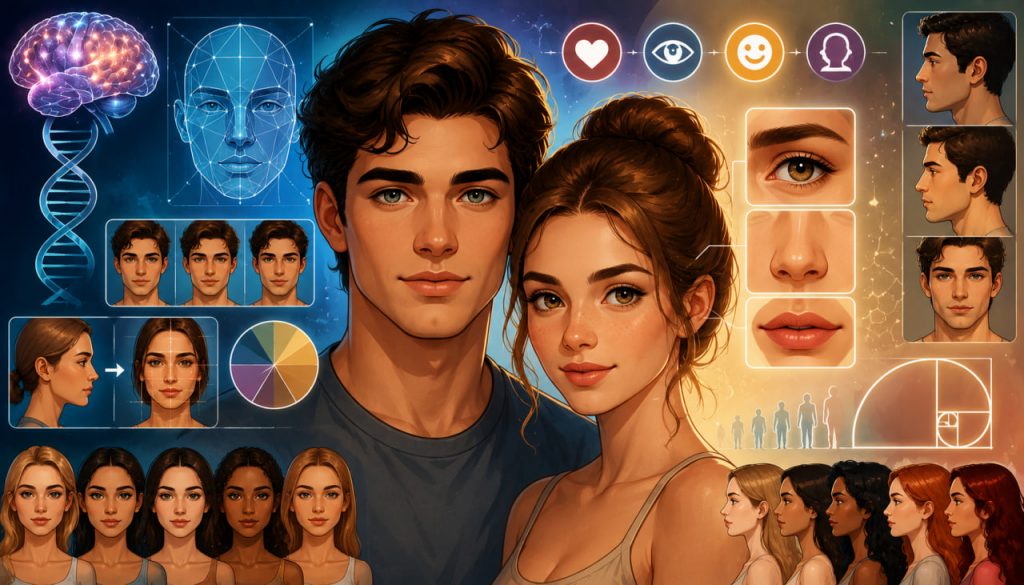
Human beauty has fascinated civilizations for thousands of years. Across cultures and historical eras, people consistently developed ideas about:
- Attractive faces
- Symmetry
- Skin quality
- Facial proportions
- Expressions
Although beauty is strongly influenced by culture, psychology, and personal preference, modern science suggests that certain facial characteristics may be widely perceived as attractive due to:
- Evolutionary biology
- Brain perception
- Health indicators
- Social psychology
Researchers studying attractiveness discovered that the human brain often evaluates faces extremely quickly — sometimes within milliseconds.
Interestingly, many beauty preferences appear connected to subconscious biological signals involving:
- Health
- Genetics
- Fertility
- Emotional communication
At the same time, beauty is far more complex than simple mathematics alone.
Understanding the science of facial attractiveness reveals how evolution, neuroscience, culture, and psychology interact in surprisingly sophisticated ways.
Why Humans Care About Faces
Humans are highly social beings.
The brain evolved specialized systems for:
- Face recognition
- Emotional interpretation
- Social communication
Faces provide enormous amounts of information involving:
- Emotion
- Age
- Health
- Identity
- Attention
- Social intent
The human brain processes faces so efficiently that people can recognize emotional expressions almost instantly.
Because faces became central to social interaction, attractiveness naturally gained evolutionary importance.
Facial Symmetry and Attractiveness
One of the most studied factors in beauty science is:
- Facial symmetry
Symmetry means the left and right sides of the face appear relatively balanced.
Researchers found that many people tend to perceive symmetrical faces as more attractive.
Why?
Scientists believe symmetry may subconsciously signal:
- Healthy development
- Genetic stability
- Lower disease stress during growth
Perfect symmetry does not exist naturally, but moderate balance often appears visually pleasing to the brain.
Evolutionary psychologist David Buss explained:
“Standards of beauty are not completely arbitrary — some reflect biological and evolutionary influences.”
Symmetry became one of the strongest examples supporting this idea.
Skin Quality and Health Signals
Clear healthy skin strongly influences attractiveness perception.
Skin may subconsciously communicate information about:
- Health
- Nutrition
- Age
- Hormonal balance
Humans often associate smooth skin with:
- Youth
- Vitality
- Physical well-being
Even slight changes in:
- Skin tone
- Texture
- Brightness
may influence attractiveness judgments.
This is one reason skincare industries became globally enormous.
The Importance of Facial Proportions
Scientists also study proportional relationships in faces.
Certain balanced proportions may appear visually harmonious to human observers.
Historically, artists and mathematicians explored concepts such as:
- The golden ratio
- Facial balance
- Geometric harmony
Although attractiveness cannot be reduced to a simple formula, proportional balance often affects visual perception positively.
The brain tends to prefer patterns that appear:
- Organized
- Balanced
- Predictable
Eyes and Emotional Communication
Eyes play an extremely important role in attractiveness and communication.
Humans instinctively focus heavily on:
- Eye contact
- Eye shape
- Emotional expression
Large expressive eyes often appear attractive because they enhance:
- Emotional visibility
- Social connection
- Attention cues
The eyes also communicate:
- Trust
- Confidence
- Interest
- Emotional warmth
Facial attractiveness therefore involves dynamic emotional interaction, not only static structure.
Smiles and Positive Emotion
A genuine smile significantly influences perceived attractiveness.
Smiling may signal:
- Friendliness
- Confidence
- Emotional openness
- Social safety
Psychologists found that emotional expression often affects attractiveness more strongly than fixed facial features alone.
Warm facial expressions may activate positive social responses in observers automatically.
Evolution and Reproductive Signals
Evolutionary theories suggest some beauty preferences developed because they helped humans unconsciously identify:
- Healthy partners
- Reproductive fitness
- Genetic quality
For example:
- Youthful features may signal fertility.
- Healthy skin may suggest physical resilience.
- Facial masculinity or femininity may reflect hormonal development.
However, modern human attraction is influenced by far more than biology alone.
Cultural Beauty Standards
Although some preferences appear widespread, beauty standards also vary strongly across:
- Cultures
- Historical periods
- Social environments
Different societies may value:
- Different body types
- Skin tones
- Hairstyles
- Facial features
Media, fashion, and social trends continuously reshape beauty ideals.
This demonstrates that attractiveness combines:
- Biology
- Culture
- Psychology
- Social influence
The Role of Familiarity
People often prefer faces that feel:
- Familiar
- Socially recognizable
- Emotionally comfortable
Psychologists call this:
- The familiarity effect
Humans may unconsciously prefer features resembling:
- Their social environment
- Their own facial characteristics
- Trusted individuals
This helps explain why attraction remains highly personal and variable.
Beauty and the Brain
Brain imaging studies show attractive faces activate regions associated with:
- Reward
- Attention
- Emotional processing
This means beauty perception partly involves neurological reward systems.
The brain reacts automatically to certain visual patterns before conscious reasoning occurs.
However, personality and emotional connection often become increasingly important over time in real relationships.
Social Media and Modern Beauty Standards
Modern digital culture strongly affects beauty perception.
Social media platforms increase exposure to:
- Filters
- Edited images
- Cosmetic trends
- Algorithm-driven beauty ideals
This may sometimes create unrealistic expectations involving:
- Skin perfection
- Facial proportions
- Body appearance
Psychologists increasingly study how digital beauty standards affect:
- Self-esteem
- Mental health
- Social comparison
Beauty Beyond Biology
Although science identifies common attractiveness patterns, human beauty cannot be explained entirely through evolution or mathematics.
People also value:
- Personality
- Humor
- Intelligence
- Kindness
- Confidence
- Emotional connection
Long-term attraction often depends far more on:
- Communication
- Trust
- Shared experiences
than facial appearance alone.
Why the Science of Beauty Matters
The evolution of beauty reveals how deeply connected:
- Biology
- Psychology
- Society
- Perception
really are.
Facial attractiveness reflects both ancient evolutionary mechanisms and modern cultural influences.
Understanding beauty scientifically helps explain why humans react emotionally to faces so quickly — while also reminding us that true human connection extends far beyond appearance alone.
Interesting Facts
- The human brain processes faces extremely rapidly.
- Symmetrical faces are often perceived as more attractive.
- Smiling strongly increases perceived attractiveness.
- Healthy skin plays a major role in facial perception.
- Social media increasingly influences modern beauty standards.
Glossary
- Facial Symmetry — Balanced similarity between the left and right sides of the face.
- Evolutionary Psychology — The study of how evolution influences human behavior and perception.
- Golden Ratio — A mathematical proportion historically associated with visual harmony.
- Hormones — Chemical messengers influencing body development and behavior.
- Neurology — The scientific study of the nervous system and brain.