Love is often described as mysterious, emotional, and deeply personal. For centuries, poets, philosophers, and artists tried to explain why humans fall in love and form emotional bonds. Today, modern neuroscience and psychology reveal that love is also strongly connected to:
- Brain chemistry
- Hormones
- Neurotransmitters
- Evolutionary biology
Human relationships involve complex interactions between emotions, behavior, memory, attraction, and chemical signaling inside the brain.
Three of the most important substances associated with love and attachment are:
- Dopamine
- Oxytocin
- Serotonin
These chemicals influence:
- Attraction
- Pleasure
- Trust
- Emotional bonding
- Motivation
- Mood regulation
Although love cannot be reduced entirely to chemistry, biological processes play a major role in shaping human emotional experiences.
Understanding the chemistry of love helps explain why relationships can feel:
- Exciting
- Addictive
- Comforting
- Emotional
- Painful
all at different stages.
What Happens in the Brain During Love?
Falling in love activates multiple brain regions associated with:
- Reward
- Motivation
- Emotional processing
- Memory
Brain imaging studies show that romantic attraction strongly affects neural systems connected to:
- Pleasure
- Desire
- Attention
Interestingly, some brain patterns observed in romantic love resemble patterns associated with:
- Motivation
- Obsession
- Reward-seeking behavior
This does not mean love is unhealthy — it demonstrates how powerful emotional bonding can become biologically.
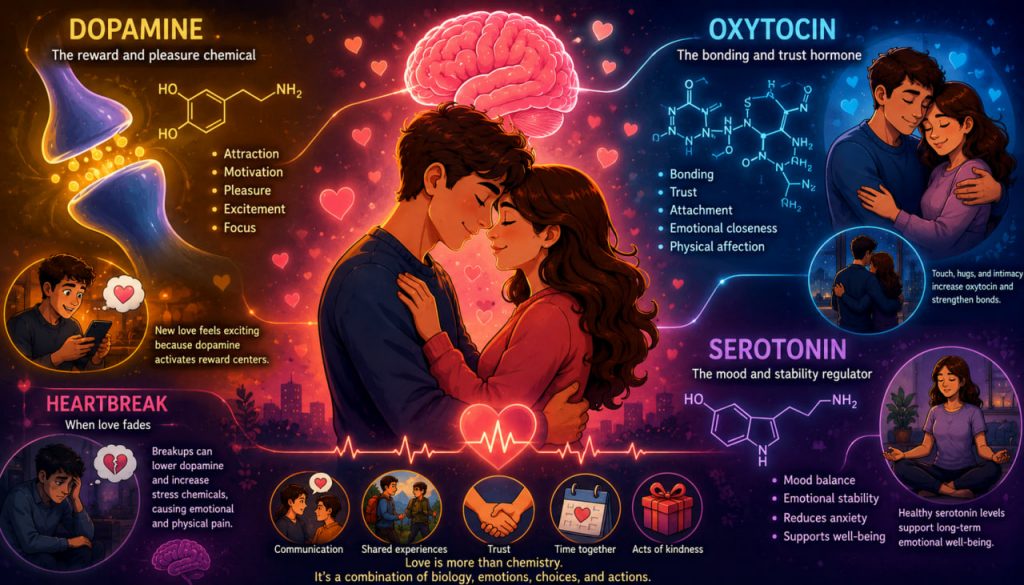
Dopamine: The Reward and Pleasure Chemical
One of the most important chemicals involved in romantic attraction is:
- Dopamine
Dopamine plays a central role in the brain’s:
- Reward system
- Motivation circuits
When people experience attraction or emotional excitement, dopamine activity often increases.
This may produce feelings such as:
- Euphoria
- Excitement
- Energy
- Anticipation
- Focus on another person
Dopamine helps explain why early romantic attraction may feel:
- Intense
- Stimulating
- Addictive
Neuroscientist Helen Fisher explained:
“Romantic love is one of the most powerful brain systems humans possess.”
Her research showed that love strongly activates dopamine-rich brain pathways.
Why New Love Feels So Intense
Early-stage romantic attraction often creates strong emotional intensity because dopamine systems become highly active.
People in early love may experience:
- Increased energy
- Reduced appetite
- Difficulty sleeping
- Constant thoughts about another person
The brain essentially treats romantic reward similarly to other highly motivating experiences.
This stage may feel emotionally overwhelming because reward systems become strongly focused on one individual.
Oxytocin: The Bonding Hormone
Another key substance in relationships is:
- Oxytocin
Oxytocin is often called:
- The bonding hormone
- The trust hormone
It plays an important role in:
- Emotional attachment
- Social bonding
- Physical affection
- Trust development
Oxytocin levels may increase during:
- Hugging
- Touch
- Childbirth
- Close emotional interaction
Long-term relationships often depend heavily on bonding mechanisms involving oxytocin.
Human Attachment and Emotional Security
Oxytocin may help create feelings of:
- Safety
- Calmness
- Emotional closeness
This chemical helps strengthen:
- Romantic attachment
- Family bonding
- Social trust
Physical affection and emotional intimacy may reinforce these biological processes over time.
Stable long-term relationships often involve stronger attachment mechanisms compared to the intense excitement of early attraction.
Serotonin and Emotional Stability
Serotonin is another important brain chemical connected to:
- Mood regulation
- Emotional balance
- Well-being
Interestingly, serotonin levels may behave differently during early romantic obsession.
Some studies suggest intense romantic attraction may temporarily alter serotonin regulation similarly to obsessive thinking patterns.
Serotonin strongly influences:
- Emotional stability
- Anxiety levels
- General mood
Balanced serotonin function is important for healthy long-term emotional well-being.
Love and Stress Hormones
Love also affects:
- Cortisol
- Adrenaline
during emotional excitement.
Early attraction may increase physiological arousal involving:
- Faster heartbeat
- Sweaty palms
- Nervousness
- Heightened attention
This explains why people often feel physically different around someone they strongly like.
The body reacts emotionally and chemically at the same time.
Why Heartbreak Hurts So Much
Romantic rejection or separation may strongly affect brain chemistry.
Breakups may influence:
- Dopamine systems
- Stress hormones
- Emotional regulation
Brain scans suggest emotional pain from heartbreak activates some regions also involved in:
- Physical pain processing
This may explain why emotional loss sometimes feels physically painful.
Human attachment systems evolved to make social bonds deeply meaningful for survival and cooperation.
Love, Evolution, and Human Survival
Scientists believe emotional bonding evolved partly to support:
- Parenting
- Cooperation
- Long-term social stability
Human children require unusually long developmental care compared to many animals.
Strong pair bonding may have helped improve:
- Child survival
- Resource sharing
- Social organization
Love therefore involves both:
- Biology
- Social evolution
Can Chemistry Fully Explain Love?
Despite the importance of brain chemistry, most researchers agree love cannot be reduced entirely to hormones alone.
Human relationships also involve:
- Personality
- Culture
- Values
- Communication
- Shared experiences
- Conscious decisions
Chemistry may help create attraction and bonding, but long-term relationships depend on far more than biological reactions alone.
Technology and Modern Relationships
Modern technology increasingly affects human bonding patterns.
Social media and digital communication may influence:
- Dopamine responses
- Attention systems
- Emotional expectations
Dating apps also interact with reward pathways involving:
- Novelty
- Anticipation
- Validation
Scientists continue studying how modern digital environments affect relationship psychology.
Why Understanding Love Chemistry Matters
The chemistry of love reveals how deeply connected:
- Brain biology
- Emotion
- Social behavior
really are.
Love is not “just chemicals,” but chemistry plays a major role in shaping:
- Attraction
- Bonding
- Trust
- Emotional attachment
Understanding these processes helps explain why relationships may feel so powerful, meaningful, and emotionally transformative throughout human life.
P.S. Friends, if you are already fed up with what social networks and the internet are filled with, then I say to you – you have a soul inside you, and true love only to God. If you strive for Him, you will never have problems with relationships, mental disorders, or anything else, and you will understand the world not through the rose-colored glasses of our internet…
Interesting Facts
- Dopamine strongly activates the brain’s reward system during attraction.
- Oxytocin is associated with trust and emotional bonding.
- Romantic rejection may activate brain regions linked to physical pain.
- Human touch may increase oxytocin release.
- Early romantic love may temporarily affect serotonin regulation.
Glossary
- Dopamine — A neurotransmitter associated with reward, motivation, and pleasure.
- Oxytocin — A hormone involved in bonding, trust, and emotional attachment.
- Serotonin — A neurotransmitter influencing mood and emotional stability.
- Neurotransmitter — A chemical messenger used by brain cells to communicate.
- Cortisol — A hormone associated with stress responses.