Few neuroscience ideas became as popular in modern culture as the concept of:
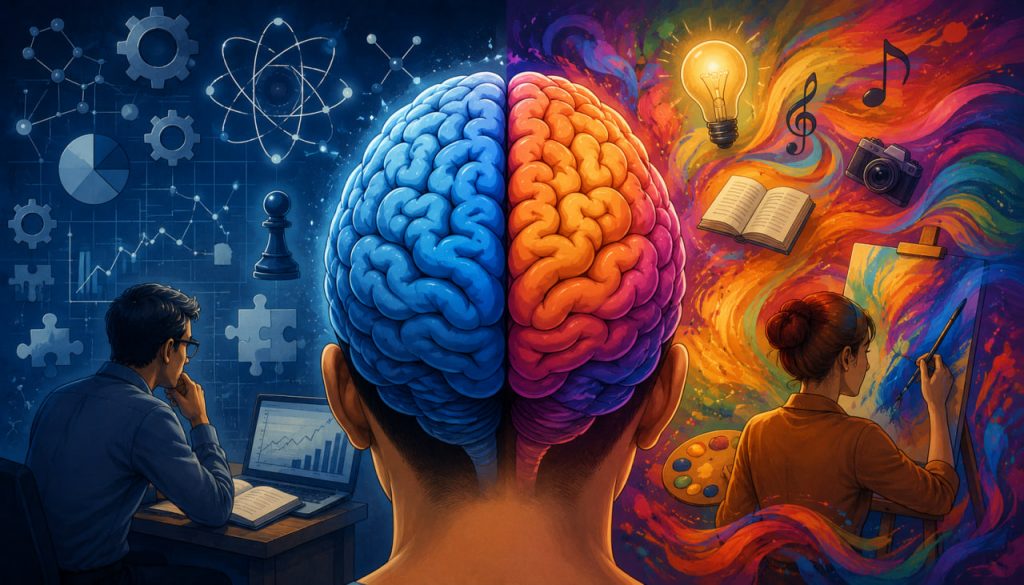
- “Left-brained” people
- “Right-brained” people
According to the popular myth:
- The left hemisphere controls logic, mathematics, and rational thinking.
- The right hemisphere controls creativity, emotion, and artistic talent.
This idea spread widely through:
- Social media
- Self-help books
- Education trends
- Personality tests
- Popular psychology
Many people still believe individuals are naturally dominated by one side of the brain.
However, modern neuroscience shows the reality is far more complex.
Although the brain’s hemispheres do have certain specialized functions, the simplistic division between:
- “Logical left brain”
- “Creative right brain”
is largely misleading.
Human thinking depends on massive cooperation between both hemispheres simultaneously.
Understanding how the brain truly works reveals one of the biggest myths in popular psychology.
What Are the Brain Hemispheres?
The human brain is divided into:
- Left hemisphere
- Right hemisphere
These two halves are connected by a large structure called:
- The corpus callosum
which allows rapid communication between both sides.
Although the hemispheres process information somewhat differently, they constantly exchange signals.
The brain operates as:
- A highly integrated system
rather than two independent personalities.
Where Did the Left-Brain vs Right-Brain Idea Come From?
The origins of this idea partly came from legitimate neuroscience discoveries.
In the 19th and 20th centuries, scientists discovered some functions are somewhat more dominant in specific hemispheres.
For example:
- Language processing is often more left-lateralized in many people.
- Spatial processing may involve stronger right-hemisphere participation.
Later, studies involving split-brain patients increased public interest in hemisphere specialization.
However, popular culture simplified these findings far beyond scientific reality.
What Are Split-Brain Patients?
Some epilepsy patients historically underwent procedures cutting the:
- Corpus callosum
to reduce seizure spread between hemispheres.
Scientists studying these patients observed unusual effects involving:
- Language
- Perception
- Motor coordination
These experiments helped researchers understand hemisphere specialization better.
However, they did not prove people are either:
- Logical machines
- Creative dreamers
based on one hemisphere alone.
The Truth About Brain Cooperation
Modern brain imaging shows most complex human activities require:
- Both hemispheres working together
This includes:
- Music
- Mathematics
- Creativity
- Language
- Problem-solving
- Emotional understanding
Even artistic creativity involves:
- Logic
- Planning
- Pattern recognition
- Motor control
Meanwhile mathematics and analytical reasoning also involve:
- Visualization
- Intuition
- Creativity
The brain functions through interconnected neural networks rather than isolated sides.
Creativity Is Not Only “Right-Brained”
One of the biggest myths claims artists use mostly the:
- Right hemisphere
In reality, creativity involves many brain systems including:
- Memory
- Emotion
- Executive planning
- Visual processing
- Attention networks
Creative thinking often requires:
- Structured analysis
- Technical skill
- Problem-solving
Neuroscientist Michael Gazzaniga explained:
“The brain is a massively parallel and integrated system.”
This means creative and analytical functions overlap heavily across the brain.
Language and Hemisphere Specialization
Some functions do show partial lateralization.
For example:
- Language processing often relies more heavily on the left hemisphere in many right-handed individuals.
However, even language requires:
- Emotional interpretation
- Context understanding
- Tone recognition
which involve broader brain networks including the right hemisphere.
No major cognitive activity belongs entirely to only one side.
Music and the Whole Brain
Music provides an excellent example of brain integration.
Listening to music may activate:
- Auditory regions
- Emotional systems
- Motor areas
- Memory centers
- Pattern recognition networks
Playing instruments requires:
- Coordination
- Timing
- Creativity
- Mathematical rhythm processing
Music therefore engages both hemispheres extensively.
Emotion Is Not Only Right-Brained
Another common myth claims emotions belong entirely to the:
- Right hemisphere
In reality, emotional processing involves multiple systems distributed throughout:
- Both hemispheres
- Limbic structures
- Frontal regions
Human emotions are neurologically extremely complex.
The brain does not divide:
- Logic on one side
- Emotion on the other
in such simple ways.
Why the Myth Became Popular
The left-brain/right-brain myth became popular partly because it offers:
- Simple personality explanations
People enjoy categorizing themselves as:
- Analytical
- Artistic
- Logical
- Creative
The idea feels intuitive and easy to understand.
However, neuroscience rarely supports such simplistic brain models.
Human cognition is highly interconnected and individualized.
Brain Plasticity and Adaptation
The brain also demonstrates:
- Neuroplasticity
meaning neural systems can adapt and reorganize over time.
If one region becomes damaged, other regions may sometimes partially compensate.
This flexibility further demonstrates that brain functions are distributed rather than rigidly separated.
Learning continuously reshapes neural connections throughout life.
Modern Brain Imaging
Technologies such as:
- fMRI
- PET scans
- EEG
allow scientists to observe living brain activity.
These studies show complex tasks activate broad networks across:
- Both hemispheres
- Multiple brain regions simultaneously
Human cognition resembles:
- Cooperative neural ecosystems
far more than separate competing halves.
Education and Learning Myths
Unfortunately, some educational programs incorrectly promoted teaching methods based on:
- “Left-brain learners”
- “Right-brain learners”
Scientific evidence does not strongly support these simplified categories.
Effective learning usually involves combining:
- Visual processing
- Logic
- Emotion
- Repetition
- Creativity
The healthiest brain development encourages broad cognitive flexibility.
Why Humans Love Simplified Brain Theories
The brain is incredibly complex.
Simplified theories become attractive because they provide:
- Easy identity labels
- Quick explanations
- Personality categories
However, neuroscience increasingly shows human cognition cannot be reduced to simple binary divisions.
Every brain develops uniquely through:
- Genetics
- Experience
- Learning
- Environment
What Neuroscience Actually Suggests
Modern neuroscience supports several key conclusions:
- Brain hemispheres have some specialization.
- Both hemispheres constantly cooperate.
- Creativity and logic involve distributed networks.
- Human cognition is highly integrated.
The brain works more like:
- An interconnected orchestra
than two separate personalities inside the skull.
Why This Myth Matters
Understanding the truth about brain hemispheres helps people avoid limiting beliefs such as:
- “I’m not creative.”
- “I’m only logical.”
- “I can’t learn artistic skills.”
Human brains are remarkably adaptable and multidimensional.
The myth of left-brained and right-brained people oversimplifies one of the most sophisticated biological systems in existence.
The real beauty of the brain lies not in separation — but in extraordinary cooperation between countless neural networks working together every second.
Interesting Facts
- The two brain hemispheres communicate through the corpus callosum.
- Creativity involves many distributed brain regions.
- Music strongly activates both hemispheres simultaneously.
- Brain plasticity allows neural adaptation throughout life.
- Modern brain imaging helped debunk many popular brain myths.
Glossary
- Hemisphere — One half of the brain.
- Corpus Callosum — The structure connecting the two brain hemispheres.
- Neuroplasticity — The brain’s ability to reorganize and adapt.
- Lateralization — Partial specialization of functions in one hemisphere.
- fMRI — Brain imaging technology measuring neural activity.