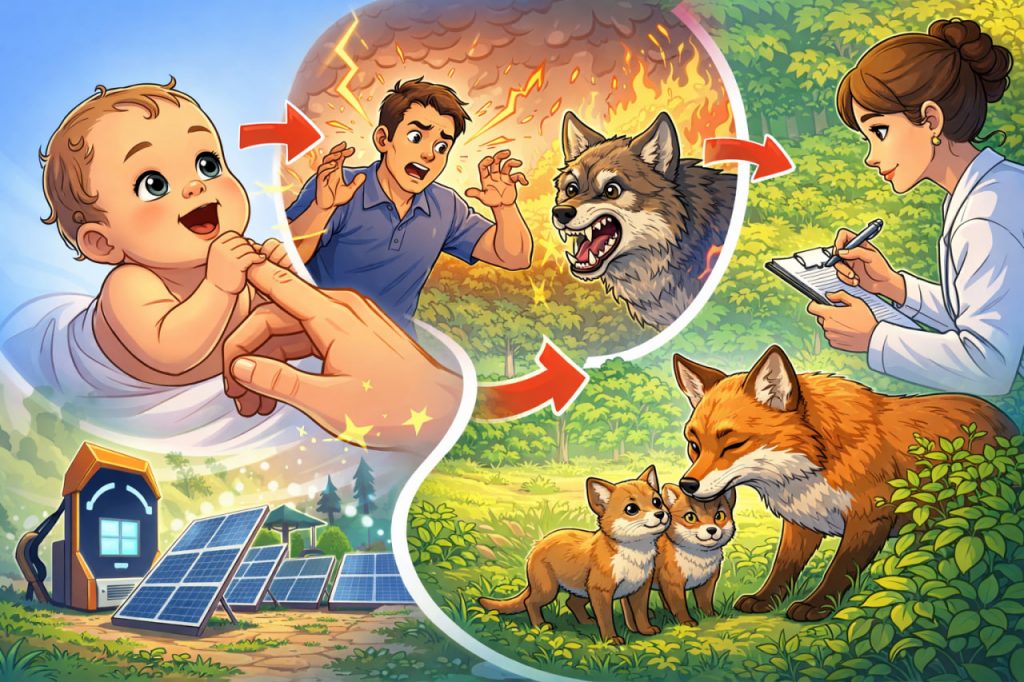
Instincts are innate patterns of behavior that are present from birth and do not require prior learning. These behaviors are typically triggered by specific stimuli and occur in a predictable way. For example, infants instinctively grasp objects or suckle, while animals may exhibit hunting or migration behaviors without training. Psychologist Dr. Emily Carter explains:
“Instincts are the brain’s built-in responses,
allowing organisms to act quickly without conscious reasoning.”
This automatic nature makes instincts essential for immediate survival.
Instincts vs Learned Behavior
One of the key distinctions in behavioral science is between instinctive and learned behavior. Learned behaviors develop through experience, observation, and practice, while instincts are present from the beginning. However, in many cases, behavior is a combination of both. For instance, humans have an instinct for language acquisition, but the specific language learned depends on the environment. This interaction between instinct and learning creates flexible and adaptive behavior.
Role in Survival and Evolution
Instincts play a critical role in survival by enabling organisms to respond quickly to threats and opportunities. Fight-or-flight responses, reproduction, and caregiving behaviors are all rooted in instinct. These behaviors have been shaped by natural selection, ensuring that beneficial traits are passed down through generations. Without instincts, organisms would need to learn everything from scratch, greatly reducing their chances of survival.
Human Instincts in Modern Life
Although humans rely heavily on reasoning and culture, instincts still influence many aspects of daily life. Emotional reactions, social bonding, and even certain fears can be linked to instinctive processes. For example, fear of heights or sudden loud noises may have evolutionary origins. In modern society, some instincts may not always align with current environments, leading to challenges such as stress or impulsive decision-making.
Are Instincts Fixed or Flexible?
While instincts are inborn, they are not entirely rigid. The human brain is capable of modifying instinctive responses through experience and conscious control. This flexibility allows individuals to adapt their behavior to complex social and cultural environments. Understanding instincts can help people better manage reactions and make more informed decisions.
Interesting Facts
- Newborn babies demonstrate several instinctive reflexes immediately after birth.
- Many animals rely almost entirely on instincts for survival behaviors.
- The fight-or-flight response is one of the most well-known human instincts.
- Some fears may be evolutionary adaptations rather than learned responses.
- Instincts can interact with learning to create complex behaviors.
Glossary
- Instinct — an inborn pattern of behavior that occurs without learning.
- Innate Behavior — behavior present from birth.
- Stimulus — a trigger that causes a response.
- Natural Selection — the process by which beneficial traits are passed on.
- Fight-or-Flight Response — a physiological reaction to perceived danger.