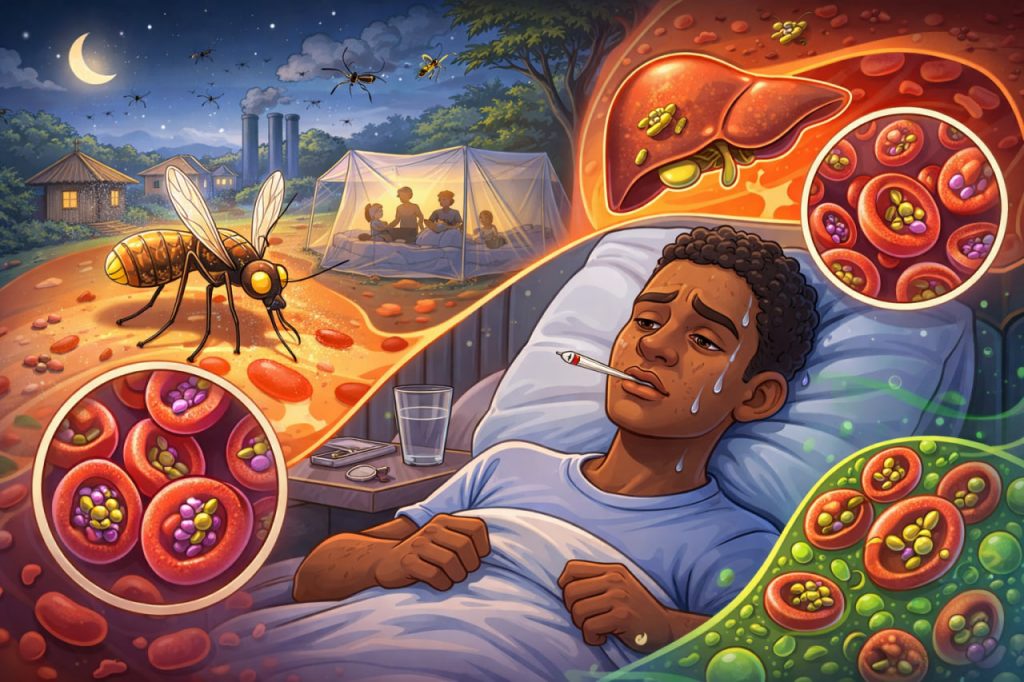
Malaria is one of the most widespread infectious diseases in the world, affecting millions of people each year, particularly in tropical and subtropical regions. Despite significant progress in prevention and treatment, it remains a major public health challenge. Understanding how malaria spreads, how it affects the body, and how it can be controlled is essential for reducing its global impact.
What Is Malaria
Malaria is a disease caused by parasites of the genus Plasmodium, which are transmitted to humans through the bites of infected mosquitoes. Once inside the body, the parasites multiply and affect the bloodstream, leading to various symptoms.
As experts explain:
“Malaria is not caused by a virus or bacteria, but by parasites transmitted through mosquito bites.”
This makes its transmission and lifecycle unique compared to many other infectious diseases.
How Malaria Spreads
The disease is transmitted by specific types of mosquitoes that act as carriers of the parasite. When a mosquito bites an infected person, it can pick up the parasite and later transmit it to another individual.
This cycle continues, allowing malaria to spread within populations, especially in regions with favorable environmental conditions for mosquito breeding.
What Happens Inside the Body
After entering the body, the parasites travel to the liver, where they multiply before entering the bloodstream. They then infect red blood cells, leading to cycles of cell destruction and release of new parasites.
This process is responsible for many of the symptoms associated with malaria.
Common Symptoms
Malaria symptoms can include fever, chills, fatigue, and general weakness. These symptoms often appear in cycles, reflecting the parasite’s lifecycle within the body.
The severity of symptoms can vary depending on factors such as the type of parasite and the individual’s condition.
Why Malaria Is Still a Problem
Malaria remains a challenge due to several factors, including environmental conditions, mosquito populations, and access to healthcare. In some regions, controlling mosquito populations is difficult, and prevention measures may be limited.
Prevention Strategies
Efforts to reduce malaria focus on preventing mosquito bites and controlling mosquito populations. This includes the use of protective measures and environmental management.
Scientific Research and Progress
Ongoing research aims to better understand the parasite, improve prevention strategies, and develop new solutions. Advances in science continue to play a key role in reducing the global burden of malaria.
A Global Health Challenge
Malaria highlights the complex relationship between humans, parasites, and the environment. Addressing it requires coordinated efforts in science, public health, and environmental management.
Interesting Facts
- Malaria is caused by parasites, not bacteria or viruses.
- It is transmitted through mosquito bites.
- The parasite first develops in the liver.
- Symptoms often appear in cycles.
- It remains a major issue in tropical regions.
Glossary
- Malaria — a disease caused by parasites transmitted by mosquitoes.
- Parasite — an organism that lives in or on a host.
- Plasmodium — the parasite responsible for malaria.
- Transmission — the spread of disease from one host to another.
- Red Blood Cells — cells that carry oxygen in the blood.