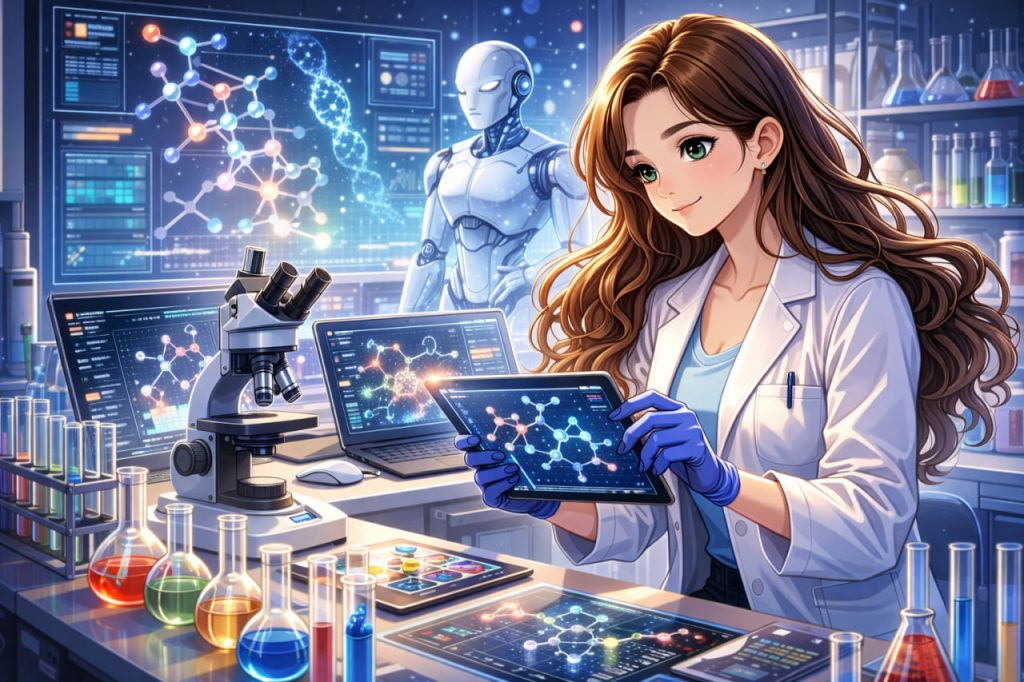
Developing a new drug has traditionally been a slow and expensive process, often taking more than a decade from discovery to approval. Scientists must identify promising molecules, test their properties, evaluate safety, and conduct clinical trials. Artificial intelligence is transforming the earliest stages of this pipeline by dramatically accelerating molecule screening and design. Instead of testing millions of compounds manually in laboratories, AI models can simulate and evaluate molecular interactions in silico. By narrowing down viable candidates faster, researchers reduce both time and cost. In some stages of early discovery, computational methods have increased screening speed by orders of magnitude compared to traditional approaches.
How AI Screens Molecules
AI systems use machine learning algorithms trained on massive chemical datasets. These models learn patterns linking molecular structures to biological activity. Once trained, they can predict how new compounds might interact with target proteins. Rather than physically synthesizing and testing every candidate, researchers first perform virtual screening. Computational chemist Dr. Laura Mendes explains:
“AI does not replace laboratory testing.
It prioritizes the most promising molecules before experiments begin.”
This prioritization significantly reduces the number of costly laboratory trials.
Structure Prediction and Target Identification
One major breakthrough enabling faster drug development was AI-driven protein structure prediction. Accurate knowledge of a protein’s three-dimensional shape allows researchers to design molecules that bind precisely to it. Advanced deep learning systems analyze protein folding and interaction sites with remarkable accuracy. With structural insights available earlier, medicinal chemists can focus on designing highly specific compounds. This targeted approach reduces trial-and-error experimentation.
Reducing Time and Cost
Traditional high-throughput screening involves testing hundreds of thousands or millions of compounds in laboratory conditions. AI-driven virtual screening can evaluate similar numbers computationally within days. According to pharmaceutical innovation analyst Dr. Martin Alvarez:
“The speed gain is not just incremental.
AI compresses months of preliminary testing into days.”
While laboratory validation remains essential, narrowing the field earlier accelerates the overall pipeline.
Applications in Rare and Emerging Diseases
AI-based drug discovery is particularly valuable in urgent or underfunded research areas. For emerging infectious diseases, rapid molecule screening can identify potential antiviral candidates quickly. In rare diseases, where funding and sample sizes are limited, AI helps focus resources efficiently. Machine learning models also assist in drug repurposing—identifying new therapeutic uses for existing medications.
Challenges and Future Directions
Despite impressive progress, AI-driven drug discovery faces challenges. Model predictions depend heavily on data quality and diversity. Biological systems are complex, and unexpected side effects may only emerge in later stages. Regulatory frameworks must also adapt to evaluate AI-assisted pipelines. Nevertheless, the integration of AI into pharmaceutical research represents one of the most promising shifts in biomedical science. By combining computational power with laboratory expertise, drug discovery becomes faster, more precise, and increasingly data-driven.
Interesting Facts
- Traditional drug development can take over 10 years from discovery to approval.
- AI can virtually screen millions of molecular structures in days.
- Protein structure prediction significantly enhances targeted drug design.
- Drug repurposing saves time compared to developing entirely new compounds.
- AI-assisted pipelines reduce early-stage experimental workload.
Glossary
- Molecule Screening — evaluating chemical compounds for potential biological activity.
- Machine Learning — algorithms that identify patterns in data to make predictions.
- In Silico — experiments performed via computer simulation.
- Drug Repurposing — finding new therapeutic uses for existing medications.
- Protein Structure Prediction — determining the 3D shape of a protein to guide drug design.