Summer brings longer days, outdoor adventures, vacations, and plenty of sunshine. While sunlight is essential for life and helps the body produce vitamin D, excessive exposure to ultraviolet (UV) radiation can pose serious health risks. Sunburn, premature skin aging, eye damage, dehydration, and an increased risk of skin cancer are all linked to prolonged exposure to the sun without proper protection.
Fortunately, protecting yourself from harmful sunlight is straightforward when you understand the risks and follow evidence-based recommendations. Whether you’re relaxing at the beach, hiking in the mountains, gardening, or simply walking through the city, adopting good sun safety habits can help you enjoy summer while protecting your health.
Why Is the Summer Sun More Dangerous?
The Sun emits several types of radiation, including ultraviolet rays that are invisible to the human eye.
The two primary types reaching Earth’s surface are:
- UVA
- UVB
Both contribute to skin damage, although in different ways.
UVA rays penetrate deeply into the skin and contribute to premature aging, while UVB rays are primarily responsible for sunburn and play a major role in the development of skin cancer.
During summer, the Sun sits higher in the sky, increasing UV intensity. Clear skies, high altitudes, and reflective surfaces such as water, sand, and snow can further increase exposure.
Even on cloudy days, a significant proportion of UV radiation reaches the ground.
Wear Broad-Spectrum Sunscreen
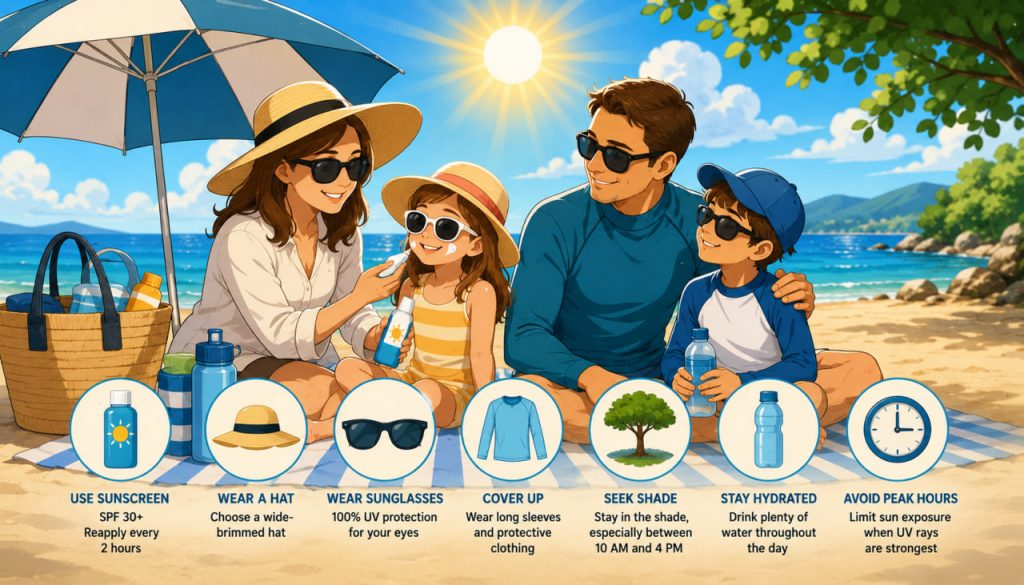
Sunscreen is one of the most effective tools for protecting exposed skin.
Choose a product that offers:
- Broad-spectrum protection (UVA and UVB)
- SPF 30 or higher
- Water resistance if swimming or exercising
Apply sunscreen generously about 15–30 minutes before going outdoors.
Most adults require approximately one ounce (30 milliliters), roughly enough to fill a shot glass, to cover the entire body.
Reapply:
- Every two hours
- Immediately after swimming
- After heavy sweating
- After towel drying
No sunscreen provides complete protection, so it should always be combined with other sun safety measures.
Wear Protective Clothing
Clothing provides one of the simplest and most reliable forms of sun protection.
Recommended options include:
- Long-sleeved lightweight shirts
- Long trousers
- Wide-brimmed hats
- UV-protective fabrics
- Lightweight breathable materials
Some clothing carries an Ultraviolet Protection Factor (UPF) rating.
UPF 50 fabric blocks approximately 98% of ultraviolet radiation.
Darker colors and tightly woven fabrics generally provide better protection than thin, light-colored materials.
Protect Your Eyes
Ultraviolet radiation can also damage the eyes.
Long-term exposure increases the risk of:
- Cataracts
- Macular degeneration
- Photokeratitis
- Eyelid skin cancers
Choose sunglasses that provide:
- 100% UVA protection
- 100% UVB protection
- UV400 certification
Wraparound styles offer additional protection by reducing sunlight entering from the sides.
Children should also wear properly fitted sunglasses during outdoor activities.
Avoid Peak Sun Hours
Ultraviolet radiation is strongest between approximately 10:00 a.m. and 4:00 p.m.
Whenever possible:
- Schedule outdoor activities earlier in the morning.
- Enjoy evening walks instead of midday exercise.
- Take breaks in shaded areas.
If you must remain outdoors during peak hours, increase your use of protective clothing, sunscreen, and hats.
Seeking shade is one of the easiest ways to reduce UV exposure without limiting outdoor enjoyment.
Stay Hydrated
Hot summer weather increases fluid loss through sweating.
Dehydration may lead to:
- Fatigue
- Headaches
- Heat exhaustion
- Reduced concentration
Drink water regularly, even if you do not feel thirsty.
During prolonged outdoor activity:
- Increase fluid intake.
- Limit excessive alcohol consumption.
- Replace electrolytes when necessary after heavy sweating.
Proper hydration also supports the body’s natural cooling system.
Be Careful Around Reflective Surfaces
Many people underestimate how much reflected sunlight increases UV exposure.
Common reflective surfaces include:
- Water
- Sand
- Concrete
- Glass
- White buildings
- Snow
For example:
- Dry sand can reflect approximately 15–25% of UV radiation.
- Water reflects varying amounts depending on the angle of the Sun.
- Fresh snow may reflect up to 80% of incoming UV radiation.
This means you can receive ultraviolet exposure from both above and below.
Special Care for Children
Children’s skin is thinner and generally more sensitive than adult skin.
Protective measures include:
- Keeping infants out of direct sunlight whenever possible.
- Dressing children in lightweight protective clothing.
- Applying child-appropriate sunscreen to exposed skin.
- Using hats with wide brims.
- Encouraging regular water intake.
Childhood sunburns significantly increase the lifetime risk of developing skin cancer.
Establishing healthy sun protection habits early can provide lifelong benefits.
Recognize Heat-Related Illness
Excessive sun exposure is often accompanied by heat stress.
Watch for symptoms such as:
- Dizziness
- Nausea
- Rapid heartbeat
- Heavy sweating
- Muscle cramps
- Confusion
If someone develops these symptoms:
- Move them into shade.
- Provide cool water if they are conscious.
- Loosen tight clothing.
- Apply cool compresses.
- Seek medical attention if symptoms worsen or do not improve.
Heat stroke is a medical emergency requiring immediate treatment.
Expert Perspective
According to Dr. Henry W. Lim, former president of the American Academy of Dermatology, effective sun protection requires combining several preventive measures rather than relying on sunscreen alone.
He has emphasized that:
“No single method of sun protection is sufficient by itself.”
This reflects current dermatological guidance recommending a combination of sunscreen, protective clothing, shade, sunglasses, and behavioral changes to minimize ultraviolet exposure.
Smart Summer Habits
Developing simple daily habits can dramatically reduce the long-term effects of UV exposure.
Good practices include:
- Checking the daily UV Index before spending time outdoors.
- Wearing sunscreen every day during summer.
- Using hats and sunglasses routinely.
- Taking regular breaks in shaded areas.
- Staying well hydrated.
- Avoiding tanning beds.
Protecting yourself from the summer sun is not about avoiding outdoor activities—it is about enjoying them safely while reducing unnecessary exposure to ultraviolet radiation. Consistent sun safety habits help protect your skin, eyes, and overall health for years to come.
Interesting Facts
- Ultraviolet radiation can damage the skin even on cloudy days.
- Water, sand, and snow all reflect UV rays, increasing exposure.
- Skin damage from UV radiation accumulates over a lifetime.
- SPF measures protection primarily against UVB radiation.
- The UV Index is used worldwide to estimate daily ultraviolet intensity.
- Shade can significantly reduce UV exposure but does not eliminate it completely.
- Wearing protective clothing is often more effective than sunscreen alone.
Glossary
- Ultraviolet (UV) Radiation — Invisible radiation emitted by the Sun that can damage skin and eyes.
- UVA — Long-wavelength ultraviolet rays associated with skin aging and long-term damage.
- UVB — Shorter-wavelength ultraviolet rays primarily responsible for sunburn.
- Broad-Spectrum Sunscreen — Sunscreen that protects against both UVA and UVB radiation.
- SPF (Sun Protection Factor) — A measure of protection against UVB-induced sunburn.
- UPF (Ultraviolet Protection Factor) — A rating indicating how effectively fabric blocks UV radiation.
- UV Index — A scale indicating the expected strength of ultraviolet radiation on a given day.
- Heat Exhaustion — A heat-related illness caused by excessive fluid and salt loss.
- Heat Stroke — A life-threatening condition in which the body’s temperature regulation fails.
- Photokeratitis — A painful eye condition caused by excessive ultraviolet exposure, often referred to as a sunburn of the eye.