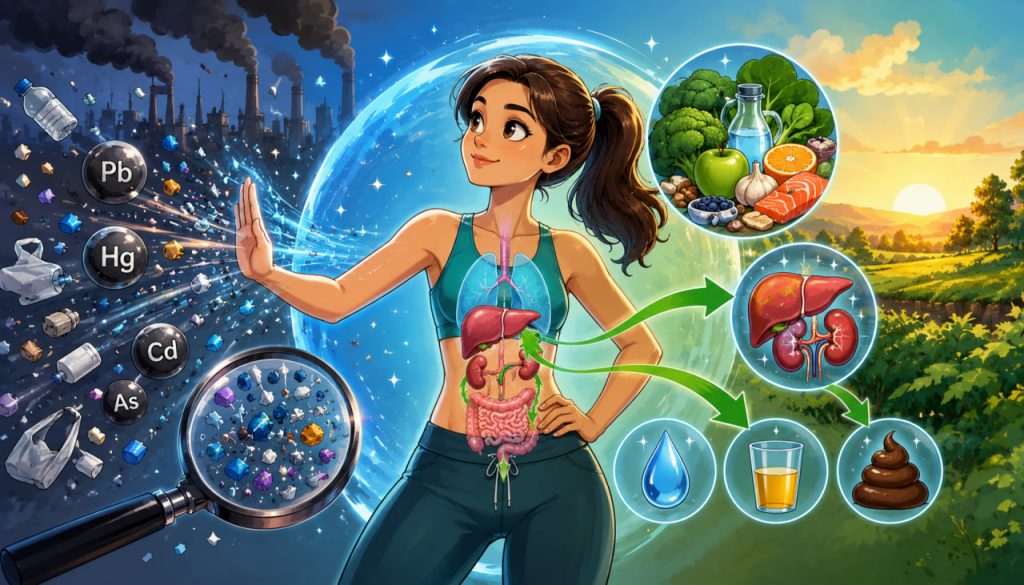
The idea of “detoxifying” the body has become extremely popular in recent years. Social media is full of advertisements for detox teas, cleansing diets, supplements, and programs that claim to eliminate toxins, heavy metals, and even microplastics from the human body.
But how much of this is supported by science?
Modern research confirms that humans are exposed to a wide variety of environmental contaminants, including heavy metals, air pollutants, industrial chemicals, and microscopic plastic particles. However, the human body also possesses sophisticated systems for processing and eliminating many unwanted substances.
The real question is not whether toxins exist—they do—but whether it is actually possible to remove microplastics and heavy metals through detox programs, and what science says about the body’s natural detoxification mechanisms.
What Does Detoxification Really Mean?
In medicine, detoxification refers to the body’s natural process of transforming and eliminating potentially harmful substances.
Several organs play major roles:
- Liver
- Kidneys
- Lungs
- Digestive system
- Skin
- Lymphatic system
The liver acts as the body’s primary chemical processing center.
It converts many compounds into forms that can be excreted through urine or feces.
The kidneys filter blood and remove waste products.
The lungs eliminate volatile compounds through breathing.
In healthy individuals, detoxification is already occurring continuously without the need for special cleansing products.
This does not mean environmental contaminants are harmless, but it does mean that many commercial detox claims oversimplify complex biological processes.
What Are Heavy Metals?
Heavy metals are naturally occurring elements with relatively high density and atomic weight.
Some are essential in small amounts, while others can be toxic at elevated levels.
Examples include:
- Lead
- Mercury
- Cadmium
- Arsenic
- Chromium
- Nickel
Exposure sources may include:
- Contaminated water
- Industrial pollution
- Certain foods
- Mining activities
- Old paint
- Electronic waste
- Occupational environments
Unlike many organic chemicals, heavy metals do not break down into harmless substances.
They can accumulate in tissues over time.
This is why chronic exposure is a significant public health concern.
What Are Microplastics?
Microplastics are plastic particles generally smaller than five millimeters.
Even smaller particles, known as nanoplastics, are often invisible to the naked eye.
Sources include:
- Synthetic clothing fibers
- Tire wear particles
- Food packaging
- Plastic bottles
- Household dust
- Cosmetic products
- Industrial waste
Researchers have detected microplastics in:
- Oceans
- Rivers
- Soil
- Air
- Drinking water
- Human blood
- Lung tissue
- Placental tissue
The long-term health effects of microplastic exposure remain an active area of research.
Scientists continue investigating how these particles interact with biological systems.
Can the Body Remove Heavy Metals Naturally?
To some extent, yes.
The body can excrete certain metals through:
- Urine
- Feces
- Sweat
- Hair growth
- Nail growth
However, elimination rates vary significantly depending on the metal.
For example:
- Some forms of mercury can remain in tissues for long periods.
- Lead can accumulate in bones for decades.
- Cadmium may persist in the body for many years.
Because of this, reducing exposure is often more effective than attempting to remove accumulated metals later.
Prevention is usually easier than treatment when it comes to heavy metal exposure.
Medical Chelation Therapy: The Real Heavy Metal Treatment
When heavy metal poisoning reaches dangerous levels, doctors may use a treatment called chelation therapy.
Chelating agents are chemicals that bind to specific metals and help remove them through urine.
Chelation therapy is used for medically confirmed cases of poisoning involving substances such as:
- Lead
- Mercury
- Arsenic
However, chelation therapy is not a general wellness treatment.
It carries risks and should only be performed under medical supervision.
There is no scientific evidence that healthy individuals benefit from routine chelation without documented heavy metal poisoning.
This is an important distinction often overlooked in commercial detox marketing.
Can We Remove Microplastics from the Body?
This question is much harder to answer.
Unlike heavy metals, there are currently no established medical treatments specifically designed to remove microplastics from human tissues.
Research is still ongoing.
Scientists do not yet fully understand:
- How long microplastics remain in different organs
- How they move through the body
- Which particles are eliminated naturally
- Which particles may accumulate
Some ingested microplastics are believed to pass through the digestive system and leave the body through feces.
However, very small particles may behave differently.
At present, there is no proven detox program that can selectively remove microplastics from the human body.
Any product claiming guaranteed plastic removal should be viewed with caution.
The Best Science-Based Approach to Reducing Exposure
Instead of relying on detox trends, experts generally recommend reducing exposure whenever possible.
Practical steps include:
Improving Food Choices
- Eat more fresh foods.
- Reduce heavily packaged products.
- Wash fruits and vegetables thoroughly.
- Limit unnecessary plastic food containers.
Improving Water Quality
- Use high-quality water filtration systems when appropriate.
- Avoid storing hot liquids in plastic containers.
Reducing Indoor Pollution
- Ventilate living spaces regularly.
- Vacuum and clean dust frequently.
- Choose products with fewer unnecessary chemicals.
Workplace Safety
- Follow occupational safety standards.
- Use protective equipment when required.
- Monitor exposure in industrial environments.
These measures help reduce the amount of contaminants entering the body in the first place.
Nutrition and the Body’s Natural Defense Systems
While no food can magically remove plastics or heavy metals, nutrition does influence detoxification systems.
A healthy diet supports:
- Liver function
- Kidney health
- Antioxidant defenses
- Gut health
- Immune regulation
Foods often associated with healthy detoxification include:
- Vegetables
- Fruits
- Whole grains
- Legumes
- Fish with low contaminant levels
- Adequate water intake
Certain nutrients such as selenium, zinc, and antioxidants may help reduce some toxic effects of environmental contaminants.
However, supporting detoxification is not the same as instantly removing accumulated toxins.
Expert Perspective
The World Health Organization and numerous toxicology organizations emphasize that environmental contaminants should be managed primarily through exposure reduction, regulation, monitoring, and evidence-based medical treatment when necessary.
Toxicologists generally agree on a key principle:
“The most effective detox strategy is preventing excessive exposure in the first place.”
This principle applies equally to heavy metals, industrial pollutants, and emerging contaminants such as microplastics.
Rather than relying on unproven cleansing products, public health experts focus on cleaner environments, safer manufacturing, improved food systems, and ongoing scientific research.
Why Detox Products Remain Popular
Detox products often appeal because they offer simple solutions to complex problems.
Environmental contamination is real, but biological detoxification is complicated.
Many commercial programs promise:
- Rapid cleansing
- Heavy metal removal
- Plastic elimination
- Cellular purification
- Whole-body resets
Most of these claims lack strong scientific evidence.
The reality is less dramatic.
The body already works continuously to process unwanted substances, and long-term health protection depends more on lifestyle, environmental quality, and exposure reduction than on short-term detox programs.
Science supports healthy organs, healthy habits, and lower exposure—not miracle detoxes.
Interesting Facts
- Lead can remain stored in human bones for decades.
- Microplastics have been detected in human blood, lungs, and placental tissue.
- The liver performs hundreds of biochemical functions related to detoxification.
- Some heavy metals are essential nutrients in tiny amounts but toxic at higher levels.
- The kidneys filter approximately 150–180 liters of fluid from the bloodstream every day.
- Most ingested microplastics are believed to pass through the digestive tract, though research is ongoing.
- Modern toxicology increasingly focuses on lifelong low-level exposure rather than acute poisoning alone.
Glossary
- Detoxification — The body’s natural process of transforming and eliminating harmful substances.
- Heavy Metal — A metallic element that can be toxic when accumulated in high amounts.
- Microplastic — A plastic particle smaller than five millimeters.
- Nanoplastic — An extremely small plastic particle measured in nanometers.
- Chelation Therapy — A medical treatment that binds certain metals to help remove them from the body.
- Toxicology — The scientific study of harmful substances and their effects on living organisms.
- Bioaccumulation — The gradual buildup of substances within an organism over time.
- Antioxidant — A compound that helps protect cells from oxidative damage.
- Exposure — Contact with a chemical, pollutant, or potentially harmful substance.
- Environmental Contaminant — A substance present in the environment that may negatively affect health or ecosystems.