Sunglasses are much more than a fashion accessory. High-quality sunglasses protect your eyes from harmful ultraviolet (UV) radiation, reduce glare, improve visual comfort, and help prevent long-term eye damage. Whether you’re driving, hiking, relaxing at the beach, or skiing in the mountains, choosing the right sunglasses can significantly improve both eye health and vision.
Despite their importance, many people purchase sunglasses based only on appearance or price. However, factors such as UV protection, lens material, polarization, and frame design are far more important than style alone. Understanding these features helps consumers make informed decisions that benefit both comfort and long-term eye health.
Why Are Sunglasses Important?
Sunlight contains visible light along with invisible ultraviolet radiation. While humans cannot see UV rays, they can damage the eyes over time.
Long-term exposure to ultraviolet radiation has been associated with an increased risk of:
- Cataracts
- Photokeratitis (sunburn of the eye)
- Macular degeneration
- Pterygium (growth of tissue on the eye)
- Certain eyelid skin cancers
Proper sunglasses block nearly all harmful UVA and UVB radiation, reducing cumulative damage throughout a person’s lifetime.
Protection is especially important because UV exposure accumulates gradually over many years.
Understanding Ultraviolet Radiation
Sunlight contains three types of ultraviolet radiation:
UVA
These rays penetrate deeply into eye tissues and contribute to long-term damage.
UVB
UVB rays are more energetic and can damage the cornea and lens of the eye.
UVC
Fortunately, UVC radiation is almost entirely absorbed by Earth’s atmosphere before reaching the surface.
When buying sunglasses, look for labels indicating:
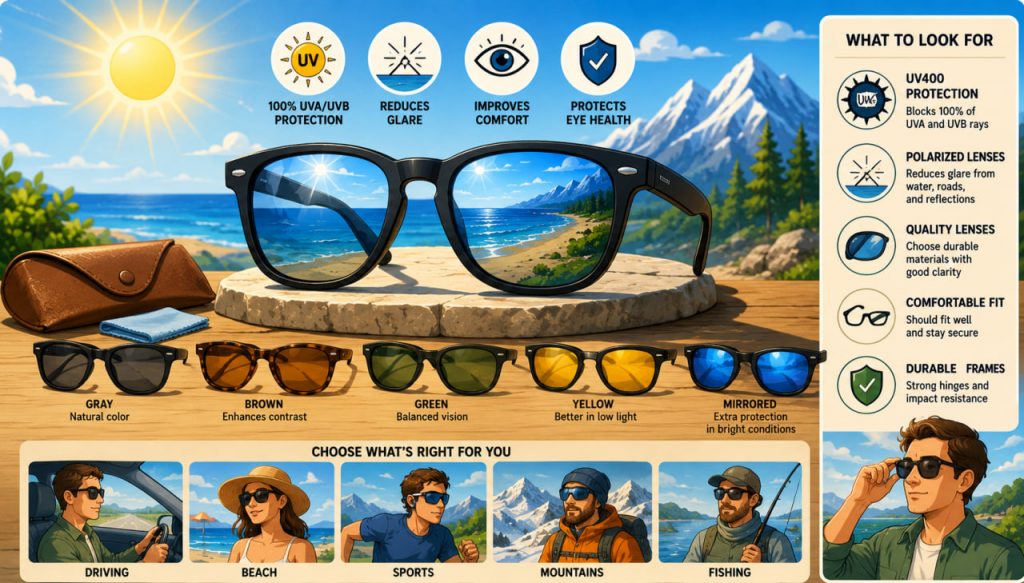
- UV400 protection
- 100% UVA protection
- 100% UVB protection
A UV400 rating means the lenses block ultraviolet wavelengths up to 400 nanometers, effectively covering nearly all UVA and UVB radiation.
Polarized vs. Non-Polarized Lenses
Many premium sunglasses feature polarized lenses.
Polarization reduces glare caused by light reflecting from flat surfaces such as:
- Water
- Snow
- Wet roads
- Glass
- Sand
Benefits include:
- Improved contrast
- Reduced eye strain
- Better visual comfort
- Enhanced driving safety
- Easier visibility while fishing or boating
However, polarized lenses are not always ideal.
They may make it more difficult to view:
- Some digital displays
- Aircraft instruments
- Certain LCD screens
Polarization reduces glare but does not replace UV protection. Both features are important and serve different purposes.
Choosing the Right Lens Color
Many people assume darker lenses provide better protection.
In reality, lens darkness does not determine UV protection.
Lens color mainly affects visual comfort and contrast.
Common options include:
Gray
Provides natural color perception and works well for everyday use.
Brown or Amber
Enhances contrast and depth perception.
Popular for driving and outdoor sports.
Green
Offers balanced color accuracy while reducing glare.
Yellow
Improves contrast in foggy or low-light conditions but is not suitable for bright sunlight.
Mirror-Coated Lenses
Reflect additional visible light, making them useful in extremely bright environments such as beaches and snowy mountains.
Lens Materials
Modern sunglasses are available with several lens materials.
Glass
Advantages:
- Excellent optical clarity
- High scratch resistance
Disadvantages:
- Heavier
- Can shatter upon impact
Polycarbonate
Advantages:
- Lightweight
- Highly impact-resistant
- Ideal for sports and children
Disadvantages:
- More prone to scratches without protective coatings
High-Index Plastic
Provides thinner, lighter lenses for stronger prescriptions.
Many high-quality sunglasses also include scratch-resistant and anti-reflective coatings.
Choosing the Right Frame
Comfort depends heavily on frame design.
A well-fitting frame should:
- Sit comfortably on the nose
- Stay secure during movement
- Avoid excessive pressure behind the ears
- Cover the eyes adequately
Wraparound designs provide additional protection by reducing sunlight entering from the sides.
This feature is especially valuable during:
- Cycling
- Hiking
- Boating
- Snow sports
Large lenses also offer better coverage against reflected sunlight.
Sunglasses for Different Activities
Different activities benefit from different features.
Driving
Recommended features:
- Polarized lenses
- Gray or brown tint
- UV400 protection
Beach
Choose:
- Polarized lenses
- Mirror coating
- Wraparound frames
Sports
Look for:
- Polycarbonate lenses
- Lightweight frames
- Impact resistance
Mountain Activities
Snow reflects significant ultraviolet radiation.
Recommended:
- High UV protection
- Wraparound design
- Darker visible light transmission
Ultraviolet exposure increases with altitude, making eye protection particularly important in mountainous environments.
Children’s Sunglasses
Children are particularly vulnerable to UV exposure because their eyes allow more ultraviolet light to reach internal structures.
Quality children’s sunglasses should include:
- UV400 protection
- Durable frames
- Impact-resistant polycarbonate lenses
- Comfortable fit
Parents should avoid inexpensive toy sunglasses that darken vision without blocking UV radiation.
Dark lenses lacking UV protection may actually increase risk by causing pupils to dilate.
Common Myths About Sunglasses
Several misconceptions continue to influence purchasing decisions.
Myth: Darker lenses provide better protection.
False.
Only certified UV protection matters.
Myth: Expensive sunglasses always protect better.
Not necessarily.
Affordable sunglasses with certified UV400 protection may provide excellent protection.
Myth: Sunglasses are unnecessary on cloudy days.
Incorrect.
Up to 80% of ultraviolet radiation can penetrate cloud cover.
Myth: Winter sunlight is harmless.
Snow can reflect up to 80% of UV radiation, increasing eye exposure.
Expert Perspective
According to Dr. Richard L. Abbott, former spokesperson for the American Academy of Ophthalmology, protecting the eyes from ultraviolet radiation should become a lifelong habit rather than a seasonal concern.
He has emphasized that:
“Ultraviolet damage accumulates over a lifetime.”
His advice reflects decades of ophthalmological research demonstrating that consistent UV protection can reduce the risk of several serious eye diseases associated with aging.
How to Buy High-Quality Sunglasses
When shopping for sunglasses, prioritize protection over appearance.
Look for these features:
- UV400 or 100% UVA/UVB protection
- Certified optical quality
- Comfortable frame fit
- Lens material appropriate for your activities
- Polarization if glare reduction is needed
- Durable construction
Designer brands may offer premium materials and craftsmanship, but effective eye protection depends primarily on proper UV certification rather than brand name.
The best sunglasses are those that combine certified UV protection, comfortable fit, appropriate lens technology, and suitability for your everyday activities.
Interesting Facts
- The human eye cannot detect ultraviolet radiation.
- Snow reflects much more UV light than grass or soil.
- Water reflects sunlight, increasing UV exposure while boating or swimming.
- Polarized lenses were first widely developed for aviation and outdoor activities.
- Polycarbonate lenses were originally developed for aerospace applications.
- Cataracts remain one of the leading causes of vision impairment worldwide.
- UV exposure is generally strongest between 10 a.m. and 4 p.m.
Glossary
- UV Radiation — Invisible ultraviolet energy emitted by the Sun.
- UV400 — A certification indicating that lenses block ultraviolet light up to 400 nanometers.
- Polarized Lens — A lens that reduces glare from reflected light.
- UVA — Long-wavelength ultraviolet radiation associated with cumulative eye damage.
- UVB — Shorter-wavelength ultraviolet radiation that can damage the cornea and lens.
- Cataract — Clouding of the eye’s natural lens that reduces vision.
- Macular Degeneration — An eye disease affecting the central part of the retina.
- Polycarbonate — A lightweight, impact-resistant lens material commonly used in protective eyewear.
- Photokeratitis — A painful condition caused by excessive ultraviolet exposure, often described as a sunburn of the eye.
- Visible Light Transmission (VLT) — The percentage of visible light that passes through a lens.