Every day, people share stories, news, observations, memories, and opinions. We often assume that information travels from one person to another like a file being copied from one computer to another. In reality, human communication works very differently.
Psychologists have long known that information changes as it passes through individual minds. Memory is imperfect, perception is selective, emotions influence interpretation, and personal beliefs shape understanding. As a result, facts can become distorted, exaggerated, simplified, or completely transformed during transmission.
This phenomenon affects everything from everyday conversations and workplace communication to journalism, social media, politics, and historical records. Understanding how the human mind alters information can help us become more critical consumers and communicators of knowledge.
Why Human Memory Is Not a Recording Device
Many people imagine memory as a video archive that stores events exactly as they occurred.
Modern neuroscience shows otherwise.
Human memory is reconstructive rather than reproductive.
When we recall an event, we do not simply replay a stored recording. Instead, the brain actively rebuilds the memory using fragments of information, previous knowledge, emotions, and expectations.
Because of this process:
- Details may be forgotten.
- Events may be rearranged.
- New information may be incorporated.
- False memories may develop.
Memory is surprisingly flexible, which makes it useful for adaptation but vulnerable to distortion.
Even highly confident individuals can recall events inaccurately.
The “Telephone Game” Effect
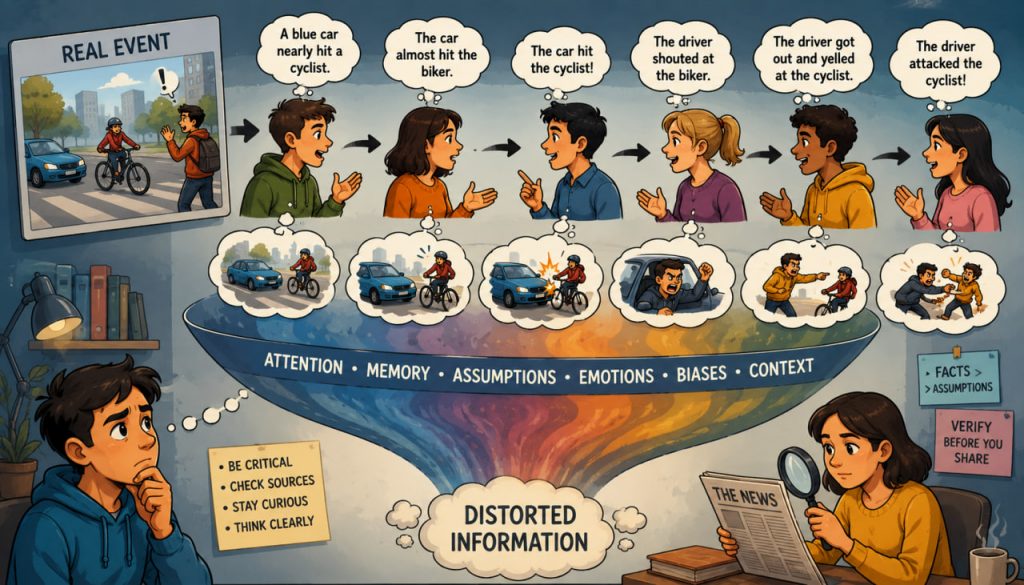
A classic demonstration of information distortion is the children’s game often called “Telephone.”
A message is whispered from one person to another through a chain of participants.
By the time the final person repeats the message aloud, it often differs dramatically from the original.
Although the game is playful, it illustrates a real psychological phenomenon.
Each participant unconsciously modifies the message by:
- Forgetting details
- Simplifying information
- Filling in gaps
- Mishearing words
- Adding assumptions
The same process occurs in real-world communication.
Information rarely remains unchanged as it moves through social networks.
Confirmation Bias: Seeing What We Expect to See
One of the strongest influences on information distortion is confirmation bias.
Confirmation bias refers to the tendency to favor information that supports existing beliefs while ignoring contradictory evidence.
When people encounter new information, they often interpret it through the lens of their existing worldview.
For example:
- A political supporter may interpret the same news differently from an opponent.
- Investors may focus on evidence supporting their financial expectations.
- Consumers may selectively notice information that confirms product preferences.
People do not merely receive information; they actively interpret it.
This interpretation process can significantly alter how facts are remembered and shared.
Emotional Amplification
Emotion strongly influences communication.
Information associated with fear, anger, surprise, or excitement tends to receive more attention and spread more rapidly.
Unfortunately, emotionally charged information is also more likely to become distorted.
Examples include:
- Rumors during crises
- Sensational news headlines
- Viral social media posts
- Urban legends
As information spreads, emotional elements often become exaggerated while factual details become less accurate.
This helps explain why dramatic stories frequently outperform careful explanations in public discourse.
The Role of Cognitive Shortcuts
The human brain processes enormous amounts of information every day.
To manage this complexity efficiently, it relies on mental shortcuts known as heuristics.
These shortcuts are useful but can introduce errors.
Common examples include:
Availability Heuristic
People tend to judge the likelihood of events based on how easily examples come to mind.
A highly publicized event may seem more common than it actually is.
Representativeness Heuristic
Individuals often make judgments based on similarities rather than statistical evidence.
Anchoring
Initial information can disproportionately influence later interpretations.
These shortcuts help the brain make rapid decisions but can also alter how facts are understood and transmitted.
Social Media and Information Distortion
Modern communication technologies have amplified traditional psychological biases.
Social media platforms allow information to spread globally within minutes.
However, rapid transmission does not guarantee accuracy.
Online environments often reward:
- Emotional content
- Simplified messages
- Controversial opinions
- Novel claims
- Attention-grabbing headlines
As information spreads through shares, reposts, summaries, and comments, details may change significantly.
The original source can become increasingly disconnected from later versions.
Digital communication accelerates the speed of information transmission but does not eliminate human cognitive biases.
False Memories and Collective Misremembering
One of the most fascinating areas of psychological research involves false memories.
Studies have shown that people can sometimes develop detailed memories of events that never occurred.
Research by cognitive psychologist Elizabeth Loftus demonstrated that memory can be influenced by suggestion, wording, and post-event information.
In some experiments, participants came to believe they had experienced events that were entirely fictional.
False memories are not necessarily signs of dishonesty.
Instead, they reveal how reconstructive memory functions.
Groups can also develop shared inaccuracies, leading to collective misremembering of historical events, public figures, or cultural phenomena.
Why Witness Testimony Can Be Unreliable
Many people assume eyewitness testimony is highly reliable.
Psychological research suggests otherwise.
Witness accounts may be influenced by:
- Stress
- Fear
- Poor visibility
- Suggestive questioning
- Time delays
- Media exposure
Even sincere witnesses may unintentionally provide inaccurate information.
This has led legal systems in many countries to adopt more rigorous methods for evaluating eyewitness evidence.
Confidence and accuracy are not always the same thing.
A confident witness can still be mistaken.
Expert Perspective
Psychologist Elizabeth Loftus, one of the world’s leading experts on memory, has spent decades studying how memories are formed, altered, and recalled.
Her research demonstrated that memory is highly susceptible to suggestion and reconstruction.
As she has frequently emphasized, memory is not a perfect record of the past but a dynamic process shaped by numerous influences.
“Memory is not like a videotape recording.”
This simple statement summarizes one of the most important findings in modern cognitive psychology.
Understanding this reality helps explain why facts can change as they pass from one mind to another.
How to Reduce Information Distortion
While distortion cannot be eliminated completely, several strategies can improve accuracy.
Verify Original Sources
Whenever possible, consult primary sources rather than relying on summaries.
Separate Facts from Interpretations
Distinguish between observable events and personal opinions.
Be Aware of Emotional Reactions
Strong emotions can influence judgment.
Encourage Critical Thinking
Question assumptions and examine alternative explanations.
Take Notes Promptly
Written records are often more reliable than long-term memory alone.
These habits can improve both personal understanding and communication quality.
Why Understanding Cognitive Distortion Matters
In an age of instant communication, information travels farther and faster than at any point in human history.
At the same time, the human brain remains fundamentally the same as it was thousands of years ago.
Our minds evolved to interpret, simplify, and reconstruct information rather than preserve it perfectly.
Recognizing these limitations does not mean abandoning trust in communication.
Instead, it encourages greater humility, critical thinking, and attention to evidence.
The challenge is not merely obtaining information but understanding how our own minds transform it along the way.
Interesting Facts
- People can develop vivid memories of events that never actually happened.
- Emotional stories tend to spread faster than neutral information.
- Confidence in a memory does not guarantee its accuracy.
- The “Telephone” game illustrates real psychological processes involved in information distortion.
- Eyewitness testimony has contributed to wrongful convictions later overturned by DNA evidence.
- Memory reconstruction occurs every time a memory is recalled.
- Social media can accelerate both accurate information and misinformation.
Glossary
- Confirmation Bias — The tendency to favor information that supports existing beliefs.
- False Memory — A recollection of an event that did not occur or occurred differently than remembered.
- Heuristic — A mental shortcut used for rapid decision-making.
- Availability Heuristic — Judging likelihood based on how easily examples come to mind.
- Anchoring — The tendency to rely heavily on initial information when making judgments.
- Cognitive Bias — A systematic pattern of deviation from objective reasoning.
- Eyewitness Testimony — A person’s account of an event they personally observed.
- Memory Reconstruction — The process by which the brain rebuilds memories during recall.
- Misinformation — Incorrect or misleading information, regardless of intent.
- Critical Thinking — The objective analysis and evaluation of information before forming conclusions.