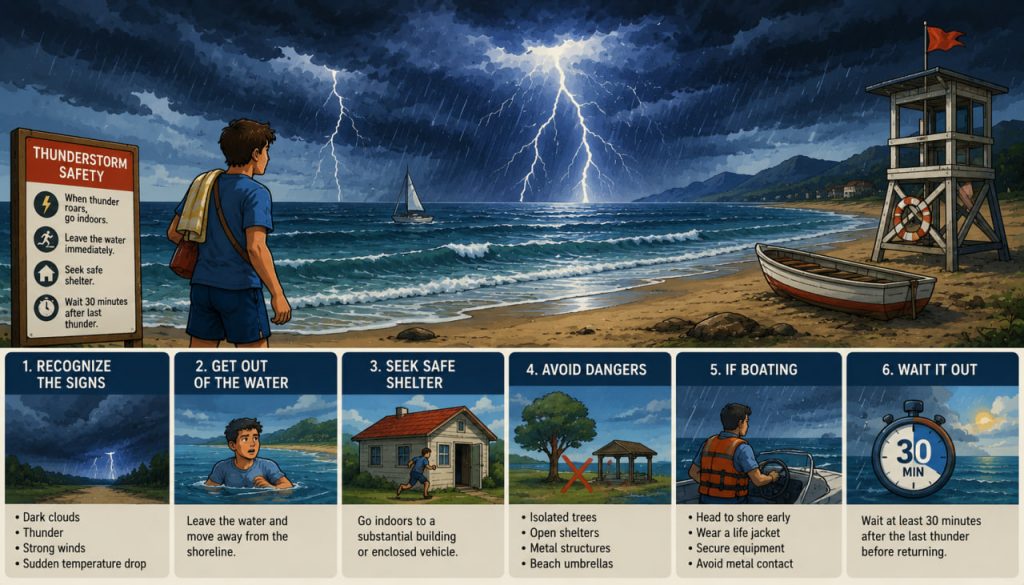
A sunny day at the beach can quickly turn dangerous when dark clouds gather on the horizon. Thunderstorms over the sea often develop rapidly and can bring strong winds, lightning, heavy rain, high waves, and dangerous currents. Every year, people are injured or killed because they underestimate the risks associated with storms near open water.
Whether you are swimming, boating, fishing, paddleboarding, or simply relaxing on the coast, knowing how to respond to a thunderstorm can significantly improve your safety. Understanding the science behind these weather events and following proven safety procedures can make the difference between a frightening experience and a life-threatening emergency.
Why Thunderstorms Are Especially Dangerous at Sea
The sea provides a unique environment for thunderstorm development.
Warm water continuously evaporates, supplying moisture to the atmosphere. When unstable air conditions are present, powerful storm clouds can form quickly.
At sea, thunderstorms create multiple hazards simultaneously:
- Lightning strikes
- Strong wind gusts
- High waves
- Reduced visibility
- Heavy rain
- Dangerous currents
- Waterspouts in some cases
Unlike on land, people on open water often have limited shelter options.
A thunderstorm that seems distant can become dangerous within minutes, especially in coastal environments.
The Biggest Threat: Lightning
Many people fear large waves during storms, but lightning is often the most immediate danger.
Water is an excellent conductor of electricity.
A lightning strike can affect a large area of water around the impact point.
Potential consequences include:
- Cardiac arrest
- Severe burns
- Nervous system damage
- Drowning due to loss of consciousness
If thunder is audible, lightning is already close enough to pose a threat.
Meteorologists often use the phrase:
“When thunder roars, go indoors.”
This advice applies strongly to beaches and marine environments.
Warning Signs of an Approaching Storm
Recognizing early warning signs allows more time to reach safety.
Watch for:
Darkening Clouds
Towering cumulonimbus clouds often signal thunderstorm development.
Distant Thunder
Even faint thunder indicates lightning-producing storms.
Sudden Wind Changes
Gusty or shifting winds frequently precede thunderstorms.
Rapid Temperature Drops
Cool air descending from storms may cause noticeable temperature changes.
Roughening Sea Surface
Increasing wave activity may indicate approaching storm conditions.
Never wait until rain begins before taking action. Lightning can strike several kilometers away from the storm’s center.
If You Are Swimming
Swimming during a thunderstorm is extremely dangerous.
If you hear thunder or see lightning:
- Leave the water immediately.
- Move away from the shoreline.
- Seek substantial shelter.
- Avoid isolated trees and open areas.
Do not remain near:
- Piers
- Docks
- Metal railings
- Beach umbrellas
Even if lightning is not directly overhead, nearby strikes can still be dangerous.
If You Are on a Small Boat
Boaters face additional risks because they may be far from shore.
If a storm approaches:
Head Toward Shore Early
Do not wait for conditions to worsen.
Wear a Life Jacket
Storm-generated waves can increase the risk of falling overboard.
Secure Equipment
Loose gear can become hazardous during rough conditions.
Monitor Weather Information
Marine weather forecasts and warning systems provide critical information.
If reaching shore is impossible:
- Stay low in the boat.
- Avoid touching metal structures.
- Reduce exposure to lightning risk as much as possible.
Modern vessels equipped with lightning protection systems offer greater safety than small open boats.
If You Are Paddleboarding or Kayaking
Kayaks, paddleboards, and similar craft provide almost no protection from storms.
If thunder is heard:
- Immediately head for shore.
- Exit the water as quickly as possible.
- Move to a safe structure.
Because these activities place people close to the water surface, exposure to lightning risk can be particularly high.
Safe Shelter Options
Not all shelters provide equal protection.
Good options include:
Substantial Buildings
Buildings with electrical wiring and plumbing provide the best protection.
Enclosed Vehicles
Metal-roofed vehicles can offer effective protection from lightning.
Avoid:
- Beach shelters
- Open pavilions
- Tents
- Small sheds
- Isolated trees
These structures may not provide adequate protection during severe weather.
The safest place during a thunderstorm is a fully enclosed building.
What About Waterspouts?
Waterspouts are tornado-like columns of rotating air that form over water.
Although relatively uncommon, they can occur during certain storm conditions.
If a waterspout is observed:
- Move away immediately.
- Change course if boating.
- Seek shelter.
Waterspouts can generate dangerous winds and waves capable of damaging small vessels.
Fortunately, most waterspouts remain relatively short-lived.
How Long Should You Wait?
One of the most common mistakes is returning to the water too soon.
Safety experts generally recommend following the 30-minute rule.
Wait at least 30 minutes after the last thunder is heard before resuming water activities.
This precaution reduces exposure to lingering lightning risks.
Storms often continue producing lightning after rainfall has decreased or stopped entirely.
Expert Perspective
Meteorologist John Jensenius, formerly a lightning safety specialist with the U.S. National Weather Service, has spent decades studying lightning-related incidents.
His work consistently emphasizes the importance of early action.
“The first lightning strike can be just as deadly as the last.”
This reminder highlights why people should not delay seeking shelter when storms approach.
Early decisions are often the most effective safety measure.
Modern Technology and Storm Safety
Today’s weather forecasting tools provide valuable information for beachgoers and boaters.
Useful resources include:
- Weather radar applications
- Marine forecasts
- Lightning detection systems
- Emergency alert services
- Coast Guard warnings
Many smartphone applications can provide near real-time thunderstorm information.
While technology improves safety, it should complement—not replace—situational awareness.
The most effective protection remains recognizing danger early and leaving the water before storm conditions arrive.
Interesting Facts
- Lightning can strike more than 15 kilometers from the center of a thunderstorm.
- Water conducts electrical current efficiently, increasing danger during storms.
- Thunderstorms can produce wind gusts exceeding 100 km/h.
- Waterspouts are most common over warm water.
- A single lightning bolt may contain temperatures hotter than the surface of the Sun.
- Many lightning-related injuries occur before or after the heaviest rainfall.
- Marine thunderstorms can form surprisingly quickly during hot, humid weather.
Glossary
- Thunderstorm — A storm characterized by lightning, thunder, rain, and often strong winds.
- Lightning — A powerful electrical discharge occurring within storms.
- Thunder — The sound produced by rapidly expanding air heated by lightning.
- Cumulonimbus Cloud — A large thunderstorm cloud capable of producing severe weather.
- Waterspout — A rotating column of air that forms over water.
- Marine Forecast — A weather prediction specifically designed for water activities and navigation.
- Wind Gust — A brief increase in wind speed.
- Visibility — The distance at which objects can be clearly seen.
- Storm Surge — An abnormal rise in water level caused by storms.
- Life Jacket — A flotation device designed to keep a person afloat in water.