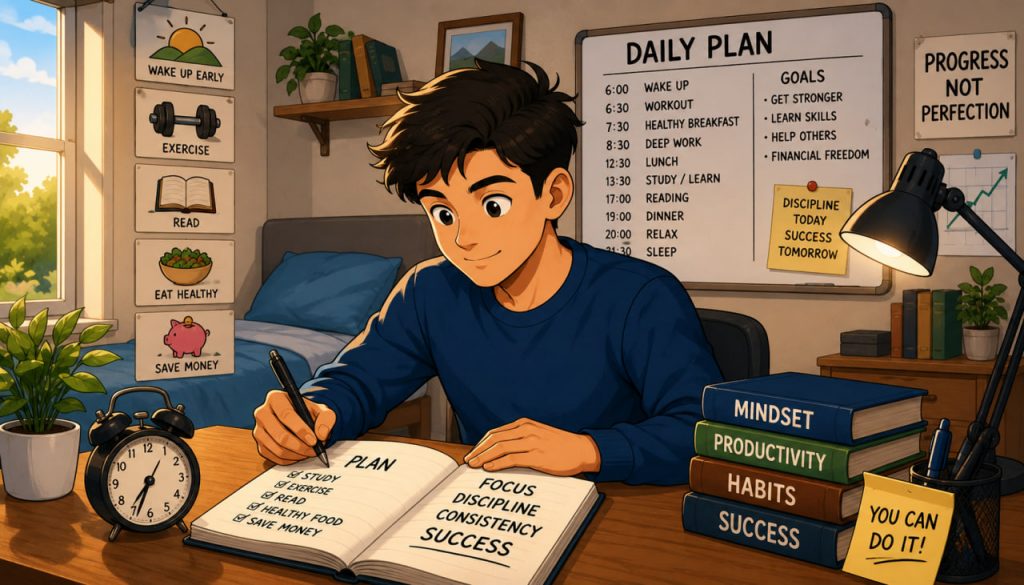
Self-discipline is often described as the bridge between goals and achievements. While motivation can help you start a new habit, discipline is what keeps you moving forward when motivation fades. Whether you want to improve your health, advance your career, learn new skills, or simply become more productive, developing self-discipline can dramatically improve your chances of success.
The good news is that discipline is not a personality trait that some people are born with and others lack. Modern psychology shows that self-discipline is a skill that can be developed and strengthened over time.
What Is Self-Discipline?
Self-discipline is the ability to control your actions, emotions, and impulses in order to achieve long-term goals. It involves choosing what is important over what is immediately pleasurable.
For example:
- Exercising instead of staying on the couch
- Studying instead of endlessly scrolling social media
- Saving money instead of making unnecessary purchases
Discipline is not about punishment or suffering. It is about consistently making choices that align with your goals.
Why Discipline Matters More Than Motivation
Many people wait until they feel motivated before taking action. The problem is that motivation is unpredictable. Some days you feel energized, while other days you do not.
Discipline works differently.
Instead of asking:
“Do I feel like doing this?”
A disciplined person asks:
“Is this what I decided to do?”
Psychologist Angela Duckworth, known for her research on perseverance and achievement, explains:
“Enthusiasm is common. Endurance is rare.”
Long-term success usually depends more on consistency than on occasional bursts of motivation.
Start With Small Habits
One of the biggest mistakes people make is trying to change everything at once.
Large goals often create:
- Overwhelm
- Stress
- Frustration
Instead, focus on small daily actions.
Examples:
- Read 5 pages per day
- Walk for 10 minutes
- Write one paragraph
- Wake up 15 minutes earlier
These small behaviors are easier to maintain and gradually build confidence.
Discipline grows through repetition, not through dramatic effort.
Create a Clear Routine
The human brain likes patterns. When an activity becomes part of a routine, it requires less mental effort.
Try establishing:
- Fixed wake-up times
- Scheduled work sessions
- Consistent exercise periods
- Regular sleep routines
The fewer decisions you need to make, the easier it becomes to stay disciplined.
Many highly successful people rely on structured routines because they reduce decision fatigue, the mental exhaustion caused by making too many choices throughout the day.
Remove Temptations
Willpower is limited. One of the most effective strategies is to design your environment so that good choices become easier.
Examples include:
- Keeping healthy food visible
- Turning off unnecessary notifications
- Placing books on your desk
- Keeping distracting apps off your phone
Rather than constantly resisting temptation, reduce its presence.
A well-designed environment supports discipline automatically.
Focus on Systems, Not Just Goals
Goals provide direction, but systems create results.
For example:
Goal:
- Lose 10 kilograms
System:
- Exercise three times per week
- Eat vegetables with every meal
- Limit sugary drinks
Goals tell you where you want to go. Systems determine whether you get there.
This concept has become popular through the work of productivity experts and behavioral scientists because it encourages sustainable progress.
Learn to Accept Discomfort
One reason discipline is difficult is that it often requires temporary discomfort.
Examples include:
- Exercising when tired
- Studying when entertainment is available
- Saving money instead of spending it
The key is understanding that discomfort is temporary, while the benefits are often long-lasting.
Highly disciplined individuals do not necessarily enjoy every task. They simply learn to act despite temporary resistance.
Track Your Progress
Monitoring progress can significantly improve consistency.
Useful methods include:
- Habit-tracking apps
- Journals
- Calendars
- Checklists
Seeing evidence of progress creates a positive feedback loop that encourages continued effort.
Even small wins can strengthen commitment.
Don’t Let One Mistake Become a Pattern
Many people abandon their goals after a single failure.
For example:
- Missing one workout
- Eating unhealthy food once
- Skipping a study session
However, one mistake rarely causes failure.
The real danger is allowing a single setback to become a permanent habit.
A useful principle is:
Never miss twice in a row.
Recover quickly and continue moving forward.
The Role of Sleep, Exercise, and Health
Discipline is closely connected to physical well-being.
Poor sleep, chronic stress, and lack of exercise can reduce:
- Focus
- Energy
- Self-control
Healthy habits support disciplined behavior by improving brain function and emotional regulation.
In many cases, improving sleep quality alone can make self-discipline significantly easier.
Building Discipline for Life
Self-discipline is not about becoming perfect. It is about becoming consistent.
The most disciplined people:
- Accept setbacks
- Continue despite challenges
- Focus on long-term improvement
- Build habits gradually
Over time, small actions compound into major achievements.
What begins as effort eventually becomes part of your identity.
Interesting Facts
- Studies show that self-discipline is often a stronger predictor of success than intelligence alone.
- Habits can become increasingly automatic as neural pathways strengthen through repetition.
- People with structured routines generally make fewer impulsive decisions.
- Small daily improvements often produce larger long-term results than occasional intense efforts.
- Consistency is one of the most common traits observed in high achievers across different fields.
Glossary
- Self-Discipline — The ability to control actions and impulses to achieve long-term goals.
- Decision Fatigue — Mental exhaustion caused by making many decisions.
- Habit — A behavior that becomes automatic through repetition.
- Willpower — The ability to resist short-term temptations.
- Consistency — Repeated action over time that produces gradual progress.