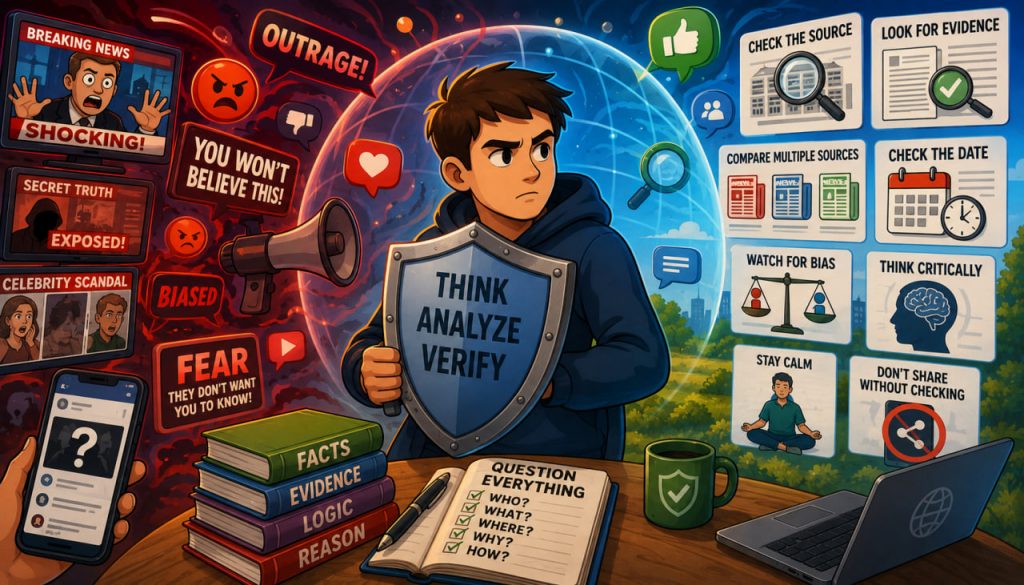
In today’s digital world, information reaches people faster than at any other time in history. News, videos, social media posts, advertisements, and recommendations constantly compete for attention. While modern media technologies provide enormous benefits, they also create opportunities for manipulation.
Media manipulation is not always obvious. It often works by influencing:
- Emotions
- Perceptions
- Attention
- Decision-making
- Beliefs
Modern technologies use sophisticated methods based on:
- Psychology
- Behavioral science
- Data analysis
- Artificial intelligence
Understanding these techniques is one of the most important skills of the information age.
The goal is not to distrust everything, but to develop critical thinking that helps separate facts from influence attempts.
What Is Media Manipulation?
Media manipulation refers to techniques designed to influence people’s opinions, emotions, or behavior without them fully realizing it.
Manipulation can occur through:
- News reporting
- Advertising
- Social media
- Political campaigns
- Online content
The objective may be:
- Selling products
- Gaining attention
- Influencing elections
- Shaping public opinion
In many cases, manipulation works because it exploits natural human cognitive tendencies.
Why Humans Are Vulnerable
The human brain evolved to make decisions quickly.
This creates mental shortcuts known as:
- Cognitive biases
These shortcuts are useful for everyday life but can sometimes lead to errors in judgment.
Examples include:
- Confirmation bias
- Availability bias
- Emotional reasoning
- Authority bias
Manipulative content often targets these natural psychological mechanisms.
Emotional Content Travels Faster
Research consistently shows that emotional content spreads more rapidly than neutral information.
Messages that trigger:
- Fear
- Anger
- Outrage
- Excitement
- Hope
are more likely to be shared.
This creates incentives for media producers to prioritize emotional impact over accuracy.
Whenever content provokes a strong emotional reaction, it is wise to pause and evaluate it carefully.
Confirmation Bias: The Invisible Trap
One of the most powerful biases is:
- Confirmation bias
People naturally prefer information that supports their existing beliefs.
As a result:
- Contradictory evidence may be ignored.
- Supporting information may be accepted too easily.
Manipulators often exploit this tendency by providing audiences with information they already want to believe.
Algorithms Shape What You See
Social media platforms increasingly use algorithms to determine which content appears in feeds.
These systems often prioritize:
- Engagement
- Clicks
- Shares
- Viewing time
Because emotionally charged content generates more engagement, algorithms may unintentionally amplify:
- Polarization
- Misinformation
- Sensationalism
Understanding that algorithms influence information exposure is essential for media literacy.
The Power of Repetition
Repeated messages often appear more believable.
Psychologists call this:
- The Illusory Truth Effect
When people encounter the same claim repeatedly, familiarity can create a sense of credibility.
This happens even when the claim is false.
For this reason, repetition alone should never be considered evidence.
Headlines Are Designed to Capture Attention
Many headlines are optimized to generate:
- Curiosity
- Surprise
- Outrage
This practice is often called:
- Clickbait
A headline may exaggerate or oversimplify information to encourage clicks.
Always read beyond the headline before forming conclusions.
Visual Manipulation
Images and videos can be extremely persuasive.
Modern technologies allow:
- Selective framing
- Editing
- Deepfakes
- AI-generated imagery
Visual content often feels trustworthy because people assume seeing is believing.
However, visual information also requires verification.
How Misinformation Spreads
False information spreads for many reasons.
These include:
- Honest mistakes
- Misunderstandings
- Financial incentives
- Political motives
In the digital era, misinformation can travel globally within minutes.
The speed of distribution often exceeds the speed of fact-checking.
Fact-Checking Is Essential
One of the most effective defenses against manipulation is verification.
Before accepting important claims:
- Check multiple sources.
- Look for primary evidence.
- Verify dates and context.
- Examine original documents when possible.
Reliable information usually withstands independent verification.
Beware of False Experts
Manipulative content often relies on:
- Appeals to authority
A person may be presented as an expert despite lacking relevant expertise.
When evaluating claims, consider:
- Credentials
- Experience
- Scientific consensus
rather than titles alone.
The Importance of Diverse Information Sources
Relying on a single source increases vulnerability to bias.
A healthier approach involves:
- Reading different perspectives
- Comparing reporting styles
- Consulting multiple outlets
Diversity of information helps reduce blind spots.
Slowing Down Improves Judgment
Many manipulative strategies depend on rapid reactions.
When encountering surprising information:
Pause before sharing.
Taking a few minutes to reflect can significantly improve decision quality.
Critical thinking often begins with slowing down.
Digital Literacy as a Modern Survival Skill
In previous centuries, literacy meant learning to read and write.
Today, digital literacy also involves:
- Evaluating sources
- Understanding algorithms
- Identifying misinformation
- Recognizing manipulation techniques
These skills are becoming increasingly important in modern society.
Artificial Intelligence and Future Challenges
AI systems can generate:
- Articles
- Images
- Videos
- Voices
with increasing realism.
While these technologies offer valuable benefits, they also create new challenges for information verification.
Future media literacy will require understanding both:
- Human influence techniques
- AI-generated content
Expert Opinion on Critical Thinking
Psychologist Daniel Kahneman, winner of the Nobel Prize in Economics, emphasized that human thinking often relies on fast, intuitive judgments that can lead to predictable errors.
His research highlights the importance of deliberate, analytical thinking when evaluating information and making decisions.
Practical Rules for Avoiding Manipulation
To reduce vulnerability to media manipulation:
- Verify information before sharing.
- Read beyond headlines.
- Check multiple sources.
- Be cautious with emotionally charged content.
- Question extraordinary claims.
- Understand your own biases.
- Take time before reacting.
These habits create a strong defense against many forms of influence.
Why Critical Thinking Matters More Than Ever
Modern media technologies are powerful tools.
They can:
- Educate
- Inform
- Connect people
but they can also:
- Distort reality
- Amplify bias
- Spread misinformation
The solution is not fear or cynicism.
Instead, it is the development of informed skepticism and critical thinking.
People who understand how manipulation works become significantly harder to manipulate.
In an age of information abundance, the most valuable skill may not be finding information—it may be learning how to evaluate it wisely.
Interesting Facts
- False information often spreads faster than factual corrections.
- Emotional content generally receives more engagement online.
- Repetition can increase perceived truthfulness even without evidence.
- Algorithms significantly influence which content users see.
- Digital literacy is increasingly considered a core modern skill.
Glossary
- Media Manipulation — Deliberate attempt to influence opinions or behavior through information.
- Cognitive Bias — Systematic pattern of thinking that can affect judgment.
- Confirmation Bias — Tendency to favor information that supports existing beliefs.
- Algorithm — Set of rules used by computer systems to select and organize content.
- Digital Literacy — Ability to critically evaluate and effectively use digital information.