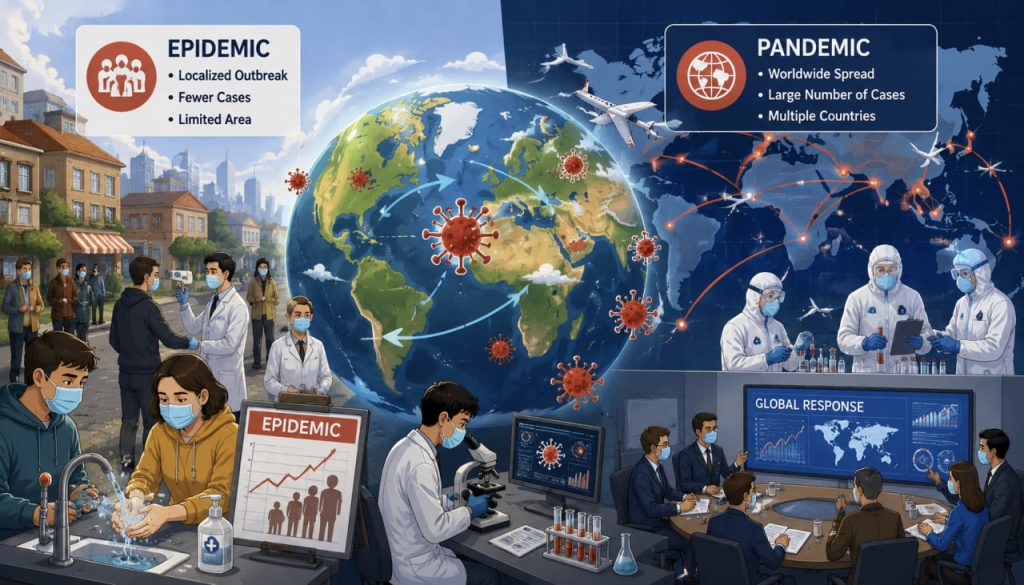
Human civilization has always faced dangerous infectious diseases. Throughout history, outbreaks of illness changed:
- Economies
- Governments
- Science
- Population growth
- Daily human life
Some outbreaks remained local, while others spread across entire continents and affected millions of people.
Modern medicine significantly improved humanity’s ability to fight infectious diseases, yet epidemics and pandemics continue posing major global risks.
Recent global events reminded the world that infectious diseases can rapidly influence:
- Healthcare systems
- International travel
- Supply chains
- Education
- Social stability
Understanding the difference between an epidemic and a pandemic is essential for understanding how diseases spread and how societies respond to biological threats.
The study of infectious disease combines:
- Medicine
- Biology
- Epidemiology
- Public health
- Global cooperation
Humanity’s future may partly depend on how effectively it prepares for future outbreaks.
What Is an Epidemic?
An epidemic occurs when a disease spreads rapidly within:
- A region
- A city
- A country
- A specific population
The number of cases rises significantly above normal expectations.
Epidemics may involve:
- Viral diseases
- Bacterial infections
- Foodborne illnesses
- New emerging pathogens
Examples from history include:
- Cholera outbreaks
- Regional influenza waves
- Ebola outbreaks
Epidemics may sometimes remain localized and eventually become controlled through public health measures.
What Is a Pandemic?
A pandemic is a much larger event.
A pandemic occurs when an infectious disease spreads:
- Across multiple countries
- Across continents
- Worldwide
Pandemics involve sustained international transmission affecting very large populations.
The most famous historical examples include:
- The Black Death
- The 1918 influenza pandemic
- COVID-19
Pandemics often create widespread social, economic, and political consequences beyond healthcare alone.
Why Diseases Spread So Quickly Today
Modern globalization significantly increases disease transmission speed.
Today people travel internationally within hours using:
- Airplanes
- Trains
- Ships
Large cities with dense populations also increase opportunities for viral spread.
Global trade and interconnected supply systems make the modern world highly connected biologically as well as economically.
This means local outbreaks may potentially become international crises much faster than in earlier centuries.
How Viruses and Bacteria Spread
Infectious diseases spread through different mechanisms depending on the pathogen.
Common transmission methods include:
- Airborne droplets
- Physical contact
- Contaminated food or water
- Animal transmission
- Blood exposure
Some pathogens spread extremely efficiently, especially in crowded environments.
Understanding transmission pathways is critical for outbreak control.
The Role of Epidemiology
Epidemiology is the scientific study of disease spread within populations.
Epidemiologists analyze:
- Infection patterns
- Transmission rates
- Population behavior
- Risk factors
This field helps governments and healthcare systems respond more effectively during outbreaks.
Epidemiologist Larry Brilliant once said:
“Outbreaks are inevitable, but pandemics are optional.”
His statement emphasizes the importance of preparation and rapid response.
Why New Diseases Appear
New infectious diseases may emerge for several reasons:
- Viral mutation
- Animal-to-human transmission
- Environmental change
- Global travel
- Deforestation
- Climate shifts
Many dangerous viruses originate in animals before crossing into humans.
This process is called:
- Zoonotic transmission
Scientists closely monitor emerging diseases worldwide to detect threats early.
Vaccines and Medical Protection
Vaccination became one of the most powerful tools in disease prevention.
Vaccines help the immune system recognize pathogens before severe illness develops.
Vaccination programs helped reduce or eliminate diseases such as:
- Smallpox
- Polio in many regions
- Certain forms of measles
During pandemics, vaccine development may become critically important for reducing severe outcomes and mortality.
Modern biotechnology significantly accelerated vaccine research capabilities.
Quarantine and Public Health Measures
Throughout history, societies used various methods to slow disease spread.
Common measures include:
- Quarantine
- Isolation
- Masking
- Hygiene practices
- Travel restrictions
Public health systems attempt to:
- Reduce transmission
- Protect hospitals
- Slow outbreak growth
The effectiveness of these measures often depends on:
- Timing
- Public cooperation
- Government coordination
Economic and Social Impact
Pandemics affect far more than health alone.
Large outbreaks may disrupt:
- Employment
- Education
- Transportation
- Manufacturing
- International trade
Mental health impacts may also become significant due to:
- Fear
- Isolation
- Uncertainty
Recent global outbreaks demonstrated how interconnected modern civilization has become.
Technology and Disease Tracking
Modern outbreak response increasingly relies on technology.
Scientists use:
- Genetic sequencing
- Artificial intelligence
- Data modeling
- Global monitoring systems
Digital systems help track:
- Infection spread
- Mutation patterns
- Healthcare capacity
Rapid information sharing became one of the most important modern tools in pandemic management.
Misinformation During Outbreaks
One major modern challenge involves:
- Misinformation
False information may spread rapidly through:
- Social media
- Rumors
- Unverified sources
This can:
- Increase panic
- Reduce trust
- Harm public health efforts
Accurate scientific communication became critically important during modern outbreaks.
Could Future Pandemics Happen Again?
Most scientists believe future pandemics are likely inevitable.
Factors increasing future risks include:
- Population growth
- Urbanization
- Environmental disruption
- Global travel
However, humanity now possesses:
- Better medicine
- Faster communication
- Advanced biotechnology
- Improved surveillance systems
Preparedness may significantly reduce future damage.
Climate Change and Disease Spread
Climate change may also influence infectious disease patterns.
Warmer temperatures can affect:
- Mosquito distribution
- Water quality
- Ecosystem balance
Some diseases may spread into regions previously unaffected.
Environmental changes therefore increasingly intersect with public health.
Why Pandemic Preparedness Matters
Pandemics reveal both the strengths and vulnerabilities of human civilization.
They test:
- Healthcare systems
- Scientific cooperation
- Political coordination
- Social resilience
Preparing for future outbreaks requires:
- Medical investment
- Research
- International collaboration
- Public education
Humanity cannot eliminate all disease risks, but understanding epidemics and pandemics helps societies respond faster and more effectively when new threats emerge.
Interesting Facts
- The word “pandemic” comes from Greek words meaning “all people.”
- Smallpox became one of the first diseases eradicated through vaccination.
- Many new infectious diseases originate in animals.
- Modern genetic sequencing helps scientists identify pathogens rapidly.
- Air travel greatly increased the speed of global disease spread.
Glossary
- Epidemic — A rapid increase of disease cases within a region or population.
- Pandemic — A worldwide outbreak affecting multiple countries or continents.
- Virus — A microscopic infectious agent requiring living cells to reproduce.
- Epidemiology — The scientific study of disease spread in populations.
- Quarantine — Restricting movement to prevent disease transmission.