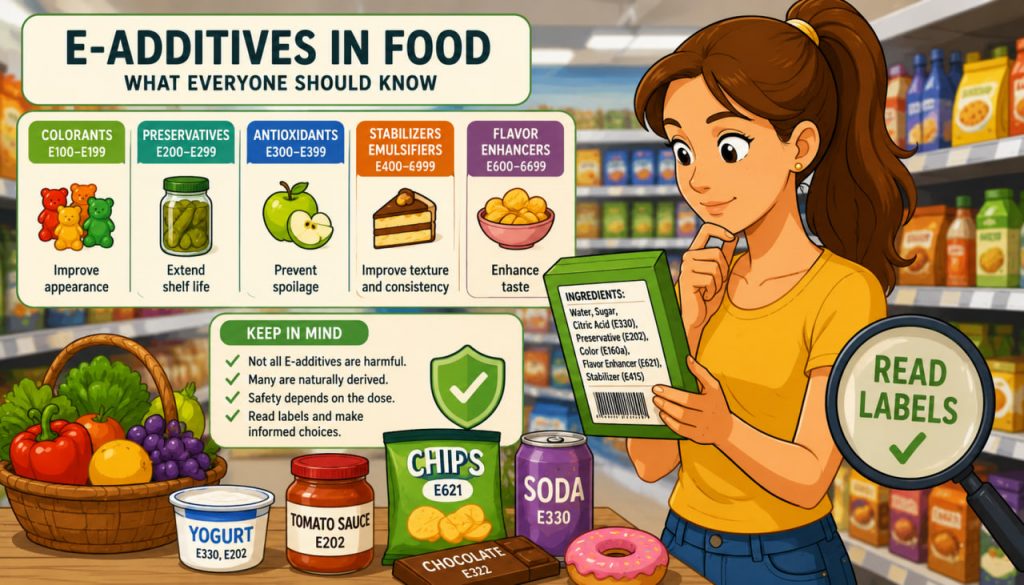
Modern food products often contain ingredients marked with codes such as:
- E100
- E202
- E330
- E621
For many consumers, these “E-numbers” sound mysterious or even dangerous. Some people believe all food additives are harmful chemicals, while others argue they are completely safe and scientifically tested.
The truth is more complex.
E-additives are substances used in food production for many purposes, including:
- Preservation
- Coloring
- Flavor enhancement
- Texture improvement
- Shelf-life extension
Some additives are naturally derived, while others are synthetically produced.
Understanding what E-additives actually are helps consumers make more informed decisions instead of relying only on fear or misinformation.
Food additives became extremely important in modern food systems because they help support:
- Food safety
- Transportation
- Mass production
- Product stability
- Global food distribution
At the same time, scientists continue researching how certain additives may affect human health.
What Does the “E” Mean?
The letter “E” refers to:
- Europe
E-numbers are part of a standardized system developed for food additives approved for use within European food regulations.
Each number identifies a specific additive that has been evaluated for food use.
Importantly:
- An E-number does not automatically mean something is dangerous.
Many common natural substances also have E-numbers.
For example:
- Vitamin C is E300
- Citric acid is E330
These substances occur naturally in many fruits.
Why Food Additives Are Used
Food additives help manufacturers solve practical challenges in food production.
They may:
- Prevent spoilage
- Improve taste
- Maintain texture
- Stabilize ingredients
- Preserve color
- Extend shelf life
Without preservatives, many foods would spoil much faster.
Modern global food transportation would also become far more difficult.
Additives became increasingly common as industrial food systems expanded worldwide.
Main Categories of E-Additives
E-additives are grouped into several categories.
Common examples include:
Colorants
Used to improve or restore food appearance.
Examples:
- E100 (Curcumin)
- E160a (Beta-carotene)
Preservatives
Help prevent bacterial or fungal growth.
Examples:
- E200 series
Antioxidants
Reduce oxidation and spoilage.
Examples:
- E300 (Vitamin C)
Stabilizers and Emulsifiers
Improve texture and consistency.
Examples:
- E400 series
Flavor Enhancers
Increase taste intensity.
Examples:
- E621 (Monosodium glutamate)
Understanding categories helps consumers interpret labels more accurately.
Are All E-Additives Artificial?
No.
One of the biggest misconceptions is that all E-additives are synthetic chemicals.
In reality, many additives come from natural sources such as:
- Plants
- Fruits
- Seaweed
- Minerals
Examples include:
- Pectin
- Citric acid
- Natural pigments
Some additives are produced synthetically because industrial manufacturing requires stable large-scale production.
The safety of an additive depends more on:
- Dosage
- Biological effects
- Long-term exposure
rather than simply whether it is “natural” or “artificial.”
How Food Additives Are Tested
Before approval, food additives typically undergo scientific evaluation.
Researchers study:
- Toxicity
- Metabolism
- Long-term effects
- Safe dosage levels
Regulatory agencies establish:
- Acceptable daily intake limits
Food scientist Marion Nestle explained:
“The dose makes the poison. Nearly everything depends on quantity and exposure.”
This principle is fundamental in toxicology and food safety.
However, scientific debates sometimes continue after approval as new research emerges.
Additives That Generate Controversy
Some additives remain controversial because studies suggested possible links to:
- Allergic reactions
- Hyperactivity
- Digestive issues
- Sensitivities in some individuals
Examples often debated include:
- Artificial colorants
- Certain preservatives
- Flavor enhancers
However, scientific evidence is not always conclusive.
Many health authorities consider approved additives safe within regulated limits.
Still, some consumers choose to limit highly processed foods as a precaution.
Processed Foods and Health
The overall quality of a diet often matters more than individual additives alone.
Highly processed foods may contain:
- Excess sugar
- Excess salt
- Unhealthy fats
- Multiple additives
Nutrition experts generally recommend focusing on:
- Whole foods
- Fruits
- Vegetables
- Balanced diets
rather than fearing every individual E-number automatically.
Reading ingredient lists carefully remains useful for informed choices.
Food Allergies and Sensitivities
Some people may react sensitively to specific additives.
Possible reactions may include:
- Skin irritation
- Digestive discomfort
- Headaches
- Allergic symptoms
However, reactions vary greatly between individuals.
People with known sensitivities should monitor ingredient labels carefully and consult medical professionals when necessary.
Why Additives Became So Common
Modern food systems operate globally.
Food products often travel:
- Long distances
- Through multiple climates
- Over extended storage periods
Additives help maintain:
- Stability
- Safety
- Appearance
- Taste consistency
Without modern preservation systems, food waste could increase significantly.
Food additives therefore play a major economic and logistical role in modern civilization.
Natural and Organic Products
Many consumers increasingly seek:
- Organic foods
- Minimal ingredient products
- Less processed foods
Some organic standards restrict certain additives.
However, even natural foods may still contain approved preservatives or stabilizers.
“Natural” does not automatically guarantee healthier products in every situation.
Balanced understanding is more useful than fear-based assumptions.
Reading Food Labels Correctly
Learning to read labels helps consumers make informed decisions.
Important factors include:
- Ingredient quantity
- Overall nutritional value
- Sugar content
- Salt levels
- Fat quality
- Processing degree
Consumers should avoid focusing only on E-numbers while ignoring overall dietary patterns.
Scientific Research Continues
Food science constantly evolves.
Researchers continue studying:
- Long-term dietary effects
- Gut microbiome interactions
- Combined additive exposure
- Population health patterns
Some additives once considered safe were later restricted, while others proved less dangerous than initially feared.
Science continuously updates recommendations as new evidence becomes available.
Why Understanding E-Additives Matters
Food additives are neither universally dangerous nor completely irrelevant.
They represent an important part of modern food technology that supports:
- Food preservation
- Global supply systems
- Product safety
- Industrial food production
At the same time, understanding food labels helps consumers make healthier and more informed nutritional choices.
Knowledge, moderation, and balanced diets remain more valuable than fear or misinformation when evaluating food additives.
We recommend that you try to eat food without E or with a minimum amount of E, and only use E that is completely safe.
Interesting Facts
- Vitamin C is officially classified as E300.
- Many natural food substances also have E-numbers.
- Preservatives help reduce food spoilage and waste.
- Food additives undergo safety evaluations before approval.
- Some additives are derived from plants or seaweed.
Glossary
- Food Additive — A substance added to food for preservation, texture, color, or flavor.
- Preservative — A compound that helps prevent food spoilage.
- Antioxidant — A substance reducing oxidation and product degradation.
- Emulsifier — A substance helping ingredients mix consistently.
- Processed Food — Food altered through industrial preparation methods.