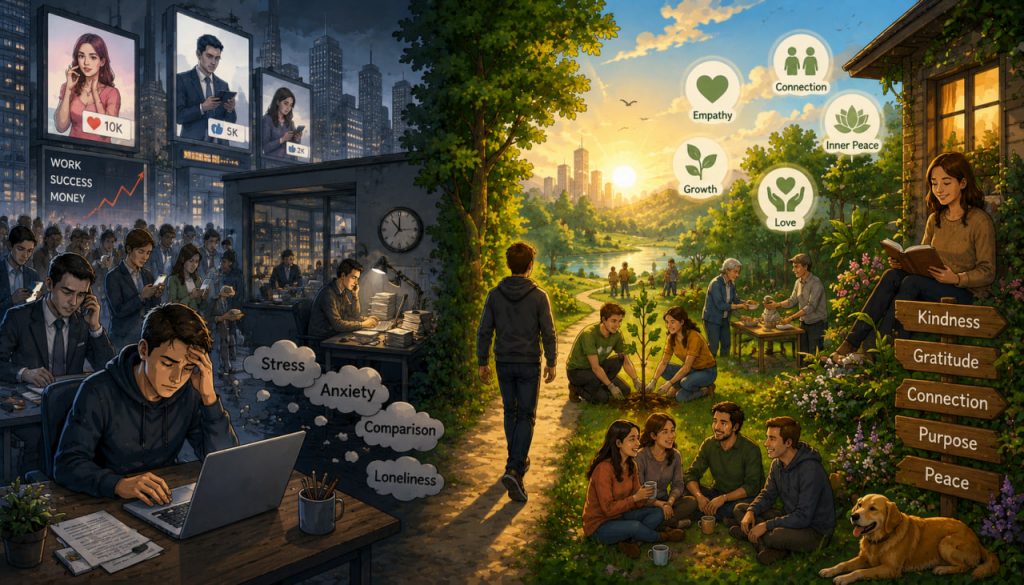
Modern society often appears dominated by stress, competition, anxiety, and constant pressure. Social media, economic uncertainty, fast-paced lifestyles, and information overload increasingly shape human behavior and emotional well-being. In this environment, people who consistently live with kindness, empathy, compassion, and emotional openness may seem unusual or even vulnerable.
Yet psychologists, neuroscientists, and sociologists increasingly study how prosocial behavior — including kindness, love, empathy, and emotional connection — affects human life. Surprisingly, scientific research suggests that genuinely kind and emotionally supportive people may experience major differences in:
- Mental health
- Relationships
- Stress levels
- Longevity
- Social stability
- Overall life satisfaction
Although kindness does not eliminate suffering or guarantee happiness, evidence increasingly suggests that compassionate lifestyles can profoundly influence both psychological and physical well-being.
What Does It Mean to Live Kindly?
Living kindly does not simply mean being “nice.”
Psychologists often associate compassionate living with:
- Empathy
- Emotional intelligence
- Altruism
- Patience
- Forgiveness
- Cooperation
- Emotional warmth
Kind individuals often prioritize:
- Human connection
- Mutual support
- Understanding
- Emotional honesty
This differs significantly from highly competitive or emotionally disconnected lifestyles common in many modern environments.
Why Modern Life Feels Emotionally Difficult
Modern society creates several psychological pressures:
- Constant comparison through social media
- Economic stress
- Information overload
- Reduced face-to-face communication
- Increased loneliness
Many researchers believe humans evolved for close tribal cooperation rather than continuous digital stimulation and social competition.
As a result, emotional exhaustion and anxiety have become widespread in many societies.
The Science of Kindness and the Brain
Neuroscience shows that compassionate behavior influences brain chemistry.
Acts of kindness may stimulate release of:
- Dopamine
- Oxytocin
- Serotonin
These chemicals are strongly connected to:
- Emotional bonding
- Trust
- Motivation
- Psychological well-being
Psychologist and researcher Dr. Stephen Post explained:
“Helping others may contribute to emotional resilience and improved overall health.”
Modern brain imaging studies increasingly support the idea that social connection deeply affects human neurological functioning.
Kindness and Stress Reduction
People living with empathy and emotional openness often experience healthier social relationships.
Strong emotional support networks may reduce:
- Chronic stress
- Feelings of isolation
- Anxiety levels
Human relationships strongly affect nervous system regulation.
Supportive interactions may lower levels of stress hormones such as cortisol.
This may positively influence:
- Sleep
- Cardiovascular health
- Immune function
Compassionate lifestyles may therefore affect physical health indirectly through emotional stability.
Relationships and Emotional Security
One major difference involves relationship quality.
People who value:
- Compassion
- Communication
- Emotional honesty
often build deeper and more stable social bonds.
Strong relationships are among the most important predictors of long-term happiness according to many psychological studies.
The famous Harvard Study of Adult Development concluded that close relationships strongly influence both health and life satisfaction over decades.
Why Kindness Is Sometimes Misunderstood
Despite its benefits, kindness is sometimes mistaken for weakness.
Highly competitive social environments may reward:
- Aggression
- Manipulation
- Dominance
- Emotional detachment
However, psychologists increasingly distinguish between:
- Healthy compassion
- Passive submission
Truly kind individuals often combine empathy with:
- Boundaries
- Emotional maturity
- Self-respect
Compassion does not necessarily mean allowing exploitation.
Loving People and Emotional Perception
Emotionally warm individuals may perceive life differently.
Research suggests compassionate people often:
- Focus more on cooperation
- Experience greater social trust
- Feel stronger emotional meaning
- Value connection over status
This may influence daily decisions, priorities, and long-term goals.
In contrast, chronically competitive environments may increase:
- Social comparison
- Stress
- Emotional isolation
Physical Health and Longevity
Interestingly, emotional well-being may affect physical health.
Some studies associate strong social bonds and emotional support with:
- Lower inflammation
- Better heart health
- Improved immune response
- Increased longevity
Loneliness itself is increasingly viewed as a major public health concern.
Humans are highly social biological organisms, and emotional connection appears deeply connected to survival mechanisms.
Compassion Fatigue and Emotional Burnout
Kind individuals also face challenges.
Constant emotional caregiving without boundaries may lead to:
- Emotional exhaustion
- Compassion fatigue
- Burnout
This is common among:
- Healthcare workers
- Caregivers
- Therapists
- Highly empathetic individuals
Healthy compassion therefore requires balance between:
- Caring for others
- Caring for oneself
Society, Competition, and Human Nature
Modern societies often emphasize:
- Productivity
- Achievement
- Financial success
- Individual competition
Yet evolutionary biology suggests humans survived largely through cooperation and group support.
Anthropologist Margaret Mead once suggested that evidence of compassion and care represented one of the earliest signs of civilization itself.
This reflects how deeply cooperation shaped human development.
Are Kind People Happier?
Happiness is complex and influenced by many factors.
However, research frequently shows that meaningful relationships and emotional connection strongly correlate with life satisfaction.
People focused primarily on:
- Material comparison
- Status competition
- External validation
may experience chronic dissatisfaction despite success.
Meanwhile, emotionally connected individuals often report greater meaning and belonging.
Why Compassion Still Matters
In highly technological societies, emotional connection remains fundamentally human.
Artificial intelligence, automation, and digital communication continue reshaping civilization, but empathy and compassion still strongly influence:
- Mental health
- Families
- Communities
- Cooperation
- Social trust
Many scientists believe future societies will increasingly recognize emotional well-being as essential rather than secondary.
P.S. It’s not for nothing that the two main commandments of the world’s major religions are: Love the Lord your God with all your heart and with all your soul, and love your neighbor as yourself.
Interesting Facts
- Positive social interaction affects brain chemistry.
- Oxytocin is strongly connected to trust and bonding.
- Chronic loneliness may negatively affect physical health.
- Strong relationships are major predictors of life satisfaction.
- Compassion and cooperation played major roles in human evolution.
Glossary
- Empathy — The ability to understand and share another person’s feelings.
- Oxytocin — A hormone associated with bonding and social trust.
- Cortisol — A stress-related hormone produced by the body.
- Altruism — Selfless concern for the well-being of others.
- Compassion Fatigue — Emotional exhaustion caused by prolonged caregiving or empathy.