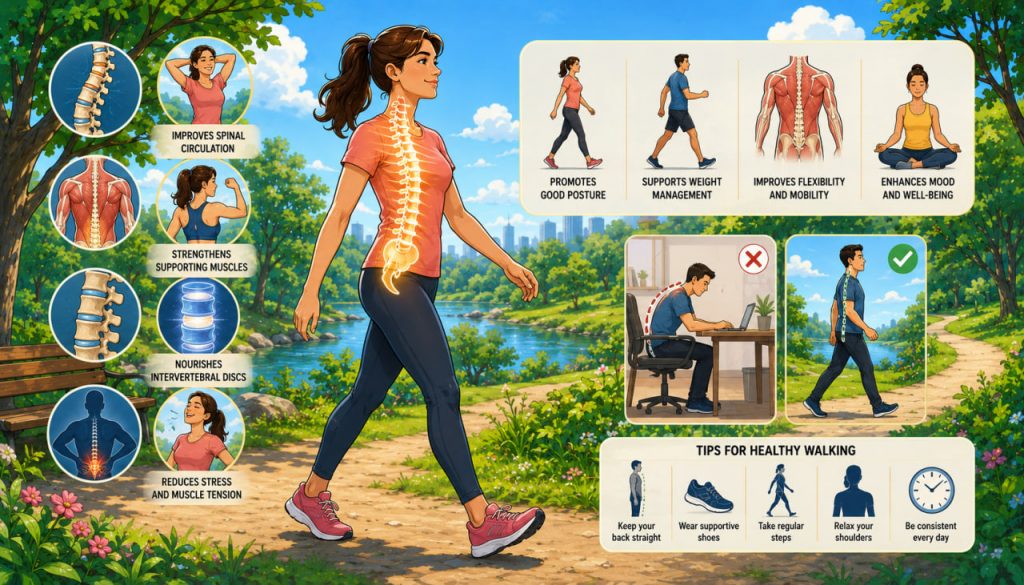
Walking is one of the oldest and most natural forms of human movement. Long before gyms, fitness programs, or modern medicine existed, humans evolved as highly mobile creatures designed for regular movement across long distances. Today, however, many people spend most of their time sitting — in offices, cars, or at home — contributing to growing problems with posture, back pain, and spinal health.
Modern research increasingly shows that regular walking may be one of the simplest and most effective ways to support spinal function, improve posture, reduce back discomfort, and maintain long-term musculoskeletal health.
Although walking may seem too simple to matter, scientists now recognize that this basic activity affects nearly every system connected to spinal stability and movement.
Why the Spine Matters
The human spine is a highly complex structure composed of:
- Vertebrae
- Intervertebral discs
- Ligaments
- Muscles
- Nerves
The spine performs several critical functions:
- Supporting body weight
- Protecting the spinal cord
- Allowing movement and flexibility
- Maintaining posture and balance
Because the spine is constantly involved in movement and load-bearing, lifestyle habits strongly influence its long-term condition.
Modern Sedentary Lifestyle and Back Problems
One major modern health issue is prolonged sitting.
Extended sedentary behavior may contribute to:
- Weak core muscles
- Poor posture
- Reduced spinal mobility
- Muscle imbalance
- Increased lower back stress
Many researchers believe the human body was not designed for long periods of inactivity.
Walking helps counteract some of these problems by restoring natural movement patterns.
How Walking Supports the Spine
Walking benefits spinal health through several mechanisms.
Improved Circulation
Movement increases blood flow to:
- Muscles
- Connective tissues
- Intervertebral discs
This helps deliver nutrients and remove waste products.
Muscle Activation
Walking gently activates:
- Core muscles
- Hip stabilizers
- Postural muscles
These muscles help support spinal alignment.
Joint Mobility
Regular walking helps maintain:
- Flexibility
- Joint lubrication
- Natural spinal motion
Movement is essential for maintaining healthy biomechanics.
Walking and Intervertebral Discs
The spine contains soft structures called intervertebral discs that act like shock absorbers between vertebrae.
Unlike many tissues, spinal discs have limited direct blood supply.
They receive nutrients partly through movement and pressure changes.
Walking creates gentle cyclic loading that may help:
- Support disc nutrition
- Maintain hydration balance
- Improve spinal mechanics
This is one reason moderate movement is often recommended for spinal health.
Can Walking Reduce Back Pain?
Research suggests regular walking may help many people with chronic lower back discomfort.
Walking may:
- Improve muscular endurance
- Reduce stiffness
- Support healthy weight management
- Improve mood and stress levels
A major advantage is that walking is:
- Low impact
- Accessible
- Easy to maintain consistently
Spine specialist Dr. Stuart McGill has emphasized that controlled movement and endurance often matter greatly for spinal resilience.
However, walking alone may not solve all causes of back pain, especially severe structural conditions.
The Connection Between Walking and Posture
Good posture depends heavily on muscular coordination and movement habits.
Walking encourages:
- Upright alignment
- Pelvic stability
- Natural spinal positioning
In contrast, prolonged sitting often promotes:
- Rounded shoulders
- Forward head posture
- Weak postural muscles
Regular movement helps retrain healthier posture patterns over time.
Walking and Weight Management
Excess body weight increases mechanical stress on the spine, especially the lower back.
Walking helps support:
- Calorie expenditure
- Metabolic health
- Healthy body composition
Even moderate weight reduction may decrease spinal load significantly.
Mental Health and Muscle Tension
Stress and anxiety can increase muscle tension, especially in:
- Neck muscles
- Shoulders
- Lower back
Walking positively affects mental health by helping regulate:
- Stress hormones
- Mood
- Nervous system activity
This indirect effect may also reduce tension-related back discomfort.
How Much Walking Is Beneficial?
Experts generally recommend regular moderate movement rather than extreme activity.
Even:
- Short daily walks
- Frequent movement breaks
- Consistent low-intensity activity
may provide benefits for spinal health.
Consistency matters more than occasional intense exercise.
Walking Technique Matters
Proper walking mechanics are important.
Helpful habits include:
- Maintaining upright posture
- Relaxing shoulders
- Avoiding excessive forward head position
- Wearing supportive footwear
Aggressive or poorly aligned walking patterns may create unnecessary stress over time.
Walking vs High-Impact Exercise
High-impact activities may increase stress on joints and spinal structures in some individuals.
Walking offers several advantages:
- Lower injury risk
- Lower joint impact
- Greater sustainability
This makes it suitable for many age groups and fitness levels.
When Walking May Not Be Enough
Certain spinal conditions may require:
- Physical therapy
- Strength training
- Medical evaluation
- Specialized rehabilitation
Examples include:
- Severe disc herniation
- Spinal instability
- Neurological symptoms
Persistent or worsening pain should always be evaluated medically.
The Evolutionary Perspective
Humans evolved as endurance walkers over millions of years.
The musculoskeletal system is highly adapted for regular movement.
Modern inactivity represents a relatively recent lifestyle change in evolutionary history.
Some scientists believe many modern spinal problems are partly linked to movement deprivation.
Why Walking Remains Powerful
Walking is simple, but simplicity does not mean weakness.
Modern science increasingly confirms that regular walking may support:
- Spinal mobility
- Posture
- Circulation
- Mental health
- Muscular endurance
One of the most accessible forms of exercise may also be one of the most biologically natural.
Interesting Facts
- The human spine contains 24 movable vertebrae.
- Intervertebral discs help absorb shock during movement.
- Walking activates numerous stabilizing muscles simultaneously.
- Sedentary lifestyles are associated with increased back problems.
- Humans evolved as long-distance endurance walkers.
Glossary
- Spine — The structure of vertebrae supporting the body and protecting the spinal cord.
- Intervertebral Disc — A soft cushioning structure located between spinal vertebrae.
- Posture — The alignment and positioning of the body.
- Core Muscles — Muscles stabilizing the trunk and spine.
- Biomechanics — The science of movement and mechanical function in living organisms.