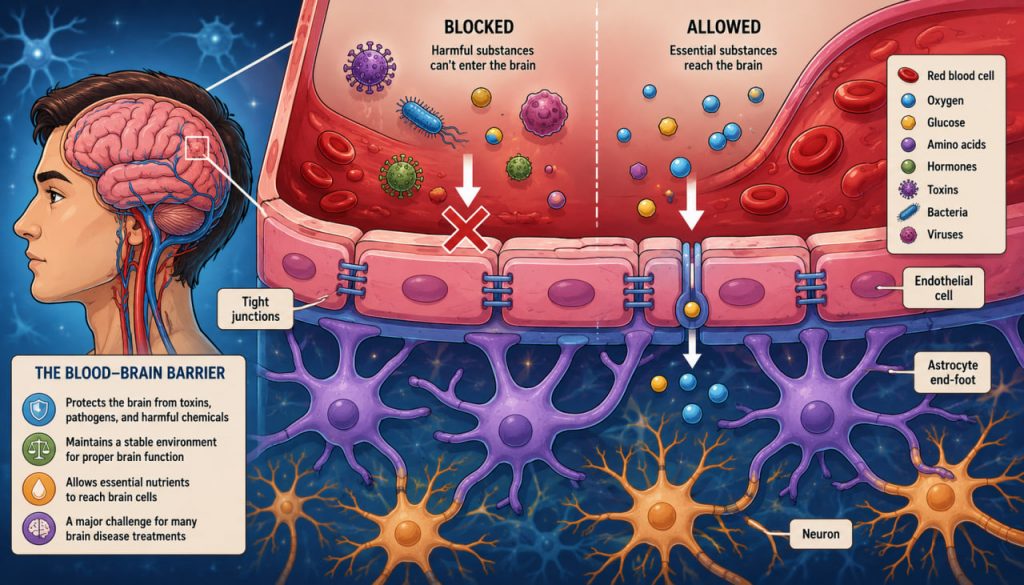
The human brain is one of the most complex and delicate organs in existence. It controls thoughts, emotions, memory, movement, and nearly every vital function in the body. Because the brain is so sensitive, nature developed an extraordinary defense system to protect it from harmful substances circulating in the bloodstream. This system is called the blood-brain barrier.
The blood-brain barrier acts like an intelligent biological filter. It carefully controls which substances can enter the brain while blocking toxins, pathogens, and potentially dangerous molecules. Scientists consider it one of the most important protective mechanisms in the human body.
At the same time, the blood-brain barrier creates major challenges for medicine because it can also prevent life-saving drugs from reaching the brain effectively.
What Is the Blood-Brain Barrier?
The blood-brain barrier, often abbreviated as BBB, is a highly selective protective barrier separating the bloodstream from brain tissue.
It consists mainly of:
- Specialized blood vessel cells
- Tight cellular junctions
- Supporting brain cells
Unlike ordinary blood vessels elsewhere in the body, blood vessels in the brain are sealed extremely tightly.
This structure allows the brain to maintain a stable internal environment essential for proper neural function.
Why the Brain Needs Protection
The bloodstream carries many substances throughout the body:
- Nutrients
- Hormones
- Immune cells
- Chemicals
- Toxins
While most organs can tolerate fluctuations in blood composition, the brain is far more sensitive.
Even small chemical imbalances may disrupt:
- Neuron signaling
- Consciousness
- Memory
- Motor control
The blood-brain barrier helps prevent harmful disturbances from affecting brain activity.
How the Blood-Brain Barrier Works
The barrier functions through highly specialized endothelial cells lining brain capillaries.
These cells are connected by tight junctions, which severely restrict movement between them.
As a result:
- Large molecules struggle to pass through
- Many toxins are blocked
- Most bacteria and viruses cannot enter easily
At the same time, essential substances still reach the brain through carefully regulated transport systems.
The barrier selectively allows:
- Oxygen
- Glucose
- Certain amino acids
- Small fat-soluble molecules
This balance is crucial for brain survival.
The Role of Astrocytes
Specialized support cells called astrocytes also help maintain the blood-brain barrier.
Astrocytes:
- Support neurons
- Regulate chemical balance
- Help strengthen barrier integrity
These cells communicate closely with blood vessels to maintain stable conditions inside the brain.
Modern neuroscience increasingly recognizes astrocytes as active participants in brain protection and communication.
Why the Blood-Brain Barrier Is a Medical Challenge
Although the BBB protects the brain, it also creates difficulties for medicine.
Many drugs cannot cross the barrier effectively, including treatments for:
- Brain tumors
- Alzheimer’s disease
- Parkinson’s disease
- Neurological infections
This means scientists must develop specialized strategies to deliver medication into the brain safely.
Neuroscientist William Pardridge explained:
“The blood-brain barrier is the single greatest challenge in developing neurotherapeutics.”
Researchers continue searching for better delivery methods.
Can the Barrier Be Damaged?
Yes — several conditions may weaken or disrupt the blood-brain barrier.
Possible causes include:
- Traumatic brain injury
- Stroke
- Chronic inflammation
- Infections
- Neurodegenerative diseases
When the barrier becomes compromised, harmful substances may enter brain tissue more easily.
This may contribute to:
- Swelling
- Neuroinflammation
- Cognitive problems
Scientists believe BBB dysfunction may play an important role in several neurological disorders.
Blood-Brain Barrier and Alzheimer’s Disease
Researchers increasingly study how BBB deterioration may contribute to Alzheimer’s disease.
If the barrier weakens:
- Toxic proteins may accumulate more easily
- Inflammation may increase
- Brain repair mechanisms may decline
Some scientists suspect that blood-brain barrier dysfunction may occur early in disease progression.
Understanding this process could improve future treatments.
How Scientists Deliver Drugs Across the BBB
Researchers are developing advanced methods to bypass or penetrate the blood-brain barrier safely.
Experimental approaches include:
- Nanoparticles
- Ultrasound-assisted delivery
- Molecular transport systems
- Engineered antibodies
Some treatments temporarily open parts of the barrier under controlled conditions.
However, maintaining safety remains extremely important because excessive barrier disruption could damage brain tissue.
The Blood-Brain Barrier and Viruses
The BBB blocks many pathogens, but some viruses can still cross it under certain conditions.
Examples include:
- Rabies virus
- HIV
- Certain encephalitis viruses
Scientists study how these pathogens bypass brain defenses to improve future prevention and treatment strategies.
Evolutionary Importance of the BBB
The blood-brain barrier evolved as an essential adaptation for complex nervous systems.
Without strict chemical regulation:
- Neural communication would become unstable
- Brain tissue would face constant biological threats
- Cognitive function could not operate efficiently
The BBB allows the human brain to function with remarkable precision.
Future Research and Brain Medicine
Future neuroscience may revolutionize how doctors treat brain diseases.
Researchers are exploring:
- Smart drug delivery systems
- AI-guided molecular therapies
- Nanotechnology for brain treatment
- Personalized neuropharmacology
Better understanding the blood-brain barrier could transform treatment for many neurological disorders.
Why the Blood-Brain Barrier Matters
The blood-brain barrier is more than just a biological wall. It is an intelligent defense system essential for consciousness, cognition, and survival itself.
It protects the brain every second of life while simultaneously challenging scientists to develop new medical technologies.
Understanding the BBB reveals how incredibly sophisticated the human body truly is.
Interesting Facts
- The blood-brain barrier blocks many common medications from reaching the brain.
- Brain capillaries are structurally different from blood vessels elsewhere in the body.
- The BBB helps maintain stable brain chemistry.
- Scientists use nanotechnology to study future brain drug delivery systems.
- Some diseases may weaken the blood-brain barrier over time.
Glossary
- Blood-Brain Barrier (BBB) — A protective biological barrier separating the bloodstream from brain tissue.
- Neuron — A nerve cell responsible for transmitting signals in the nervous system.
- Astrocyte — A support cell in the brain helping maintain neural stability and BBB integrity.
- Capillary — A tiny blood vessel where exchange of substances occurs.
- Neuroinflammation — Inflammation affecting nervous system tissues.