Modern humans live surrounded by synthetic materials. Plastic packaging, polluted air, industrial chemicals, heavy metals, pesticides, and microscopic particles are now part of everyday life. Scientists have even detected tiny plastic particles — called microplastics — in human blood, lungs, and other tissues.
This naturally raises an important question: can the body remove harmful substances such as plastics and toxins, and is it possible to help this process safely?
The answer is complex. The human body already possesses highly sophisticated detoxification systems, but modern environmental exposure places increasing pressure on these biological defenses. While many “detox” products advertised online lack scientific evidence, researchers agree that certain healthy habits may help support the body’s natural elimination processes and reduce exposure to harmful substances.
What Are Microplastics?
Microplastics are extremely small plastic particles typically less than 5 millimeters in size.
They originate from:
- Plastic packaging
- Synthetic clothing
- Tire wear
- Cosmetic products
- Industrial waste
Humans may inhale or consume microplastics through:
- Food
- Water
- Air
Researchers continue studying how these particles affect long-term human health.
The Body Already Has Detoxification Systems
The human body constantly removes waste and harmful substances through several major organs.
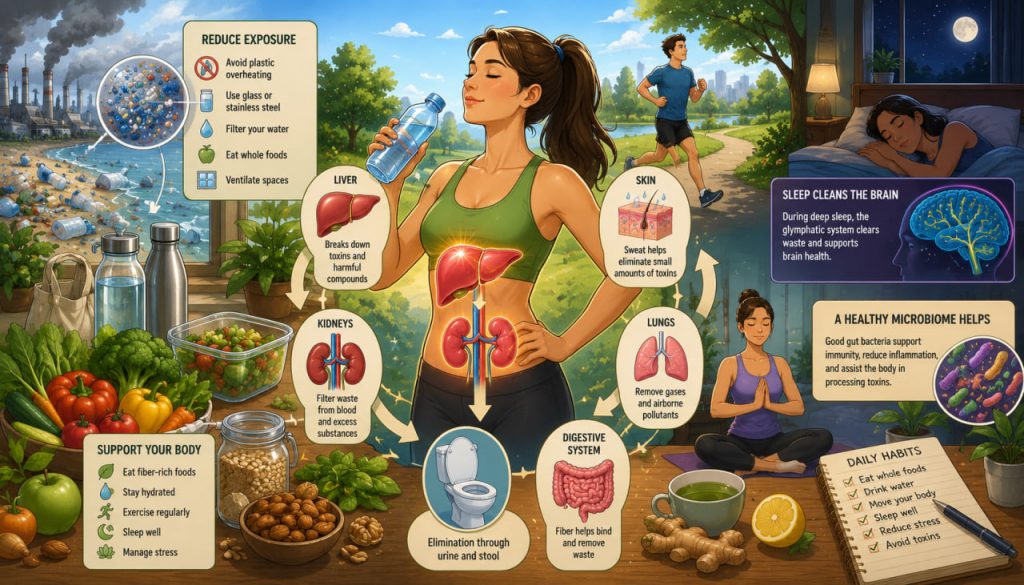
Key detoxification systems include:
- Liver
- Kidneys
- Lungs
- Digestive system
- Skin
These systems filter, process, and eliminate many toxins naturally.
The liver plays a particularly important role by chemically transforming harmful compounds into forms the body can excrete more easily.
Toxicologist Dr. David Bellinger explained:
“The body has evolved remarkable mechanisms to process and remove many environmental chemicals.”
However, not all substances are eliminated equally efficiently.
Can the Body Remove Microplastics?
Scientists still do not fully understand how the body handles microplastics.
Some tiny particles may:
- Pass through the digestive system and leave naturally
- Become trapped temporarily in tissues
- Trigger inflammatory responses
Research is ongoing regarding whether certain particles accumulate long-term in the body.
Currently, there is no scientifically proven method that can completely “clean” microplastics from human tissues.
Many commercial detox claims lack reliable evidence.
Why the Liver Is So Important
The liver functions as the body’s main chemical processing center.
It helps:
- Break down toxins
- Neutralize harmful compounds
- Process medications
- Support metabolic balance
Supporting liver health may improve the body’s natural detoxification capacity.
Doctors generally recommend:
- Balanced nutrition
- Limiting excessive alcohol
- Maintaining healthy weight
- Avoiding unnecessary toxic exposure
rather than relying on extreme detox programs.
The Role of the Kidneys
The kidneys filter enormous amounts of blood every day.
They remove:
- Waste products
- Excess minerals
- Water-soluble toxins
Hydration is essential for proper kidney function.
Drinking enough water supports:
- Urine production
- Waste elimination
- Overall metabolic health
However, excessive “detox water cures” or extreme cleansing practices are not scientifically necessary for healthy individuals.
Fiber and Digestive Elimination
Dietary fiber plays an important role in removing waste through the digestive system.
Fiber may help:
- Improve bowel movement regularity
- Bind certain substances in the gut
- Support healthy gut bacteria
Foods rich in fiber include:
- Vegetables
- Fruits
- Whole grains
- Legumes
A healthy digestive system supports the body’s natural elimination pathways.
Exercise and Sweat
Physical activity indirectly supports detoxification by improving:
- Circulation
- Metabolism
- Cardiovascular health
Sweating eliminates small amounts of certain substances, but scientists emphasize that sweat is not the body’s primary detox system.
The major detoxification work is still performed mainly by:
- Liver
- Kidneys
- Digestive organs
Exercise remains beneficial overall for long-term health and resilience.
Sleep and Brain Detoxification
Recent neuroscience research discovered that the brain has its own waste-clearing system called the glymphatic system.
This system becomes especially active during sleep.
During deep sleep:
- Metabolic waste is cleared more efficiently
- Brain fluid circulation increases
Poor sleep may reduce this natural cleaning process.
This is one reason why chronic sleep deprivation negatively affects long-term health.
Reducing Exposure Is Often More Important
Experts increasingly emphasize that reducing exposure to harmful substances may be more effective than attempting aggressive “detoxification.”
Practical ways to reduce exposure include:
- Avoiding excessive plastic heating
- Using glass or stainless-steel containers
- Ventilating indoor spaces
- Limiting tobacco smoke exposure
- Washing fruits and vegetables
Small lifestyle changes may reduce cumulative environmental exposure over time.
Are Detox Diets Scientifically Proven?
Many commercial detox diets, supplements, and cleanses promise dramatic toxin removal.
However, scientists warn that:
- Most detox products lack strong evidence
- Extreme cleanses may sometimes be harmful
- The body already performs detoxification naturally
Nutrition researchers generally support balanced long-term habits rather than short-term extreme detox programs.
Microbiome and Toxin Processing
Scientists are also studying how gut bacteria influence detoxification.
The gut microbiome may affect:
- Chemical metabolism
- Inflammation
- Immune responses
A healthy microbiome may help the body process some environmental substances more effectively.
This area remains an active field of research.
The Future of Detoxification Research
Future medicine may develop advanced methods to:
- Detect environmental pollutants in tissues
- Improve toxin elimination
- Reduce microplastic exposure
- Protect cells from chemical damage
Researchers continue investigating how modern pollution affects long-term human biology.
Why This Topic Matters
Modern humans live in an environment filled with synthetic chemicals and microscopic pollutants never encountered during most of evolutionary history.
Understanding how the body processes these substances is becoming increasingly important for:
- Public health
- Environmental policy
- Nutrition science
- Preventive medicine
While no magical detox solution exists, supporting the body’s natural systems through healthy habits remains the most scientifically supported approach.
Interesting Facts
- Scientists have detected microplastics in human blood samples.
- The liver performs hundreds of important chemical processes daily.
- Sleep activates special brain-cleaning mechanisms.
- The kidneys filter roughly dozens of liters of blood every day.
- Many online detox products are not supported by strong scientific evidence.
Glossary
- Microplastics — Extremely small plastic particles found in the environment and sometimes inside living organisms.
- Detoxification — The biological process of removing harmful substances from the body.
- Liver — An organ responsible for chemical processing and detoxification.
- Glymphatic System — A brain waste-removal system most active during sleep.
- Microbiome — The community of microorganisms living inside the human body.