Olive oil has been valued for thousands of years as one of the healthiest and most important foods in Mediterranean culture. Often called “liquid gold,” it is used in cooking, cosmetics, medicine, and even religious traditions. Today, olive oil remains one of the world’s most respected natural products because of its flavor, nutritional benefits, and rich history.
But how exactly is olive oil made? The production process combines ancient agricultural traditions with modern technology designed to preserve quality, aroma, and nutrients.
From harvesting olives to extracting pure oil, every step plays an important role in determining the final product.
What Is Olive Oil?
Olive oil is a natural oil extracted from the fruit of the olive tree (Olea europaea).
Unlike many vegetable oils produced using chemical processing, high-quality olive oil is made primarily through mechanical extraction.
The oil contains:
- Healthy monounsaturated fats
- Antioxidants
- Vitamins
- Natural plant compounds called polyphenols
These substances contribute to olive oil’s reputation as one of the healthiest fats in the human diet.
The Importance of Olive Trees
Olive trees are among the oldest cultivated plants in human history.
They thrive in:
- Warm Mediterranean climates
- Rocky soils
- Dry environments
Many olive trees can live for hundreds or even thousands of years.
Countries famous for olive oil production include:
- Spain
- Italy
- Greece
- Turkey
- Tunisia
The flavor and quality of olive oil depend heavily on:
- Olive variety
- Climate
- Soil conditions
- Harvest timing
Harvesting the Olives
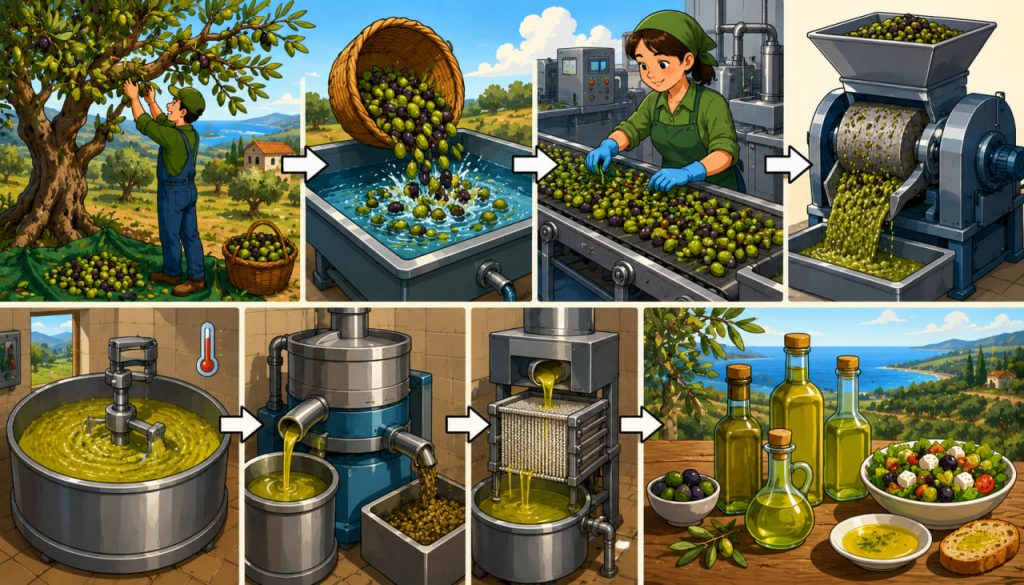
The process begins with harvesting ripe olives from trees.
Traditionally, olives were collected by hand or shaken from branches onto nets.
Modern farms may use:
- Mechanical shakers
- Harvesting machines
- Specialized comb tools
Harvest timing is extremely important.
Early-harvest olives usually produce:
- Stronger flavors
- More antioxidants
- Lower oil yield
Riper olives often create:
- Milder taste
- Higher oil quantity
Producers carefully balance quality and productivity.
Cleaning and Sorting
After harvesting, olives are quickly transported to mills to prevent spoilage.
The olives are then:
- Washed with water
- Cleared of leaves and branches
- Sorted for quality
Freshness is critical because damaged or fermented olives can reduce oil quality significantly.
High-end olive oil producers often process olives within hours after harvesting.
Crushing the Olives
Next, the olives are crushed into a thick paste.
Modern mills usually use:
- Stainless steel grinders
- Hammer crushers
- Stone mills in traditional methods
Importantly, the entire olive is crushed:
- Flesh
- Skin
- Pit
This paste contains:
- Oil droplets
- Water
- Solid olive material
Crushing releases the oil trapped inside the fruit cells.
Malaxation: Mixing the Olive Paste
After crushing, the olive paste is slowly mixed in a process called malaxation.
This stage helps tiny oil droplets combine into larger droplets, making extraction easier.
Temperature control is extremely important.
For extra virgin olive oil, producers keep temperatures relatively low to preserve:
- Flavor
- Aroma
- Nutritional compounds
This is why premium olive oil is often labeled as “cold pressed” or “cold extracted.”
Olive oil expert Paul Vossen explained:
“Temperature and oxygen exposure strongly influence olive oil quality.”
Careful processing helps preserve the oil’s delicate chemical profile.
Separating the Oil
The next step separates oil from water and solid material.
Modern systems commonly use centrifuges that spin the olive paste rapidly.
The spinning process separates:
- Olive oil
- Vegetation water
- Solid residue
Traditional methods once used pressing mats and hydraulic presses, but modern centrifuges are more hygienic and efficient.
Filtering and Storage
Freshly extracted olive oil may contain tiny particles and moisture.
Some producers filter the oil to improve:
- Clarity
- Shelf life
- Stability
Others prefer unfiltered oil for a stronger, rustic flavor.
Proper storage is essential because olive oil is sensitive to:
- Light
- Heat
- Oxygen
High-quality olive oil is usually stored in:
- Dark bottles
- Stainless steel tanks
- Cool environments
Types of Olive Oil
Not all olive oils are the same.
Extra Virgin Olive Oil
The highest quality type.
Characteristics:
- Mechanically extracted
- No chemical refining
- Low acidity
- Strong natural flavor
Virgin Olive Oil
Also mechanically extracted but with slightly higher acidity and lower quality standards.
Refined Olive Oil
Processed further to remove defects, often resulting in milder flavor and reduced nutrients.
Why Olive Oil Is Considered Healthy
Olive oil is strongly associated with the Mediterranean diet.
Research suggests it may help support:
- Heart health
- Reduced inflammation
- Healthy cholesterol levels
Its healthy fats and antioxidants contribute to its positive nutritional reputation.
However, moderation remains important because olive oil is still calorie-dense.
The Cultural Importance of Olive Oil
For thousands of years, olive oil has symbolized:
- Prosperity
- Peace
- Purity
Ancient civilizations used it for:
- Cooking
- Medicine
- Religious ceremonies
- Lamps
Even today, olive oil remains deeply connected to Mediterranean identity and cuisine.
Interesting Facts
- Some olive trees are believed to be over 2,000 years old.
- Extra virgin olive oil is made without chemical solvents.
- Olive oil quality can decline if exposed to heat or sunlight.
- Spain is the world’s largest olive oil producer.
- Fresh olive oil often has grassy or fruity aromas.
Glossary
- Extra Virgin Olive Oil — The highest quality olive oil produced through mechanical extraction with low acidity.
- Polyphenols — Natural antioxidant compounds found in plants.
- Malaxation — Slow mixing of olive paste during oil extraction.
- Centrifuge — A machine that separates substances through rapid spinning.
- Cold Extraction — Producing olive oil at controlled low temperatures to preserve quality.