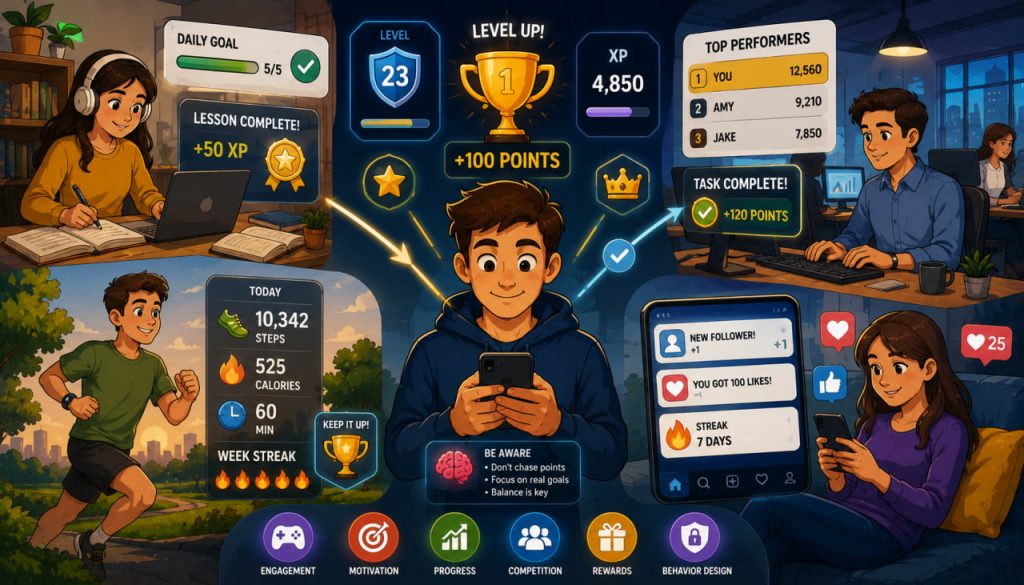
Modern life increasingly feels like a giant game. People collect points for exercise, earn badges for learning languages, climb productivity rankings at work, and receive digital rewards for shopping, studying, or even sleeping well. This phenomenon is known as gamification — the use of game-like mechanics in non-game environments.
Originally popularized in marketing and mobile apps, gamification has expanded into education, workplaces, healthcare, finance, and social media. Supporters argue that it increases motivation and engagement. Critics warn that it may manipulate human psychology and transform everyday life into a system of endless digital rewards and behavioral control.
As technology becomes more integrated into daily routines, gamification is quietly shaping how millions of people think, work, and behave.
What Is Gamification?
Gamification means applying elements commonly found in games to ordinary activities.
Typical gamification features include:
- Points
- Achievements
- Levels
- Rankings
- Rewards
- Progress bars
- Challenges
These systems are designed to encourage participation and repeated engagement.
For example:
- Fitness apps reward exercise streaks
- Educational apps give experience points
- Workplace platforms track employee achievements
The goal is to make tasks feel more engaging and psychologically rewarding.
Why Gamification Works So Well
Gamification taps into fundamental psychological mechanisms.
Humans naturally respond to:
- Competition
- Achievement
- Social recognition
- Reward anticipation
Even small digital rewards can activate motivational systems in the brain.
Behavioral researcher Yu-kai Chou explained:
“Gamification is about understanding what motivates people and designing systems that engage those motivations.”
The effectiveness comes not from the rewards themselves, but from how they influence behavior and emotional satisfaction.
Gamification in Education
Educational platforms increasingly use gamification to make learning more interactive.
Common features include:
- Daily learning streaks
- Level progression
- Virtual rewards
- Achievement systems
Language-learning apps are among the most famous examples.
Supporters argue that gamification:
- Improves motivation
- Encourages consistency
- Makes difficult subjects feel less intimidating
For many students, turning education into a challenge-based system increases participation significantly.
Workplace Gamification
Companies also use gamification to increase employee productivity.
Workplace systems may track:
- Sales performance
- Task completion
- Team rankings
- Customer ratings
Employees sometimes receive:
- Badges
- Public recognition
- Performance points
While these systems can improve efficiency, critics argue they may also increase stress and constant performance pressure.
Social Media and Psychological Rewards
Social media platforms heavily rely on gamification principles.
Features such as:
- Likes
- Follower counts
- Notifications
- Streak systems
create feedback loops that encourage users to return repeatedly.
These mechanisms trigger dopamine-related reward pathways associated with anticipation and social validation.
This helps explain why social media can become highly habit-forming.
Fitness and Health Gamification
Health and fitness apps often use game mechanics to encourage healthier behavior.
Examples include:
- Step counters
- Daily goals
- Virtual competitions
- Reward systems for consistency
Gamification can help users:
- Exercise more regularly
- Track progress visually
- Maintain long-term habits
In some cases, healthcare systems are experimenting with gamified wellness programs to improve patient engagement.
The Dark Side of Gamification
Although gamification can be useful, experts also warn about potential negative effects.
Possible concerns include:
- Addiction-like behavior
- Emotional manipulation
- Increased anxiety
- Loss of intrinsic motivation
When every activity becomes reward-driven, people may begin focusing more on points and external validation than on genuine interest or personal meaning.
Some critics argue that excessive gamification may reduce authentic human motivation.
Intrinsic vs Extrinsic Motivation
Psychologists distinguish between:
- Intrinsic motivation
- Extrinsic motivation
Intrinsic motivation comes from genuine enjoyment or curiosity.
Extrinsic motivation relies on external rewards such as:
- Points
- Money
- Status
- Badges
Overreliance on external rewards can sometimes weaken internal motivation over time.
This is an important debate in education and workplace psychology.
Gamification and Behavioral Control
Some researchers believe gamification may become a subtle tool of social control.
Digital systems can shape behavior by rewarding:
- Certain actions
- Productivity patterns
- Consumption habits
This raises ethical questions about:
- Manipulation
- Surveillance
- Autonomy
As algorithms become more sophisticated, gamified systems may increasingly influence everyday decision-making.
Why Humans Enjoy Progress Systems
Humans are naturally motivated by visible progress.
Progress bars, levels, and achievement systems provide:
- Clear goals
- Frequent feedback
- Sense of accomplishment
Games mastered these psychological techniques long before they spread into real-world applications.
Modern technology companies now use similar principles across countless digital platforms.
The Future of Gamification
Gamification is likely to expand even further with:
- Artificial intelligence
- Virtual reality
- Personalized digital systems
Future systems may adapt rewards dynamically based on:
- Personality
- Emotional responses
- Behavioral patterns
Some experts believe future societies may become increasingly structured around invisible motivational systems embedded into everyday life.
Why Gamification Matters
Gamification is not simply about entertainment. It reflects a deeper transformation in how technology shapes human behavior.
It influences:
- Learning habits
- Work culture
- Social interaction
- Consumer behavior
Understanding gamification helps people recognize how digital systems are designed to capture attention, guide decisions, and influence motivation.
Interesting Facts
- Gamification became a major business trend in the 2010s.
- Many fitness apps use reward systems inspired by video games.
- Social media notifications rely heavily on behavioral psychology.
- Progress bars significantly increase task completion rates.
- Some companies experiment with AI-driven personalized motivation systems.
Glossary
- Gamification — Applying game-like mechanics to non-game activities.
- Intrinsic Motivation — Motivation driven by genuine personal interest or enjoyment.
- Extrinsic Motivation — Motivation based on external rewards or recognition.
- Dopamine — A neurotransmitter associated with reward and motivation.
- Behavioral Psychology — The scientific study of how behavior is influenced and shaped.