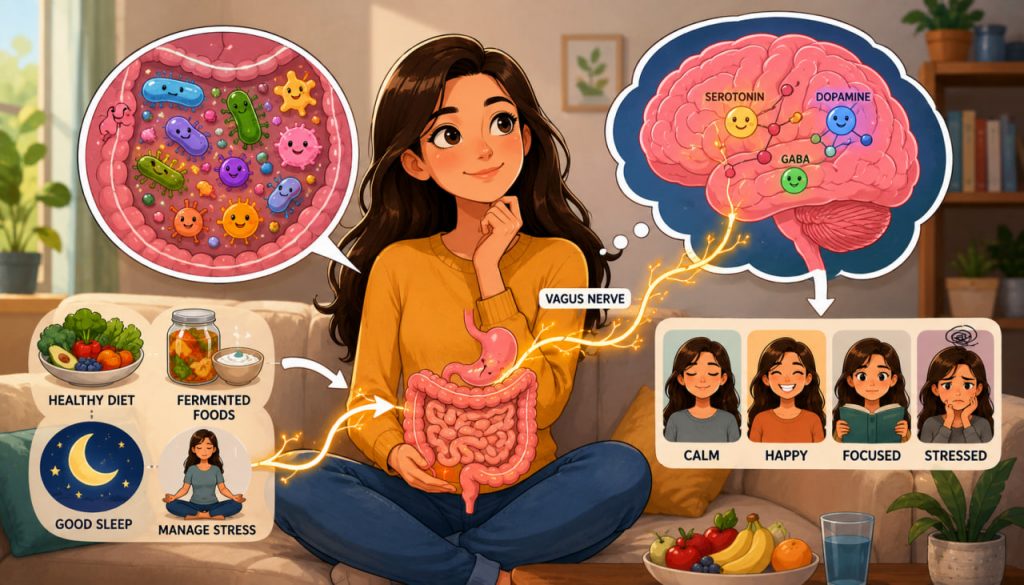
For many years, scientists believed that emotions and mental health were controlled almost entirely by the brain. However, modern research has revealed something surprising: the human gut may play a major role in shaping mood, stress levels, emotional stability, and even mental disorders.
Inside the digestive system lives a vast ecosystem of microorganisms known as the gut microbiome. This microscopic world contains trillions of bacteria, fungi, and other microbes that constantly interact with the body. Scientists now believe that communication between the gut and the brain forms a complex biological network often called the gut-brain axis.
This discovery has become one of the most fascinating areas of modern neuroscience and medicine.
What Is the Gut Microbiome?
The gut microbiome is the community of microorganisms living mainly inside the intestines.
These microbes help with:
- Digestion
- Vitamin production
- Immune system regulation
- Protection against harmful bacteria
Although invisible, the microbiome functions almost like an additional biological organ inside the body.
Each person’s microbiome is unique and influenced by:
- Diet
- Lifestyle
- Stress
- Sleep
- Antibiotic use
- Environment
A healthy microbiome usually contains a diverse balance of beneficial microorganisms.
The Gut-Brain Connection
Scientists discovered that the digestive system and the brain constantly communicate through multiple pathways.
This communication involves:
- Nerves
- Hormones
- Immune signals
- Chemical messengers produced by bacteria
One of the most important communication routes is the vagus nerve, a major nerve connecting the gut and brain.
Because of this connection, changes in gut health can influence emotional and cognitive functions.
Neuroscientist John Cryan, one of the leading experts in this field, explained:
“The microbiome is shaping how we think, feel, and behave.”
This idea has transformed how researchers understand mental health.
How Gut Bacteria Affect Mood
Gut microbes produce many biologically active substances.
Some bacteria help generate:
- Serotonin
- Dopamine
- Short-chain fatty acids
Serotonin is especially important because it helps regulate:
- Mood
- Sleep
- Appetite
- Emotional stability
Interestingly, a large portion of the body’s serotonin is produced in the digestive system rather than directly in the brain.
While gut serotonin does not simply travel into the brain, the microbiome still strongly influences the body’s overall neurochemical balance.
Stress and the Microbiome
Stress can significantly affect gut bacteria.
Chronic stress may:
- Reduce microbial diversity
- Increase inflammation
- Disrupt digestion
At the same time, an unhealthy microbiome may worsen stress responses and emotional instability.
This creates a two-way relationship:
- The brain affects the gut
- The gut affects the brain
Scientists increasingly view mental and digestive health as deeply interconnected.
The Microbiome and Mental Disorders
Researchers are studying possible links between gut bacteria and conditions such as:
- Anxiety
- Depression
- Autism spectrum disorders
- Chronic stress disorders
Some studies suggest that people with certain mental health conditions may have noticeably different microbiome compositions.
However, this field is still developing, and scientists remain cautious about oversimplified conclusions.
The microbiome alone does not determine mental health, but it may contribute significantly alongside genetics, environment, and psychology.
Diet and Emotional Well-Being
Diet strongly influences the gut microbiome.
Foods that support beneficial bacteria include:
- Fiber-rich vegetables
- Fruits
- Fermented foods
- Whole grains
Meanwhile, excessive consumption of:
- Highly processed foods
- Added sugars
- Artificial additives
may negatively affect microbial balance.
Researchers increasingly study whether nutritional changes could support mental well-being through microbiome improvement.
Antibiotics and Microbial Balance
Antibiotics can save lives by fighting dangerous infections, but they may also disrupt beneficial gut bacteria.
After antibiotic use, some people experience:
- Digestive problems
- Temporary mood changes
- Reduced microbial diversity
This is one reason why scientists are interested in restoring healthy microbiomes after medical treatment.
Probiotics and “Psychobiotics”
Certain beneficial bacteria are called probiotics.
Scientists are also exploring “psychobiotics” — microorganisms that may potentially support mental health.
Some experimental studies suggest that certain bacterial strains may influence:
- Anxiety levels
- Emotional resilience
- Stress responses
However, this area remains scientifically complex, and researchers caution against exaggerated commercial claims.
The Role of Inflammation
The microbiome also affects inflammation throughout the body.
Chronic inflammation has been linked to:
- Depression
- Fatigue
- Cognitive problems
Healthy gut bacteria may help regulate inflammatory responses and support overall neurological health.
This connection is one reason why gut health has become such an important topic in modern medicine.
Why the Gut Is Sometimes Called the “Second Brain”
The digestive system contains a vast network of neurons called the enteric nervous system.
This network can:
- Control digestion independently
- Communicate with the central nervous system
- Respond to emotional states
Because of its complexity, some scientists informally refer to the gut as the body’s “second brain.”
The Future of Microbiome Research
The study of the microbiome is still relatively new, but it is advancing rapidly.
Future research may lead to:
- Personalized nutrition plans
- Microbiome-based therapies
- Improved mental health treatments
- Better understanding of brain-body interactions
Scientists believe the microbiome could become one of the most important medical frontiers of the 21st century.
Interesting Facts
- The human gut contains trillions of microorganisms.
- Gut bacteria help produce important chemical messengers in the body.
- Stress can rapidly alter microbiome composition.
- The gut and brain communicate constantly through the vagus nerve.
- Every person has a unique microbiome profile.
Glossary
- Gut Microbiome — The community of microorganisms living inside the digestive system.
- Gut-Brain Axis — The communication network linking the gut and brain.
- Serotonin — A chemical involved in mood regulation and emotional balance.
- Probiotics — Beneficial microorganisms that may support health.
- Enteric Nervous System — A large network of neurons located in the digestive tract.