Almost everyone procrastinates sometimes. People delay important tasks, avoid difficult conversations, postpone studying, or endlessly scroll social media instead of working. Although procrastination is often associated with laziness or poor discipline, modern psychology and neuroscience suggest the reality is far more complex.
Researchers increasingly believe procrastination may be connected to how the human brain evolved to manage stress, uncertainty, and emotional discomfort. Some scientists even argue that procrastination is not simply a flaw, but partially a protective mechanism designed to conserve mental energy and avoid psychological overload.
So is procrastination an evolutionary mistake, or is the brain trying to protect itself?
What Is Procrastination?
Procrastination is the voluntary delay of an important task despite knowing that postponement may create negative consequences.
It often involves:
- Avoiding uncomfortable work
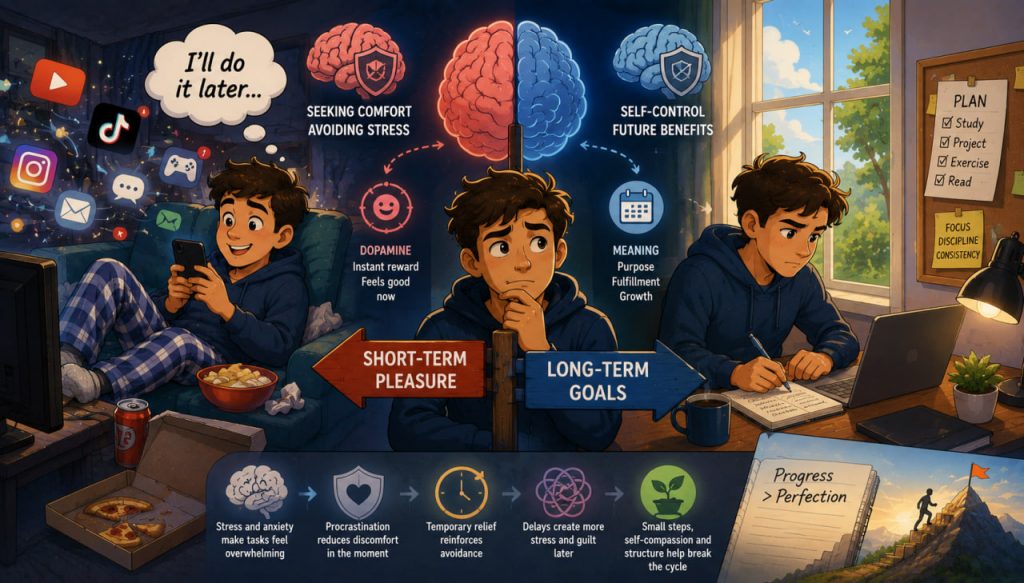
- Choosing short-term pleasure instead of long-term goals
- Delaying decision-making
- Escaping mentally demanding activities
Importantly, procrastination is not always about poor time management. In many cases, it is strongly connected to emotions.
Psychologist Tim Pychyl, one of the leading researchers on procrastination, explained:
“Procrastination is not a time-management problem. It’s an emotion-management problem.”
This idea changed how scientists understand the phenomenon.
Why the Brain Avoids Difficult Tasks
The human brain naturally seeks comfort and efficiency.
Tasks that trigger:
- Stress
- Anxiety
- Fear of failure
- Uncertainty
- Boredom
may activate avoidance behavior.
When facing emotionally unpleasant work, the brain often chooses activities that provide immediate psychological relief.
Examples include:
- Watching videos
- Checking messages
- Cleaning unnecessarily
- Browsing social media
These distractions temporarily reduce stress, even if they worsen problems later.
The Role of Dopamine and Instant Rewards
Modern neuroscience shows that procrastination is closely linked to the brain’s reward system.
The brain strongly prefers:
- Immediate rewards
- Instant gratification
- Short-term pleasure
Difficult long-term tasks often provide delayed rewards, making them less attractive neurologically.
Meanwhile:
- Notifications
- Entertainment
- Quick digital stimulation
can trigger fast dopamine responses associated with pleasure and motivation.
This creates constant competition for attention in the modern digital world.
Evolutionary Origins of Procrastination
Some scientists believe procrastination may partly originate from evolutionary survival strategies.
For early humans:
- Conserving energy was important
- Immediate dangers mattered more than distant future planning
- Short-term survival often had higher priority than abstract long-term goals
The human brain evolved in environments very different from modern office life.
Today, however, people must manage:
- Deadlines
- Long-term projects
- Abstract responsibilities
which ancient brains were not specifically designed to handle.
This mismatch may contribute to procrastination behavior.
Is Procrastination a Defense Mechanism?
Many psychologists view procrastination as a form of emotional self-protection.
People may delay tasks because they fear:
- Failure
- Criticism
- Perfectionism
- Feeling inadequate
In this sense, procrastination temporarily protects self-esteem by avoiding emotionally threatening situations.
For example:
- A student may avoid studying to escape anxiety about poor performance
- A writer may postpone work due to fear of criticism
- An employee may avoid difficult decisions because of uncertainty
The delay itself becomes a coping mechanism.
Perfectionism and Procrastination
Perfectionism is strongly connected to procrastination.
People who fear making mistakes often:
- Overanalyze tasks
- Delay starting
- Wait for “perfect conditions”
Ironically, high achievers sometimes procrastinate precisely because they care too much about outcomes.
The fear of imperfection can become paralyzing.
The Internet and Modern Distraction
Modern technology dramatically amplifies procrastination.
Digital platforms are specifically designed to capture attention using:
- Infinite scrolling
- Notifications
- Personalized content
- Instant entertainment
This creates an environment where distractions are constantly available.
Behavioral scientist Nir Eyal noted that modern digital systems compete aggressively for human attention and emotional engagement.
As a result, resisting distraction has become increasingly difficult.
Why Procrastination Feels Good Temporarily
When people avoid stressful tasks, they often experience temporary emotional relief.
This relief reinforces procrastination behavior psychologically.
The cycle works like this:
- A task creates stress
- The person avoids the task
- Stress temporarily decreases
- The brain learns avoidance reduces discomfort
Unfortunately, the problem usually returns later with even greater anxiety.
Chronic Procrastination and Mental Health
Occasional procrastination is normal, but chronic procrastination may affect:
- Productivity
- Relationships
- Sleep
- Self-esteem
- Mental health
Researchers also found connections between severe procrastination and:
- Anxiety disorders
- Depression
- Chronic stress
This is why psychologists increasingly treat procrastination as an emotional regulation issue rather than simple laziness.
Can Procrastination Be Reduced?
Experts recommend several strategies:
- Breaking tasks into smaller steps
- Reducing perfectionism
- Creating structured routines
- Limiting digital distractions
- Focusing on progress rather than perfection
Self-compassion may also help.
Research suggests people who harshly criticize themselves for procrastination often become trapped in stronger avoidance cycles.
Why Procrastination May Never Fully Disappear
The human brain naturally balances:
- Effort
- Reward
- Emotional discomfort
- Energy conservation
Because of this, procrastination may always remain part of human psychology to some degree.
However, understanding its emotional and neurological roots allows people to manage it more effectively.
Interesting Facts
- Procrastination research increased dramatically in the digital era.
- Perfectionists often procrastinate more than expected.
- Social media platforms are designed to maximize attention retention.
- The brain strongly prefers immediate rewards over delayed rewards.
- Chronic procrastination may increase stress and reduce well-being.
Glossary
- Procrastination — Delaying important tasks despite potential negative consequences.
- Dopamine — A neurotransmitter associated with reward and motivation.
- Perfectionism — Excessive concern with avoiding mistakes or achieving flawless results.
- Instant Gratification — Preference for immediate rewards over future benefits.
- Emotional Regulation — The ability to manage emotional responses effectively.