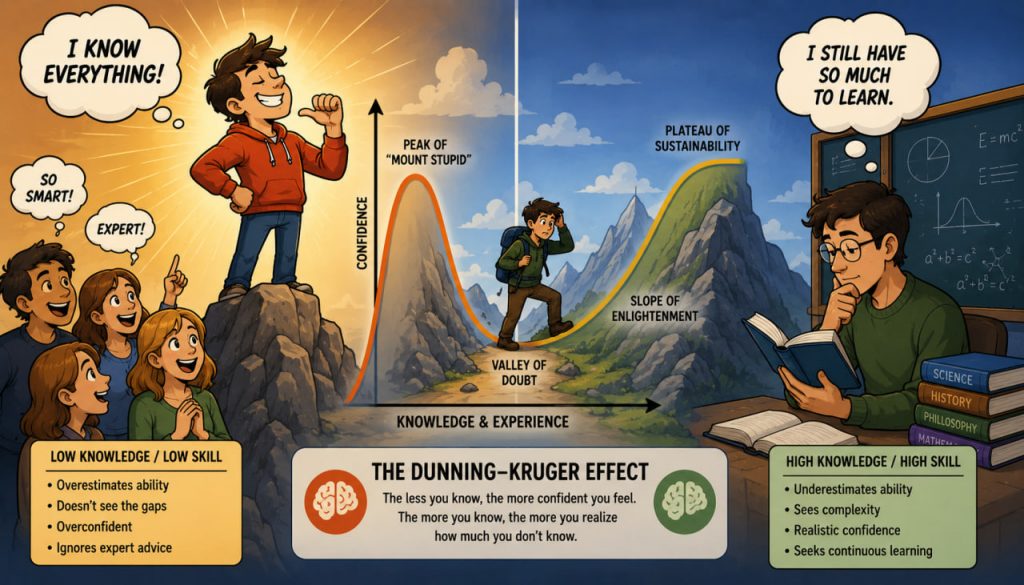
Human intelligence is not only about knowledge or skills — it is also about the ability to accurately evaluate one’s own abilities. Surprisingly, psychology research has shown that people who know the least about a subject are often the most confident in their understanding. This cognitive phenomenon became famous as the Dunning–Kruger effect.
The Dunning–Kruger effect helps explain many situations in modern life:
- Overconfident internet experts
- People spreading misinformation
- Poor decision-making in leadership
- Heated online arguments
- Individuals refusing expert advice
Although often discussed humorously, the effect reveals important truths about human psychology, self-awareness, and critical thinking.
What Is the Dunning–Kruger Effect?
The Dunning–Kruger effect is a cognitive bias in which people with low competence in a particular area tend to overestimate their own abilities.
At the same time:
- Highly skilled people may underestimate themselves
- Experts often recognize complexity and uncertainty more clearly
In simple terms:
- Beginners may feel extremely confident
- Experts often become more cautious and humble
This happens because the knowledge required to perform well is often the same knowledge required to recognize mistakes.
How the Theory Was Discovered
The concept was introduced in 1999 by psychologists David Dunning and Justin Kruger.
Their research studied how people evaluated their own performance in areas such as:
- Logic
- Grammar
- Humor
The results showed that participants with the weakest performance consistently rated themselves much higher than their actual ability justified.
Meanwhile, more competent participants often assumed tasks were easier for everyone else as well.
David Dunning later summarized the phenomenon famously:
“If you’re incompetent, you can’t know you’re incompetent.”
This statement became one of the most widely quoted ideas in modern psychology.
Why Incompetent People Overestimate Themselves
The Dunning–Kruger effect occurs partly because people lacking knowledge also lack the tools needed for accurate self-evaluation.
Without understanding:
- Complexity
- Nuance
- Technical details
a person may incorrectly assume the subject is simple.
This creates an illusion of mastery.
For example:
- A beginner may think investing is easy after a few successful trades
- Someone reading a few internet articles may feel more informed than medical experts
- A new driver may feel overly confident before encountering dangerous situations
True expertise often reveals how much there is still left to learn.
Why Experts Sometimes Doubt Themselves
Interestingly, the effect also works in the opposite direction.
Experts often:
- Recognize uncertainty
- Understand exceptions
- See hidden complexities
Because of this, knowledgeable people may become more cautious and self-critical.
This is sometimes connected to the idea that:
“The more you know, the more you realize how little you know.”
Real expertise often increases intellectual humility rather than arrogance.
The Dunning–Kruger Effect on the Internet
The internet dramatically amplified the visibility of the Dunning–Kruger effect.
Online platforms allow anyone to:
- Share opinions instantly
- Present themselves as experts
- Gain large audiences regardless of qualifications
Social media algorithms may even reward:
- Confidence
- Simplicity
- Emotional certainty
rather than accuracy or expertise.
As a result, overconfident misinformation can spread rapidly.
Politics, Leadership, and Overconfidence
The Dunning–Kruger effect is especially dangerous in leadership and decision-making.
Overconfident individuals may:
- Ignore expert advice
- Underestimate risks
- Make poor strategic decisions
In politics and business, excessive confidence sometimes appears persuasive even when unsupported by evidence.
Psychologists study how overconfidence can influence:
- Elections
- Corporate failures
- Public opinion
- Group decision-making
Education and Self-Awareness
One important lesson from the Dunning–Kruger effect is the importance of critical self-reflection.
Healthy learning requires:
- Openness to correction
- Intellectual humility
- Willingness to admit uncertainty
Good education teaches not only facts, but also awareness of personal limitations.
Experts emphasize that questioning one’s own assumptions is a key part of genuine intelligence.
Is Everyone Affected?
Yes — virtually everyone experiences the Dunning–Kruger effect in some area of life.
Humans naturally develop blind spots involving:
- Skills
- Knowledge
- Personal judgment
Even experts may overestimate themselves outside their own fields.
The effect is not a sign of stupidity alone, but a normal limitation of human cognition.
The Difference Between Confidence and Competence
Modern society often rewards confidence visibly.
However:
- Confidence does not guarantee expertise
- Strong opinions are not always informed opinions
In some cases, highly confident people may simply lack the knowledge necessary to recognize their own errors.
This distinction becomes increasingly important in the digital information age.
Can the Dunning–Kruger Effect Be Reduced?
Psychologists suggest several ways to improve self-awareness:
- Continuous learning
- Constructive feedback
- Exposure to expert criticism
- Intellectual curiosity
- Reflective thinking
Experience and education often help people develop more realistic self-evaluations over time.
The key is remaining open to the possibility of being wrong.
Why the Dunning–Kruger Effect Matters Today
The modern world contains enormous amounts of information, misinformation, and public opinion.
Understanding the Dunning–Kruger effect helps explain:
- Online misinformation
- Extreme overconfidence
- Anti-scientific attitudes
- Simplistic thinking about complex problems
It also reminds people that genuine expertise usually involves humility, caution, and constant learning.
P.S. In my opinion, pride is the scourge of our humanity. And the only cure for it is God’s Love…
Interesting Facts
- The Dunning–Kruger effect became one of the most famous concepts in modern psychology.
- The original research won widespread scientific attention after publication in 1999.
- Experts often underestimate how difficult subjects appear to beginners.
- Overconfidence can occur in nearly any field, including finance, medicine, and politics.
- Social media can amplify confident misinformation regardless of expertise.
Glossary
- Dunning–Kruger Effect — A cognitive bias where people with low ability overestimate their competence.
- Cognitive Bias — A systematic error in thinking or judgment.
- Intellectual Humility — Awareness of the limits of one’s own knowledge.
- Self-Awareness — The ability to recognize and evaluate one’s own thoughts and abilities accurately.
- Misinformation — False or inaccurate information spread intentionally or unintentionally.