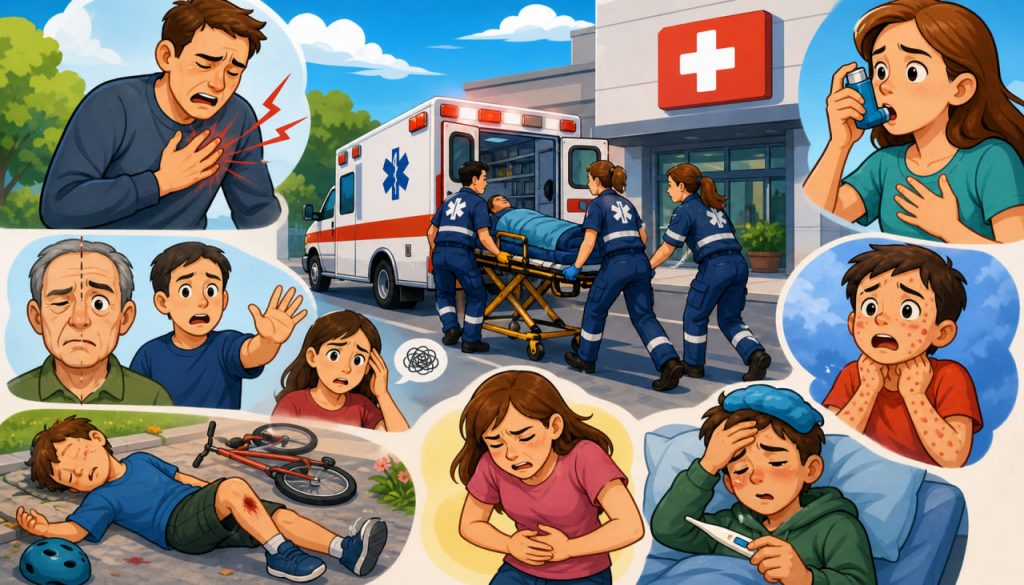
Some symptoms should never be ignored. They may signal a life-threatening condition that needs urgent medical care. In these situations, waiting “to see if it gets better” can be dangerous. The safest choice is to call emergency services or go to the nearest emergency department.
This article explains the most important warning signs, why they matter, and when immediate action is necessary.
Chest Pain or Pressure
Chest pain is one of the most serious symptoms. It may feel like pressure, squeezing, burning, heaviness, or pain in the center of the chest. Sometimes the discomfort spreads to the arm, back, neck, jaw, or stomach.
You should seek emergency help if chest pain lasts more than a few minutes, returns repeatedly, or appears with shortness of breath, cold sweat, nausea, or dizziness. These may be signs of a heart attack. The American Heart Association notes that heart attack symptoms often include chest discomfort, upper-body pain, shortness of breath, nausea, or lightheadedness.
Trouble Breathing
Sudden or severe difficulty breathing is always urgent. It can be caused by asthma attacks, allergic reactions, blood clots in the lungs, heart problems, severe infections, or airway obstruction.
Call emergency services if breathing becomes very difficult, lips or face turn bluish, speech becomes hard because of breathlessness, or breathing problems appear with chest pain or fainting.
Stroke Symptoms
A stroke happens when blood flow to part of the brain is blocked or when bleeding occurs in the brain. Fast treatment can reduce brain damage.
Seek immediate help if someone suddenly has face drooping, arm weakness, speech trouble, confusion, vision problems, loss of balance, dizziness, or a severe unexplained headache. The CDC advises calling emergency services right away for these symptoms.
Loss of Consciousness or Severe Confusion
Fainting can sometimes be harmless, but it can also signal heart rhythm problems, low blood sugar, internal bleeding, stroke, poisoning, or severe infection.
Immediate help is needed if a person loses consciousness, cannot be fully awakened, becomes suddenly confused, behaves strangely, has a seizure, or has confusion with high fever, stiff neck, or severe headache.
Severe Bleeding or Deep Injury
Heavy bleeding needs urgent care, especially if it does not stop after firm pressure. Deep wounds, major cuts, injuries from falls, animal bites, or wounds with possible broken bones should be checked quickly.
Emergency care is needed if blood is spurting, soaking through bandages, the person becomes pale or weak, or the injury involves the head, neck, chest, abdomen, or eye.
Severe Allergic Reaction
A severe allergic reaction can develop quickly and become life-threatening. Warning signs include swelling of the lips, tongue, throat, or face; wheezing; trouble breathing; widespread hives; dizziness; or collapse.
This condition is called anaphylaxis. It requires emergency treatment even if symptoms seem to improve.
Severe Abdominal Pain
Abdominal pain can come from many causes, but some are urgent. Seek immediate care if the pain is sudden, severe, worsening, or accompanied by vomiting blood, black stool, fainting, rigid abdomen, high fever, pregnancy, or chest pain.
Mayo Clinic recommends prompt medical attention when vomiting or nausea appears with warning signs such as chest pain, severe abdominal pain, confusion, high fever with stiff neck, or rectal bleeding.
Head Injury or Sudden Severe Headache
A head injury should be taken seriously if it causes vomiting, confusion, worsening headache, seizure, unequal pupils, weakness, difficulty speaking, or loss of consciousness.
A sudden “worst headache of life” can be a warning sign of bleeding in the brain and needs emergency evaluation.
High Fever with Dangerous Symptoms
Fever alone does not always mean an emergency, but fever with stiff neck, confusion, trouble breathing, rash that does not fade under pressure, severe dehydration, or extreme weakness can indicate serious infection.
Babies, older adults, pregnant people, and people with weak immune systems need extra caution.
Signs of Severe Dehydration
Dehydration can become dangerous when the body loses too much fluid. Warning signs include extreme thirst, very little urination, confusion, dizziness, dry mouth, rapid heartbeat, or inability to keep fluids down.
Young children and older adults can worsen faster than healthy adults.
When in Doubt, Get Help
A simple rule is useful: if a symptom feels sudden, severe, unusual, or life-threatening, treat it as urgent. Emergency departments are designed for conditions that may threaten life, limb, breathing, circulation, or brain function. Mayo Clinic describes emergency care as the right option for life- or limb-threatening conditions needing immediate attention.
Interesting Facts
- Many heart attacks begin slowly, with mild discomfort rather than dramatic pain.
- Stroke treatment is most effective when started quickly.
- Shortness of breath can be a heart symptom, not only a lung symptom.
- Removing delays is one of the most important factors in emergency survival.
- Severe allergic reactions can return after initial improvement.
Glossary
- Emergency Department — A hospital unit for serious or life-threatening conditions.
- Anaphylaxis — A severe allergic reaction that can affect breathing and blood pressure.
- Stroke — A sudden interruption of blood flow or bleeding in the brain.
- Heart Attack — Damage to heart muscle caused by blocked blood flow.
- Dehydration — A dangerous loss of body fluids.