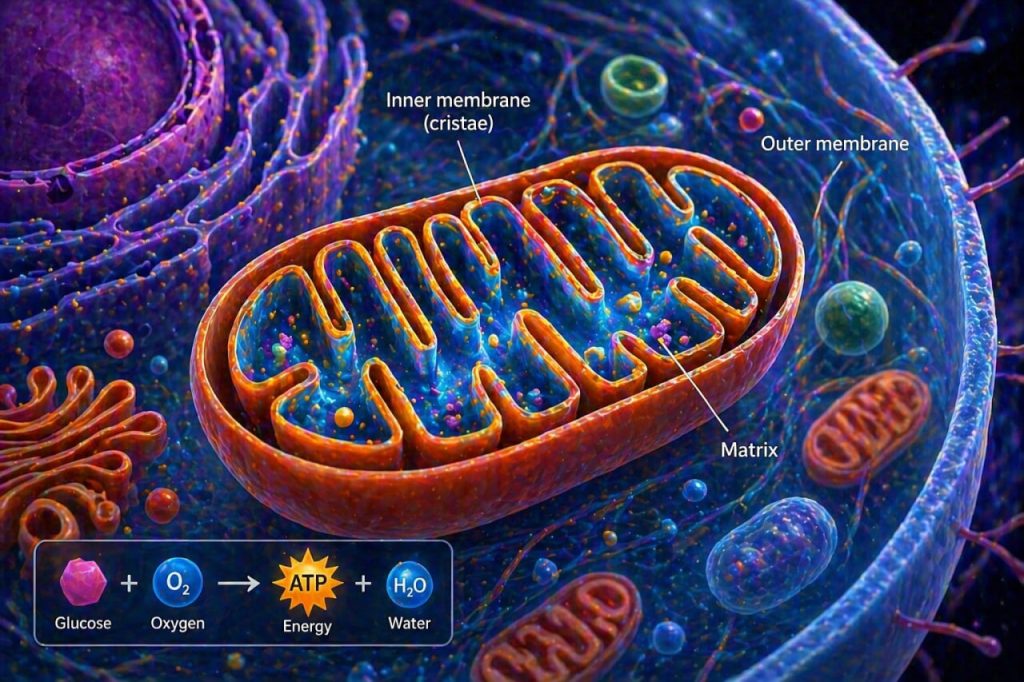
Mitochondria are essential structures found in most cells of the human body and other complex organisms. Often described as the “powerhouses of the cell,” they are responsible for producing the energy that cells need to function. Without mitochondria, life as we know it would not exist.
But mitochondria are more than just energy producers—they play key roles in metabolism, cell survival, and even aging.
What Are Mitochondria?
Mitochondria are small, membrane-bound organelles located inside cells. Each cell can contain hundreds or even thousands of mitochondria, depending on its energy needs.
They have a unique structure:
- An outer membrane that encloses the organelle
- An inner membrane folded into structures called cristae
- An internal space known as the matrix
These folds increase the surface area, allowing mitochondria to produce energy more efficiently.
How Mitochondria Produce Energy
The main function of mitochondria is to generate ATP (adenosine triphosphate), the molecule that stores and delivers energy in cells.
This process is called cellular respiration.
It occurs in several steps:
- Nutrients like glucose are broken down
- Electrons are transferred through a series of reactions
- Energy is used to produce ATP
Oxygen plays a crucial role, which is why this process is often called aerobic respiration.
Why ATP Is Important
ATP acts like a rechargeable battery for the cell. It powers:
- Muscle contraction
- Nerve signaling
- Chemical reactions
- Cell growth and repair
Without ATP, cells cannot perform their basic functions.
The Unique Features of Mitochondria
Mitochondria are unusual compared to other cell structures.
Their Own DNA
Mitochondria contain their own genetic material, separate from the DNA in the cell nucleus.
This suggests they may have originated from ancient bacteria that formed a symbiotic relationship with early cells.
Self-Replication
They can grow and divide independently within the cell.
Mitochondria and Health
Proper mitochondrial function is essential for overall health.
When mitochondria do not work correctly, it can lead to:
- Fatigue and low energy
- Muscle weakness
- Neurological problems
Some diseases are directly linked to mitochondrial dysfunction.
Mitochondria and Aging
Mitochondria are also connected to aging.
Over time:
- They accumulate damage
- Their efficiency decreases
- Cells produce less energy
This decline is thought to contribute to aging and age-related diseases.
Mitochondria in Different Types of Cells
Not all cells have the same number of mitochondria.
- Muscle cells have many, because they require a lot of energy
- Brain cells also have high energy demands
- Some simple cells have fewer mitochondria
The number depends on how much energy the cell needs.
Why Mitochondria Matter
Mitochondria are central to life at the cellular level. They convert food into usable energy and support essential biological processes.
Their importance extends beyond basic function—they are involved in:
- Cell signaling
- Regulation of cell death
- Adaptation to environmental changes
Understanding mitochondria helps scientists develop treatments for diseases and improve human health.
Interesting Facts
- Mitochondria are inherited mostly from the mother.
- A single cell can contain thousands of mitochondria.
- They produce most of the cell’s ATP.
- Their structure increases efficiency through folded membranes.
- They may have evolved from ancient bacteria billions of years ago.
Glossary
- Organelle — A specialized structure within a cell.
- ATP — The main energy-carrying molecule in cells.
- Cellular Respiration — The process of producing energy from nutrients.
- Cristae — Folds of the inner mitochondrial membrane.
- Matrix — The inner space of the mitochondrion.