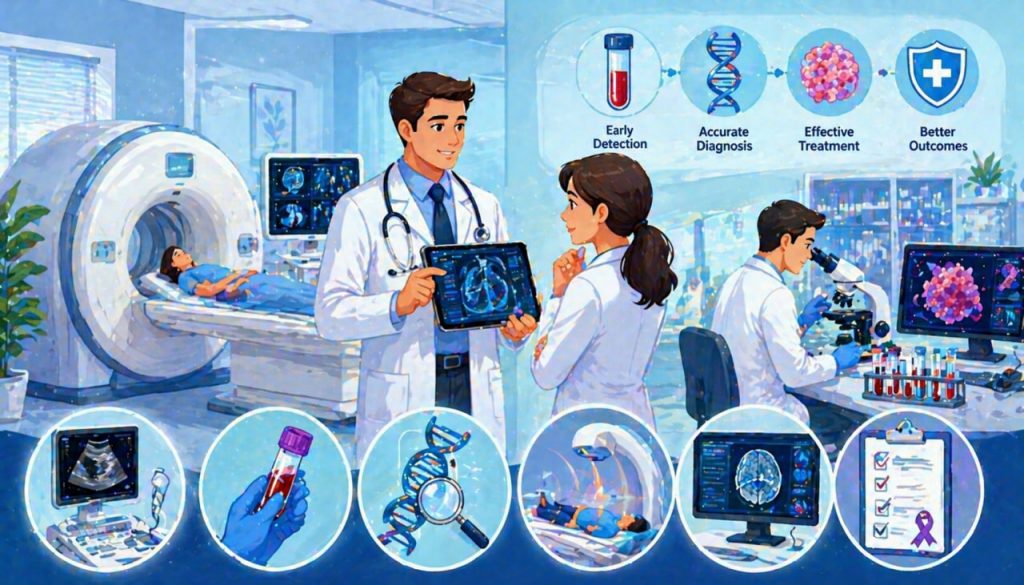
Early detection is one of the most important factors in successfully treating cancer. Advances in medical technology have made it possible to diagnose many types of cancer earlier, more accurately, and with minimal risk to patients. Today, safe cancer diagnostics focus on balancing effectiveness with reduced invasiveness, lower radiation exposure, and improved patient comfort.
Understanding how modern diagnostic tools work can help individuals make informed decisions about their health and screening options.
Why Early and Safe Diagnosis Matters
Cancer often develops silently in its early stages. Detecting it before symptoms appear significantly increases the chances of successful treatment.
Safe diagnostics are important because:
- They reduce unnecessary harm or side effects
- They allow for regular screening without excessive risk
- They improve patient compliance and comfort
According to Dr. Otis Brawley, former Chief Medical Officer of the American Cancer Society:
“Early detection, when combined with appropriate screening, is one of the most effective ways to reduce cancer mortality.”
Non-Invasive Screening Methods
Modern medicine increasingly relies on non-invasive techniques, meaning procedures that do not require surgery or penetration into the body.
Imaging Techniques
Medical imaging plays a key role in detecting tumors and abnormal tissues.
Common methods include:
- MRI (Magnetic Resonance Imaging), which uses magnetic fields instead of radiation
- Ultrasound, which uses sound waves and is considered very safe
- Low-dose CT scans, which reduce radiation exposure compared to traditional scans
These tools allow doctors to visualize internal structures without causing harm.
Blood Tests and Biomarkers
Blood-based diagnostics are becoming more advanced and widely used.
These tests look for:
- Biomarkers, substances that may indicate the presence of cancer
- Circulating tumor cells or DNA fragments
One of the most promising developments is the liquid biopsy, a test that detects cancer-related genetic material in the bloodstream. It is less invasive than traditional tissue biopsies and can be repeated safely over time.
Minimally Invasive Procedures
When more detailed analysis is needed, doctors may use minimally invasive techniques.
Biopsy Techniques
A biopsy involves taking a small sample of tissue for examination. Modern approaches aim to reduce discomfort and risk.
Examples include:
- Needle biopsies guided by imaging
- Endoscopic procedures using small flexible instruments
These methods provide accurate results while minimizing recovery time and complications.
Reducing Radiation Exposure
Some diagnostic tools, such as X-rays and CT scans, involve radiation. While generally safe in controlled amounts, minimizing exposure is a key goal in modern medicine.
Strategies include:
- Using low-dose imaging protocols
- Limiting unnecessary scans
- Choosing alternative methods like MRI or ultrasound when possible
Healthcare providers carefully balance diagnostic benefits with potential risks.
The Role of Artificial Intelligence
Artificial intelligence is transforming cancer diagnostics by improving accuracy and efficiency.
AI systems can:
- Analyze medical images for early signs of cancer
- Detect patterns that may be missed by the human eye
- Assist doctors in making faster and more precise diagnoses
This technology helps reduce errors and supports safer, more reliable screening processes.
Personalized Screening Approaches
Not everyone has the same risk of developing cancer. Personalized diagnostics take into account factors such as:
- Age
- Family history
- Lifestyle
- Genetic predisposition
This approach ensures that screening is targeted and appropriate, avoiding unnecessary procedures while focusing on those who need them most.
Challenges in Safe Cancer Diagnostics
Despite progress, there are still challenges to overcome.
These include:
- False positives, which may lead to unnecessary anxiety or procedures
- False negatives, where cancer is missed
- Limited access to advanced diagnostic tools in some regions
Ongoing research aims to improve accuracy and accessibility worldwide.
Future Directions in Cancer Detection
The future of cancer diagnostics is focused on making detection even safer and earlier.
Emerging trends include:
- Multi-cancer early detection blood tests
- Advanced imaging technologies with higher precision
- Integration of genetic data into routine screening
These innovations aim to detect cancer before it becomes life-threatening, while minimizing risk to patients.
Why Safe Diagnostics Are the Future
Safe cancer diagnostics represent a shift toward preventive and patient-centered healthcare. By reducing invasiveness and improving accuracy, these methods encourage more people to participate in regular screenings.
Early detection saves lives, and safer diagnostic tools make it easier to achieve.
Interesting Facts
- Early-stage cancer detection can increase survival rates dramatically for many cancer types.
- MRI scans do not use ionizing radiation, making them safer for repeated use.
- Liquid biopsies can sometimes detect cancer before symptoms appear.
- AI can match or exceed human accuracy in some diagnostic imaging tasks.
- Screening programs have reduced mortality rates for cancers such as breast and colorectal cancer.
Glossary
- Biomarker — A biological substance that indicates a medical condition.
- Biopsy — A procedure to remove and examine tissue from the body.
- Liquid Biopsy — A blood test that detects cancer-related material.
- MRI — Imaging technique using magnetic fields to create detailed images.
- False Positive — A test result that incorrectly indicates disease.