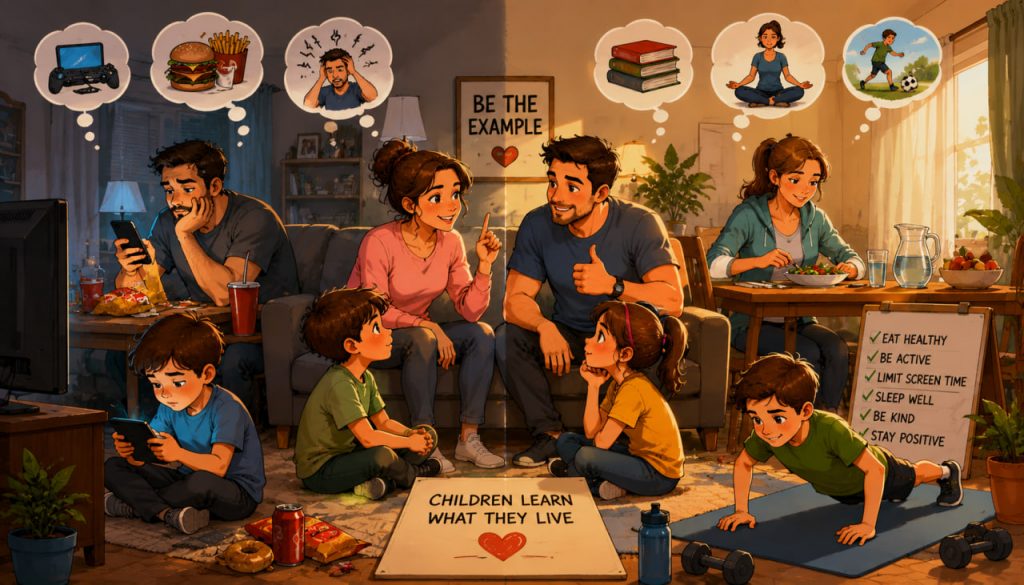
Children are often described as great listeners, but in reality, they are even better observers. Long before they fully understand words, they begin copying the behavior of the adults around them. Parents naturally want the best for their children, yet many everyday habits—some seemingly harmless—are unintentionally passed from one generation to the next.
Research in developmental psychology consistently shows that children learn more from what adults do than from what adults say. This process, known as observational learning, influences everything from eating habits and emotional regulation to screen time, physical activity, and attitudes toward health.
The encouraging news is that changing our own behavior often becomes the most powerful lesson we can teach.
Children Learn by Watching, Not Just Listening
Parents frequently remind children to:
- Eat healthy foods
- Be polite
- Exercise regularly
- Read books
- Limit screen time
- Stay calm during conflicts
However, children naturally compare these messages with what they observe every day.
If a parent says one thing but consistently does another, children are more likely to imitate the behavior rather than the instruction.
Consistency between words and actions builds trust and creates lasting habits.
Unhealthy Eating Habits Begin at Home
Food preferences start developing early in life.
Children often adopt eating patterns they observe within the family.
Common habits that may unintentionally be passed on include:
- Frequent consumption of highly processed foods
- Eating while watching television
- Skipping breakfast
- Emotional eating
- Constant snacking
- Drinking sugary beverages instead of water
Family meals, on the other hand, are associated in many studies with healthier diets and better social development.
Parents do not need perfect nutrition.
Instead, regularly modeling balanced eating helps children develop healthier lifelong relationships with food.
Too Much Screen Time
Technology is part of modern life, but children carefully observe how adults use it.
If parents constantly check phones during meals, conversations, or family activities, children often learn that screens deserve constant attention.
Potential consequences include:
- Reduced face-to-face communication
- Poor sleep habits
- Less physical activity
- Difficulty concentrating
- Increased dependence on digital entertainment
Healthy digital habits begin with adults demonstrating that technology is a useful tool—not something that controls daily life.
Children Learn How to Handle Stress from Adults
Every family experiences stress.
What matters is how adults respond to it.
Children closely observe whether parents:
- Solve problems calmly
- Yell frequently
- Blame others
- Stay respectful during disagreements
- Practice patience
- Ask for help when needed
Psychologists have found that emotional regulation develops largely through repeated observation and supportive relationships.
Calm behavior teaches calm behavior.
Physical Activity Is Contagious
Parents often encourage children to play outside while remaining inactive themselves.
Research consistently shows that children with physically active parents are generally more likely to become active as well.
Simple family activities include:
- Walking together
- Riding bicycles
- Hiking
- Playing ball games
- Swimming
- Gardening
Children rarely think of exercise as a “health obligation.”
Instead, they see it as normal family behavior.
Sleep Habits Are Learned Too
Healthy sleep routines often begin with consistent family schedules.
Children notice whether adults:
- Stay up very late
- Use phones before bedtime
- Maintain regular sleep schedules
- Prioritize rest
- Balance work and recovery
Poor sleep affects mood, concentration, learning, and overall health in both adults and children.
Creating a calm bedtime routine benefits the entire household.
Negative Self-Talk Can Become a Family Habit
Children listen carefully to how adults speak about themselves.
Statements such as:
- “I’m terrible at everything.”
- “I’m too old to learn.”
- “I hate how I look.”
- “I’ll never succeed.”
may unintentionally teach children to criticize themselves in similar ways.
Instead, parents can model healthier attitudes by acknowledging mistakes while maintaining self-respect.
For example:
- “I made a mistake, but I can learn from it.”
- “This is difficult, but I’ll keep practicing.”
Children often develop their inner voice by listening to the voices around them.
Respect and Kindness Begin at Home
Children learn social behavior long before entering school.
They observe how adults treat:
- Family members
- Friends
- Neighbors
- Restaurant staff
- Cashiers
- Teachers
- Elderly people
- Animals
Acts of kindness, gratitude, honesty, and empathy become powerful daily lessons when consistently demonstrated.
Small interactions often leave lasting impressions.
The Importance of Admitting Mistakes
Many parents worry about appearing imperfect.
In reality, acknowledging mistakes can strengthen children’s development.
When adults say:
- “I was wrong.”
- “I’m sorry.”
- “Thank you.”
- “Let’s solve this together.”
children learn accountability and emotional maturity.
Perfection is not the goal.
Healthy parenting is built on authenticity, responsibility, and continuous learning.
Expert Perspective
Psychologist Albert Bandura, whose Social Learning Theory transformed developmental psychology, demonstrated that children acquire many behaviors by observing and imitating others rather than through direct instruction alone. His famous Bobo doll experiments showed that children readily model behaviors they see adults perform, especially when those adults are viewed as trusted role models.
Bandura emphasized that parents teach constantly—even when they are not intentionally teaching. Modern developmental research continues to support this principle: everyday behavior inside the home plays a central role in shaping children’s habits, emotional skills, and attitudes throughout life.
Small Changes Create Lifelong Habits
Improving family habits does not require dramatic lifestyle changes.
Simple daily actions often have the greatest impact:
- Eat meals together regularly.
- Put phones away during conversations.
- Stay physically active as a family.
- Speak respectfully during disagreements.
- Prioritize sleep.
- Read together.
- Show gratitude.
- Admit mistakes.
- Celebrate effort instead of perfection.
Children are remarkably adaptable.
When parents gradually improve their own habits, children often follow naturally.
The most effective parenting advice is surprisingly simple: become the example you hope your child will imitate.
P.S. All we can give our children is love and our own example…
Interesting Facts
- Children begin learning through observation during infancy, long before they can speak.
- Family meals have been associated in many studies with healthier eating patterns and improved communication.
- Parents’ physical activity levels often predict children’s activity levels more strongly than verbal encouragement alone.
- Consistent bedtime routines can improve both children’s sleep quality and emotional well-being.
- Young children often imitate facial expressions, tone of voice, and problem-solving strategies without realizing it.
- Positive habits are contagious within families—small behavioral changes by one family member can influence the entire household over time.
Glossary
- Observational Learning – Learning by watching and imitating the behavior of others.
- Social Learning Theory – A psychological theory developed by Albert Bandura explaining how people learn through observation, imitation, and experience.
- Emotional Regulation – The ability to understand, manage, and respond appropriately to emotions.
- Role Model – A person whose behavior serves as an example for others to follow.
- Self-Talk – The internal dialogue or thoughts people have about themselves and their experiences.
- Empathy – The ability to understand and share another person’s feelings and perspectives.
- Healthy Habit – A repeated behavior that supports long-term physical, mental, or emotional well-being.
- Positive Reinforcement – Encouraging desired behavior by providing praise, recognition, or other rewarding responses.