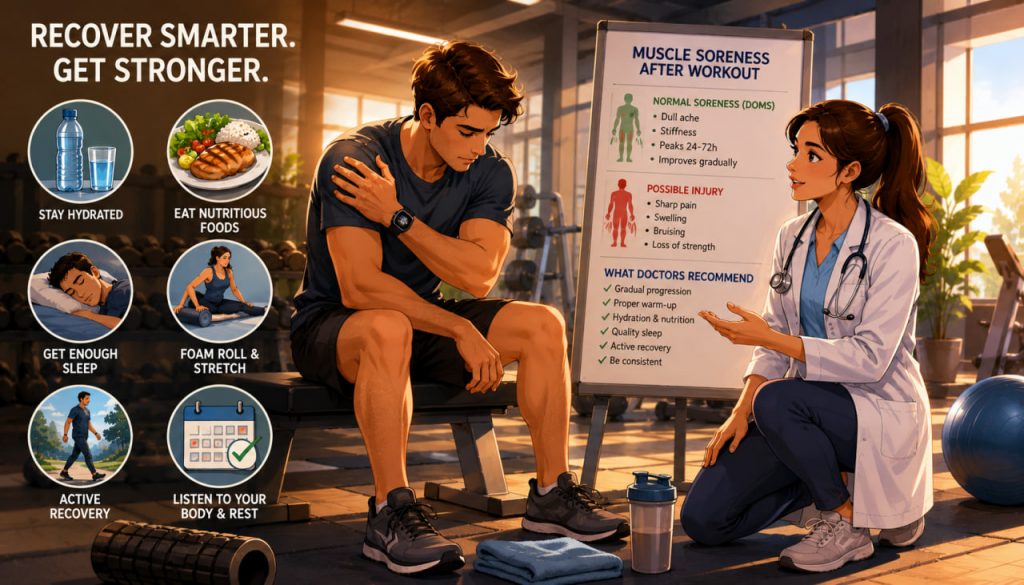
Muscle soreness after exercise is something nearly everyone experiences, from beginners starting their fitness journey to elite athletes pushing their physical limits. While post-workout discomfort can be frustrating, it is often a normal response to challenging your muscles and does not necessarily indicate injury.
The most common type of soreness is known as Delayed Onset Muscle Soreness (DOMS). It typically develops several hours after exercise, peaks within one to three days, and gradually disappears as the muscles recover.
Understanding why muscle soreness occurs—and how doctors recommend managing it—can help you recover faster, reduce discomfort, and continue exercising safely.
What Causes Muscle Soreness?
For many years, people believed that muscle soreness was caused by lactic acid buildup.
Modern research has shown that this is not true.
Lactic acid is cleared from muscles relatively quickly after exercise and is not responsible for DOMS.
Instead, muscle soreness mainly results from:
- Microscopic muscle fiber damage
- Inflammation during tissue repair
- Adaptation to unfamiliar exercise
- Eccentric muscle contractions (when muscles lengthen while under tension)
Examples include:
- Running downhill
- Lowering weights slowly
- Squats
- Lunges
- Plyometric exercises
DOMS is part of the body’s natural adaptation process that helps muscles become stronger over time.
When Is Muscle Soreness Normal?
Typical DOMS usually appears:
- 6–12 hours after exercise
- Peaks after 24–72 hours
- Gradually improves over several days
Normal soreness often feels like:
- Muscle tenderness
- Stiffness
- Mild swelling
- Reduced flexibility
- Temporary weakness
The discomfort usually affects both sides of the body if both muscle groups were exercised equally.
Importantly, normal soreness should gradually improve each day.
When Pain May Signal an Injury
Not all post-workout pain is harmless.
You should seek medical evaluation if you experience:
- Sharp or stabbing pain
- Severe swelling
- Joint instability
- Inability to bear weight
- Significant bruising
- Loss of muscle function
- Persistent pain lasting more than one week
- Fever or dark-colored urine after extreme exercise
These symptoms may indicate muscle strains, tendon injuries, ligament damage, or in rare cases exertional rhabdomyolysis, a serious condition requiring immediate medical attention.
Pain that worsens rather than improves should never be ignored.
Active Recovery Is Often Better Than Complete Rest
One of the biggest misconceptions is that sore muscles require complete inactivity.
In most cases, doctors recommend active recovery.
Light movement helps increase blood flow without placing excessive stress on healing muscles.
Examples include:
- Walking
- Easy cycling
- Gentle swimming
- Yoga
- Light stretching
- Mobility exercises
Complete bed rest is usually unnecessary unless an actual injury has occurred.
Gentle movement often reduces stiffness more effectively than remaining inactive.
Hydration and Nutrition Support Recovery
Recovery begins long before soreness appears.
Proper nutrition provides muscles with the building blocks needed for repair.
Important recovery nutrients include:
- Healthy protein
- Complex carbohydrates
- Healthy fats
- Vitamins
- Minerals
Protein is particularly important because it supplies amino acids required for rebuilding muscle tissue.
Hydration also plays a major role.
Exercise increases fluid loss through sweat, and dehydration may worsen fatigue and delay recovery.
Eating balanced meals and drinking enough water support the body’s natural healing process.
Sleep Is One of the Best Recovery Tools
Many athletes focus heavily on training but underestimate sleep.
During sleep, the body performs many important recovery processes.
These include:
- Muscle protein synthesis
- Hormone regulation
- Tissue repair
- Immune function
- Nervous system recovery
Adults generally benefit from 7–9 hours of quality sleep per night, although athletes undergoing intense training may require even more.
Poor sleep has been associated with slower recovery, reduced athletic performance, and increased injury risk.
Do Massage, Foam Rolling, and Stretching Help?
Several recovery methods may provide temporary relief.
Research suggests potential benefits from:
- Massage therapy
- Foam rolling
- Light stretching
- Compression garments
- Warm baths
Foam rolling may reduce perceived soreness and temporarily improve flexibility.
Massage can improve comfort and relaxation, although its effects on actual muscle healing appear modest.
Stretching after exercise improves flexibility but has not consistently been shown to prevent DOMS.
These techniques should be viewed as supportive tools rather than miracle cures.
Should You Exercise Through Muscle Soreness?
The answer depends on the severity of the soreness.
Mild soreness often allows continued training using:
- Lower intensity
- Different muscle groups
- Reduced training volume
However, exercising intensely on severely sore muscles may:
- Increase injury risk
- Reduce performance
- Delay recovery
Listening to your body remains one of the most important aspects of safe training.
Expert Perspective
Professor Stuart M. Phillips, Professor of Kinesiology at McMaster University and one of the world’s leading researchers in exercise physiology and muscle protein metabolism, has emphasized that muscle adaptation depends on an appropriate balance between training, nutrition, and recovery—not simply training harder.
His work reinforces an important message: recovery is an essential part of improving fitness, not a break from it.
How to Reduce Future Muscle Soreness
Although soreness cannot always be avoided, several strategies may reduce its severity.
Doctors commonly recommend:
- Increasing training gradually.
- Warming up before exercise.
- Using proper technique.
- Staying hydrated.
- Eating enough healthy protein.
- Sleeping well.
- Allowing adequate recovery between hard workouts.
- Avoiding sudden dramatic increases in exercise intensity.
As your body adapts, the same workout usually produces less soreness—a phenomenon known as the repeated bout effect.
Progressive training is far more effective than trying to do too much too soon.
Interesting Facts
- DOMS usually peaks 24–72 hours after unfamiliar or intense exercise.
- Eccentric exercises, such as slowly lowering weights or running downhill, often produce more soreness than concentric movements.
- The old belief that lactic acid causes next-day muscle soreness has been disproven by modern research.
- Foam rolling may temporarily reduce muscle soreness and improve range of motion.
- Well-trained athletes often experience less soreness because their muscles have adapted to regular exercise.
- Recovery is influenced by multiple factors, including sleep, nutrition, hydration, age, training history, and overall health.
Glossary
- Delayed Onset Muscle Soreness (DOMS) – Temporary muscle soreness that develops several hours after unfamiliar or intense exercise.
- Eccentric Contraction – A muscle contraction in which the muscle lengthens while producing force, such as lowering a weight.
- Muscle Protein Synthesis – The biological process through which the body repairs and builds muscle proteins after exercise.
- Active Recovery – Low-intensity physical activity performed to promote circulation and aid recovery after exercise.
- Foam Rolling – A self-massage technique using a cylindrical foam roller to reduce muscle stiffness and improve mobility.
- Progressive Overload – The gradual increase of training intensity, volume, or resistance to stimulate continued physical adaptation.
- Repeated Bout Effect – The phenomenon in which muscles become more resistant to soreness after repeated exposure to the same type of exercise.
- Rhabdomyolysis – A rare but serious medical condition involving severe muscle breakdown that can damage the kidneys and requires immediate medical attention.