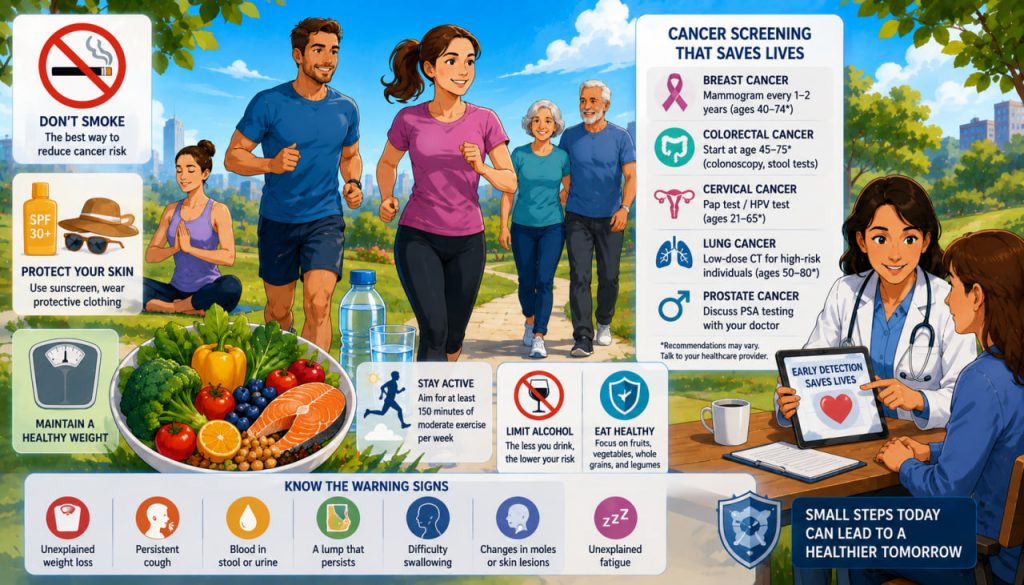
Cancer remains one of the leading causes of death worldwide, affecting millions of people each year. While not every cancer can be prevented, modern medical research shows that many cases can either be avoided or detected at an early stage, when treatment is often far more effective. Advances in screening programs, vaccinations, healthy lifestyle choices, and public awareness have significantly improved survival rates for several common cancers.
Understanding which preventive measures are supported by strong scientific evidence—and which popular claims are not—can help people make informed decisions about their health. Cancer prevention is not about eliminating all risk but about reducing it as much as possible through evidence-based strategies.
What Is Cancer Prevention?
Cancer prevention includes actions that reduce the likelihood of developing cancer or increase the chances of detecting it early.
Prevention generally falls into two categories:
- Primary prevention, which aims to reduce cancer risk before it develops.
- Secondary prevention, which focuses on detecting cancer early through screening.
Both approaches play important roles in improving long-term health outcomes.
Early detection often allows treatment before cancer spreads, greatly improving survival for many types of cancer.
Lifestyle Choices That Reduce Cancer Risk
Scientific evidence consistently shows that lifestyle has a major influence on cancer risk.
According to organizations such as the World Health Organization (WHO) and the American Cancer Society (ACS), important preventive habits include:
- Avoiding tobacco products
- Excluding alcohol consumption
- Maintaining a healthy body weight
- Exercising regularly
- Eating a balanced diet rich in fruits, vegetables, whole grains, and legumes
- Limiting processed and red meats
- Protecting skin from excessive ultraviolet (UV) radiation
No single food or supplement can prevent cancer, but an overall healthy lifestyle contributes to lowering risk.
The Importance of Not Smoking
Tobacco remains the single largest preventable cause of cancer worldwide.
Smoking increases the risk of numerous cancers, including:
- Lung cancer
- Mouth cancer
- Throat cancer
- Bladder cancer
- Pancreatic cancer
- Kidney cancer
- Esophageal cancer
Secondhand smoke also increases health risks for non-smokers.
The good news is that quitting smoking benefits people of all ages. Although risk does not disappear immediately, it gradually declines after smoking cessation.
Vaccines That Help Prevent Cancer
Some cancers are linked to viral infections.
Fortunately, vaccines can reduce this risk.
The two most important examples are:
Human Papillomavirus (HPV) Vaccine
HPV vaccination helps prevent infections associated with several cancers, including:
- Cervical cancer
- Anal cancer
- Oropharyngeal cancer
- Penile cancer
- Vulvar cancer
- Vaginal cancer
Hepatitis B Vaccine
Chronic hepatitis B infection significantly increases the risk of liver cancer.
Vaccination provides long-term protection against this virus.
These vaccines represent one of the most effective forms of cancer prevention available today.
Which Cancer Screening Tests Are Recommended?
Screening recommendations vary depending on age, sex, personal risk factors, and family history.
Common evidence-based screening programs include:
Breast Cancer
Mammography is recommended for many women beginning in middle age, with the exact starting age and screening interval depending on national guidelines and individual risk.
Colorectal Cancer
Screening may include:
- Stool-based tests
- Colonoscopy
- Flexible sigmoidoscopy
- CT colonography in selected cases
Removing precancerous polyps during colonoscopy can prevent colorectal cancer from developing.
Cervical Cancer
Screening with Pap tests and/or HPV testing can detect precancerous changes long before cancer develops.
Lung Cancer
Low-dose CT scanning may benefit certain adults with a substantial history of smoking after discussing risks and benefits with their healthcare provider.
Prostate Cancer
PSA testing is not recommended universally for all men. Instead, many medical organizations recommend individualized decision-making based on age, risk factors, and discussion with a healthcare professional.
Family History Matters
Some cancers have inherited genetic components.
Individuals with strong family histories of cancers such as:
- Breast cancer
- Ovarian cancer
- Colorectal cancer
- Prostate cancer
may benefit from earlier or more frequent screening.
Genetic counseling and testing can help identify people with inherited mutations, such as BRCA1 or BRCA2, when appropriate.
However, most cancers occur in people without known inherited genetic syndromes.
Know the Warning Signs
Screening does not replace paying attention to new or persistent symptoms.
Seek medical evaluation if you notice symptoms such as:
- Unexplained weight loss
- Persistent cough
- Blood in the stool or urine
- Unusual bleeding
- A lump that persists or grows
- Changes in moles or skin lesions
- Persistent difficulty swallowing
- Unexplained fatigue lasting several weeks
These symptoms do not necessarily indicate cancer, but they should not be ignored.
Myths About Cancer Prevention
Many misconceptions circulate online.
Some common myths include:
Myth: Superfoods can prevent cancer.
Reality: No single food eliminates cancer risk. Overall dietary patterns matter far more.
Myth: Vitamin supplements prevent most cancers.
Reality: Most supplements have not been shown to reduce cancer risk in healthy individuals, and some high-dose supplements may even be harmful.
Myth: If you feel healthy, screening is unnecessary.
Reality: Many early cancers produce no symptoms, making recommended screening especially valuable.
Evidence-based prevention is far more effective than relying on unsupported health claims.
Expert Perspective
According to the World Health Organization (WHO), between 30% and 50% of cancer cases could potentially be prevented by reducing exposure to known risk factors and implementing proven prevention strategies such as tobacco control, vaccination, healthy diets, physical activity, and early detection.
Similarly, the American Cancer Society (ACS) emphasizes that routine screening for appropriate individuals has significantly reduced deaths from several major cancers, particularly breast, colorectal, and cervical cancer. Experts stress that screening decisions should be individualized based on age, personal medical history, family history, and current clinical guidelines.
Taking Control of Your Health
Although cancer cannot always be prevented, every person can take meaningful steps to reduce their risk.
Healthy habits, recommended vaccinations, regular medical care, and evidence-based screening together provide the strongest foundation for long-term cancer prevention.
Rather than searching for miracle cures or unproven supplements, modern medicine encourages a balanced approach based on decades of scientific research.
The most effective strategy is simple but powerful: avoid known risk factors whenever possible, stay informed, participate in appropriate screening programs, and consult healthcare professionals when concerns arise.
Early action remains one of the most valuable tools in the fight against cancer.
Interesting Facts
- Tobacco use is responsible for millions of cancer-related deaths worldwide every year.
- Colonoscopy can both detect cancer early and remove precancerous polyps before they become cancerous.
- HPV vaccination has dramatically reduced infections with high-risk HPV types in vaccinated populations.
- Skin cancer is one of the most preventable cancers through proper sun protection.
- Regular physical activity is associated with a lower risk of several cancers, including colorectal and breast cancer.
- Most cancers develop through the gradual accumulation of genetic changes over many years.
- Improvements in screening and treatment have significantly increased survival rates for many common cancers over recent decades.
Glossary
- Cancer Screening — Testing people without symptoms to detect cancer or precancerous changes at an early stage.
- Mammography — A specialized X-ray examination used to detect breast cancer.
- Colonoscopy — A procedure that examines the large intestine using a flexible camera and can remove precancerous polyps.
- Pap Test (Pap Smear) — A screening test that detects abnormal cervical cells that may develop into cancer.
- HPV (Human Papillomavirus) — A common virus that can cause several types of cancer if persistent infection occurs.
- BRCA1/BRCA2 — Genes in which certain inherited mutations increase the risk of breast, ovarian, and some other cancers.
- Low-Dose CT (LDCT) — A specialized computed tomography scan used for lung cancer screening in selected high-risk individuals.
- Precancerous Lesion — An abnormal area of tissue that has the potential to develop into cancer if left untreated.